
In this week’s digest from the Hungarian election campaign trail: Ukraine oil rows, Viktor Orban vows to finish off the job against civil society and independent media after April election and accuses the Shell oil company of being behind the opposition.
 Zoltan Szalay



Our weekly Thursday digest offers a comprehensive guide to the most significant political developments of the week in Hungary. We accompany our readers along the historic road to the April 2026 election – a journey unlike anything seen in the region over the past decade-and-a-half.
This week we examine:
The Hungarian–Ukrainian dispute enters a new phase. The sex-video blackmail saga continues. Orbán sees an Erste and Shell conspiracy behind Tisza. Barely a quarter of Hungarians believe the war-scare narrative. Poll of the week: smaller parties could shape the outcome.
Follow Hungary’s road to the 2026 election — subscribe to Days Until the Hungarian Elections on Substack and get every edition straight to your inbox.
The Hungary–Ukraine dispute enters a new phase
Ukraine has interfered in Hungary’s election. The opposition Tisza party is colluding with Kyiv to sever Hungary from Russian crude. These have become the central campaign messages of the ruling Fidesz party in recent days, after Russian oil deliveries to Hungary and Slovakia via the Druzhba pipeline were halted.
This is not an entirely new turn.
Anti-Ukrainian rhetoric has long been a mainstay of Fidesz campaigning. In recent weeks, billboards across Hungary have claimed that Tisza leader Péter Magyar is throwing Hungarians’ money into a “golden toilet” alongside EU Commission president Ursula von der Leyen and Ukrainian president Volodymyr Zelensky.
Now Orbán’s camp has raised the stakes, arguing that a forced break from Russian oil will bring price rises and render the government’s flagship utility price-caps unsustainable.
Viktor Orbán went furthest on the issue at a campaign rally in the city of Szombathely on 7 February, where he described Ukraine as a “hostile country” for demanding that Hungary detach itself from Russian energy.
The Hungarian government had already waged intense anti-Ukraine PR campaigns in 2025, primarily targeting Ukraine’s EU accession.
On Thursday (19 February), pro-government media outlets carried reports suggesting that Ukraine had deliberately prepared for the shutdown of the Druzhba pipeline. Although deliveries were disrupted at the end of January due to a Russian attack, Fidesz-aligned portals — echoing government insinuations — claim Kyiv has no intention of repairing the pipeline. The pro-government news site Index reported that Tisza’s leadership had been informed, via German intermediaries at last weekend’s Munich Security Conference, that Druzhba would not be restarted.
The current condition of the Druzhba pipeline cannot be independently verified. Gergely Gulyás, the minister heading the prime minister’s office, said at the government press conference that Hungary’s MOL refinery group possesses firm information indicating the pipeline could be restarted at any time. Ukrainian officials have not confirmed this publicly, stating instead that a pump station lacks electricity due to Russian strikes.
A trap for Fidesz
The situation is potentially awkward for Fidesz. If Russian oil deliveries do not resume — and if Hungary begins receiving crude from alternative sources alongside shipments arriving via the Adriatic — it may become clear that breaking with Russian energy is not impossible after all.
Orbán’s government must also ensure that no tangible price increases are felt during the campaign, as this would damage its prospects.
In any case, the claim that abandoning Russian oil would immediately trigger dramatic price hikes does not withstand scrutiny. Fuel prices in neighbouring countries tell a different story: in Poland and the Czech Republic, which have fully detached from Russian energy, Natural 95 petrol is currently cheaper than in Hungary and Slovakia, according to European Commission data. As the outlet Válasz Online has noted, oil prices are not central to Hungary’s household utility cost regime, since the country does not generate significant heat or electricity from oil.
Fico lends a hand
The Druzhba shutdown has once again aligned Budapest and Bratislava. Slovak prime minister Robert Fico and Andrej Danko, leader of the Slovak National Party, have reinforced Orbán’s campaign claim that Ukraine interfered in Hungary’s election.
Danko devoted a separate social media video to the issue, arguing that Orbán espouses the same values as Slovakia’s government and is therefore attacked by Brussels. “Social media is awash with slogans such as ‘dirty Fidesz’,” he says anxiously in the video. According to Danko, Zelensky is not an independent political actor, and Slovakia should sever ties with Kyiv. Alone within the Slovak governing coalition, Danko echoes the Hungarian government line that Ukraine has no place in either Nato or the EU.
Sex-video blackmail saga continues
Although no video featuring Péter Magyar has yet been published on the website that has preoccupied Hungarian public life in recent weeks, the issue remains alive in the campaign. As we reported earlier, a photograph of a bed, published under the domain name radnaimark.hu – bearing the name of Márk Radnai, vice-president of Tisza — appeared online more than a week ago.
Magyar said last Thursday in a video that he had been in the room whose photograph appeared on the website. He also stated that after a Tisza party event, he and his former partner attended a house party at the flat, where there was alcohol and something that appeared to be drugs — though he says he did not touch the latter. Later, he slept with his partner in the room shown in the photograph. Magyar’s explanatory video has since been viewed more than four million times and received around 190,000 likes. However, the photo taken of the bed has not yet appeared in a video.
Days ago, a new message appeared on the site, quoting Magyar’s words: “There was alcohol and a substance resembling drugs on the table. I did not touch what was on the table…” The anonymous authors add a single word, followed by a question mark: “Are you sure?”
Over the past week, Fidesz has adopted a strategy of portraying Magyar as unreliable and debauched — a man who frequents “drug parties” and is therefore unfit to lead the country. Gergely Gulyás emphasised the phrase “drug party” at Thursday’s government press briefing. Despite the absence of any evidence that Magyar used drugs, Fidesz politicians and propagandists have chosen to overlook this detail.
Orbán sees Erste Bank and Shell conspiracy behind Tisza party
Orbán gave a speech on Saturday (14 February), and Magyar on Sunday (15 February). Both delivered what were billed as annual state-of-the-nation addresses, though in substance they were classic campaign speeches.
Orbán on the “toll collectors of death”
Orbán’s main points were as follows:
Behind Tisza stand Shell and Erste Bank; according to Orbán, Magyar’s party was “founded by the Germans”. Accusations of being “Putinists” are primitive and unserious; the real threat is Brussels, which seeks to drag Europe into war. Companies such as Shell and Erste are “toll collectors of death”, profiting most from the conflict. Orbán said only “half the job” had been done in pushing back against civil society and media actors deemed to threaten sovereignty — work that would be completed after April. “Pseudo-civic organisations, bought journalists, courts, algorithms, bureaucrats, rolling euro-millions” are among those he would settle accounts with after the election. The government had previously submitted a draft “transparency” law to parliament that would have severely constrained independent media and civil society, but later withdrew it.
The most striking new element was the attack on Shell and Erste. The choice is not accidental: Tisza’s head of economic development and energy is István Kapitány, a former global executive vice-president at Shell; its fiscal and tax policy expert is András Kármán, former head of Erste’s mortgage bank.
The irony is that the Hungarian government signed a long-term gas contract with Shell in September 2025. At the time, foreign minister Péter Szijjártó said relations with Shell had “always been based on trust, mutual respect, innovation and a long-term commitment to sustainable growth”. Now the prime minister himself has called the company the tax collector of death, whose interest is to maintain war.
Kármán himself served as a state secretary in Orbán’s government in 2010 and 2011.
Magyar strikes a confident tone
Magyar told supporters that Tisza stands “at the gates of victory” and needs only step through. He once again challenged Orbán to a debate — an offer the prime minister has repeatedly declined, describing Magyar as “a puppet of Brussels”.
Magyar also referenced the sex-video affair. Anyone who wants Orbán or Antal Rogán — the minister overseeing the secret services – peering into their bedroom “should feel free to vote for Fidesz,” he said.
On foreign policy, Magyar confirmed that Tisza would maintain several positions associated with Fidesz: opposing the EU migration pact, retaining the Hungarian-Serbian border fence and rejecting fast-tracked EU membership for Ukraine. Military conscription would not be reintroduced — a commitment he would enshrine in the constitution.
Barely quarter of Hungarians believe the war-scare ploy
One of Fidesz’s central campaign claims is that a Tisza victory would drag Hungary into war. The same message was deployed four years ago against the then opposition, delivering Orbán a two-thirds majority.
A poll published on Thursday by the 21 Research Centre found that 23 percent of respondents agree that a Tisza victory would take Hungary into war. At first glance, this appears low, but the institute urges caution.
“Is 23 percent of the total population and 58 percent of government voters a lot or a little? If we look at how many agree with Fidesz’s core campaign message, it seems low. But if we consider the gravity and true meaning of the claim, it is very high,” the analysis states.
Some 53 percent reject the claim; a further 23 percent could not or would not answer. Among Fidesz voters, 58 percent agree and 15 percent disagree. Among Tisza voters, 97 percent reject it.
A new AI video: ‘Little girl, your father will be executed in war’
That Fidesz intends to escalate this theme is evident in a new AI-generated video posted on Thursday by the party’s Budapest organisation. In the dramatic clip, a young girl asks her mother where her father is and when she will see him again. Through tears, the mother replies: soon. The next shot shows a blindfolded soldier executed at the front. “For now, this is only a nightmare, but Brussels is preparing to make it reality,” reads the caption.
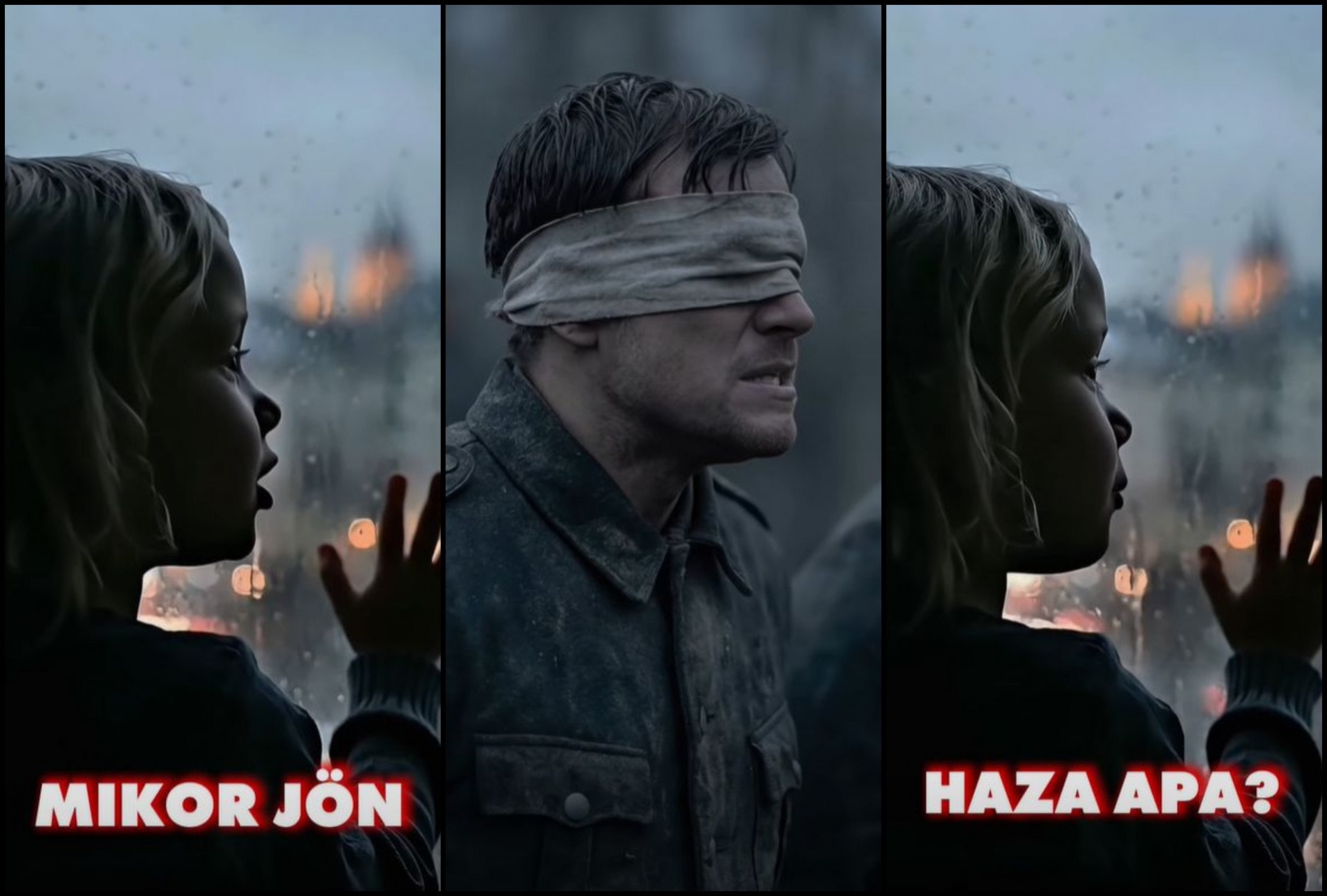 Source: Fidesz
Magyar responded in a statement, calling the video a “total moral nadir”. “Playing with children, executions and fear is not politics — it is soulless manipulation. Revolting, unforgivable and deeply outrageous,” he wrote, demanding its removal.
Asked about it at Thursday’s briefing (19 February), Gulyás said he had not seen the video but added: “Such is the reality of war.”
Poll of the week: smaller parties could shape outcome
A survey published on Thursday by the Republikon Institute shows Tisza maintaining a stable lead, but suggests smaller parties could influence the final result.
Among decided voters, Tisza leads Fidesz by eight percentage points: 47 percent to 39 percent. The far-right Mi Hazánk would enter parliament with six percent, while the Hungarian Two-Tailed Dog party would clear the threshold with five percent. The Democratic Coalition would fall short.
Such a result would produce a complex scenario. Mi Hazánk is regarded as a potential ally of Fidesz and could help secure a Fidesz-led government. The (joke party turning serious) Two-Tailed Dog party, like Tisza, supports a change of government, yet began life as a joke party, pursues a markedly different style of politics and has never before sat in parliament, making its behaviour in such circumstances difficult to predict.