
With three days to go before Hungary’s election, the opposition Tisza party is riding high in the final independent polls, while leaked recordings, allegations of false-flag tactics and a high-profile visit by JD Vance intensify the sense of a system under strain. Whether this is the beginning of an historic
 Veronika Munk



In our ongoing weekly digest, award-winning journalist Veronika Munk summarises and explains the most important political developments in Hungary.
This is our final edition of this series before the election. We guide readers on the route to the crunch Sunday (12 April) election — a poll without precedent in the region over the past 16 years. We are not stopping here: after the election, we will continue the series to report on the most important measures taken by the incoming government.
This week, we cover the following topics:
The latest independent poll predicts a commanding Tisza party victory — and a record-high turnout. If the race is close, the final result could be delayed by as much as a week. Audio recordings suggest the Hungarian government has been cosying up to both Russia and Iran. Explosives at the Serbian-Hungarian border: terrorist act or false-flag operation? JD Vance in Budapest: a symbolic show of support for Viktor Orbán, but one unlikely to meaningfully alter voter intentions. What do we know about undecided voters? In the final stretch of the campaign, insiders are appearing in public in an unprecedented way to speak, with their names and faces, about abuses inside the military, the police and the state administration.
Follow Hungary’s road to the 2026 election — subscribe to Days Until the Hungarian Elections on Substack and get every edition, and other Hungary-related articles straight to your inbox. Join now to gain access to our exclusive Post-Election, The “Day After” Live Video Briefing on 13 April.
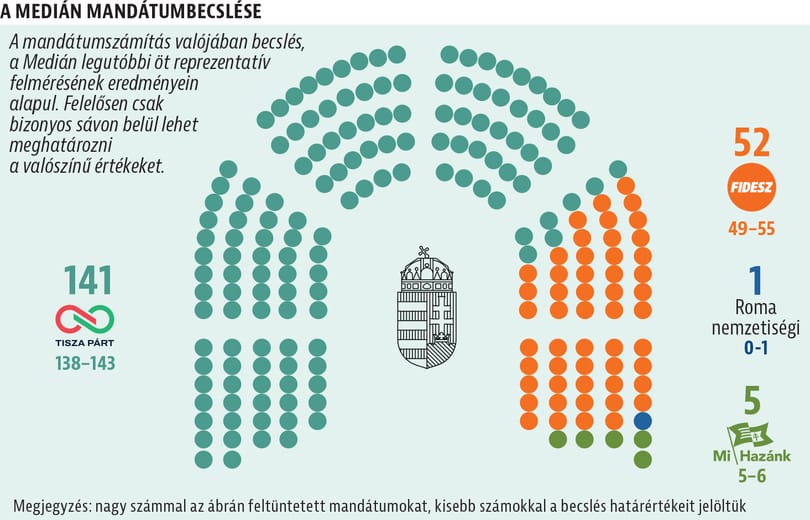
What do the final polls before election day show? The last government-independent Medián poll before the election points to a strong Tisza victory: its seat projection shows a stable Tisza government with a two-thirds majority. (The poll was conducted for HVG, with a sample of 5,000 respondents, between the last week of February and the end of March.) According to Medián’s data, Tisza holds a lead of 20 to 21 percentage points among certain voters. The poll suggests that Tisza did not win over voters from Fidesz; instead, supporters of smaller opposition parties migrated to Péter Magyar’s party. The forecast also indicates that Mi Hazánk, the radical rightwing nationalist party, will make it into parliament. The head of Medián has forecast a record-breaking turnout, saying in an interview that he would not be surprised by participation as high as 74 percent. High turnout favours Tisza. Responding to the Medián poll at Thursday’s government press briefing, Fidesz minister Gergely Gulyás accused the polling institute of falsification, saying anyone could commission similar results from them for money. “In three days, everyone will see that what Medián is doing is falsification,” he said. There was also fresh polling this week on attitudes towards the EU. According to a survey by the 21 Research Center, while a majority of Hungarians still support EU membership, the share of undecided respondents has grown in recent years: in a hypothetical referendum held now, 62 percent would vote to remain, 16 percent would vote to leave, while 17 percent would be unable to decide. That marks a decline from 65 percent support in 2024, while the proportion of undecided voters has risen significantly, from 10 percent to 17 percent. At the same time, the share of those opposed to EU membership has fallen slightly, suggesting that the number of outright opponents is not increasing; rather, part of the population has become more uncertain — likely not unrelated to Fidesz’s anti-EU rhetoric.
Péter Magyar reacted to the Medián poll by saying: “No one should allow themselves to be misled or lulled into complacency. Elections are not won in opinion polls, and there are at least 30 to 40 constituencies where the difference is within 1,000 votes. So this could still become either a two-thirds Tisza victory or a very narrow win.”
If the race is close, the final result could be delayed by as much as a week
According to a statement issued on Thursday by Hungary’s National Election Office, vote counting will begin immediately after 7pm on Sunday in most polling stations, meaning that the first preliminary results, published alongside early processing figures, could appear at around 8pm.
At the same time, the National Election Office will begin aggregating postal ballots cast from abroad. Votes cast at embassies and through re-registration will only arrive in the days following the election; the Office will forward these to the constituencies on 17 April, where they will be counted one or two days later.
On election night, around 92 to 95 percent of party-list votes and 94 to 97 percent of constituency votes are expected to be processed, meaning that in a tight race, the outcome could still change until next Saturday, 18 April, by which point all ballots will have been counted.
Recordings show the Fidesz government cosying up to both Russia and Iran
“Our friendship has risen to such a high level that I will help in any way I can,” Hungarian prime miniser Viktor Orbán told Russian president Vladimir Putin by phone, according to an intercepted transcript published by Bloomberg. “In any matter where I can be of assistance, I am at your service,” Orbán also told Putin.
Further documents and audio recordings suggest that Hungary’s foreign minister, Péter Szijjártó, not only held regular consultations with Russia’s foreign minister, Sergei Lavrov, on easing EU sanctions and obstructing Ukraine’s accession to the EU, but went so far as to promise confidential EU documents to the Russians, while also assuring Tehran’s leadership of his loyalty.
At least, that is what emerged this week after an international investigative consortium — Bloomberg, the Washington Post and Politico — leaked further details about the Hungarian leadership’s Russian and Iranian ties.
The most serious allegation contained in the leaked recordings is that Szijjártó offered Lavrov the delivery of EU documents through the Hungarian embassy in Moscow.
In one concrete case, he allegedly promised to hand over “immediately” the negotiating framework document on Ukraine’s accession talks. In the conversations, Szijjártó also reportedly briefed Lavrov on Orbán’s visit to Kyiv and other western diplomatic moves, in effect seeking prior approval or advice for steps that were detrimental to the EU and Ukraine.
The diplomatic freelancing did not stop at information-sharing. Politico reported on a secret 12-point strategic cooperation plan signed by Szijjártó in Moscow in December 2025.
Beyond energy and economic entanglement, the agreement reportedly included strengthening Russian-language education in Hungary, including through the employment of teachers arriving from Russia, as well as closer cultural and sporting ties.
Meanwhile, according to the Washington Post, after the Hezbollah pagers exploded in 2024, Szijjártó hurried to assure Iran’s foreign minister that Hungary had nothing to do with the operation, declaring: “I am always at your service.”
The background to the case is that pagers used by members of Hezbollah in Lebanon exploded simultaneously at the time. It was suggested during the affair that some of the devices or logistical elements linked to the operation might have had ties to Hungary — something the Hungarian government firmly denied.
According to the newly leaked conversation, however, Hungary’s foreign ministry very much did coordinate with Iran and bent over backwards to reassure it.
Szijjártó responded to the leaks with familiar government talking points, speaking of an “unusually brutal and open intelligence intervention”.
According to the minister, foreign services intercepted and published his calls in order to influence the outcome of the 2026 parliamentary election. He justified his conversation with Iran’s foreign minister by claiming that had he not called them, Hungary might have become the target of terrorist attacks; in his telling, the call was therefore in the service of the Hungarian people’s security.
Although the minister, in effect, acknowledged the authenticity of the recordings and transcripts through his reaction, he did not address the contradictions.
The ministry did not respond to questions about how the assistance offered to Iran squared with the government’s professed support for Israel and the United States, nor did it seriously address whether the concessions and document-sharing with Russia conflicted with Hungary’s obligations as an EU member, dismissing the issue simply by saying that such relations were not incompatible with EU membership.
Explosives at the Serbian-Hungarian border: terrorist act or false-flag operation?
On Sunday (5 April) morning, the Serbian army found suspicious objects near the TurkStream gas pipeline, after which the Serbian president, Aleksandar Vučić, announced that high-powered explosives and detonating cords had been discovered at the scene. (TurkStream is carrying Russian gas through Turkey and the Balkans, strategically important for Hungary’s energy supply.)