

The FTSE 100 isn’t known as the flashiest of stock markets, lacking the might of the trillion-dollar tech stocks of the US or the glamorous luxury conglomerates of France. But what it lacks in shine, it makes up for in reliability, with the index reporting a 21.5 gain in 2025,
 Maisie Grice




Monday 04 May 2026 10:41 am | Updated: Monday 04 May 2026 10:42 am
The FTSE 100 isn’t known as the flashiest of stock markets, lacking the might of the trillion-dollar tech stocks of the US or the glamorous luxury conglomerates of France.
But what it lacks in shine, it makes up for in reliability, with the index reporting a 21.5 gain in 2025, its strongest calendar year performance since 2009.
The growth however was narrow, with the market bolstered by the financial and defence sector, as well as energy and utilities.
Energy stocks have been taking centre stage among investors, amid discussions of net zero, but now that oil prices have been sent spiralling amid the Iran war, heads are turning to utilities in a bid to secure steady growth and stable dividends.
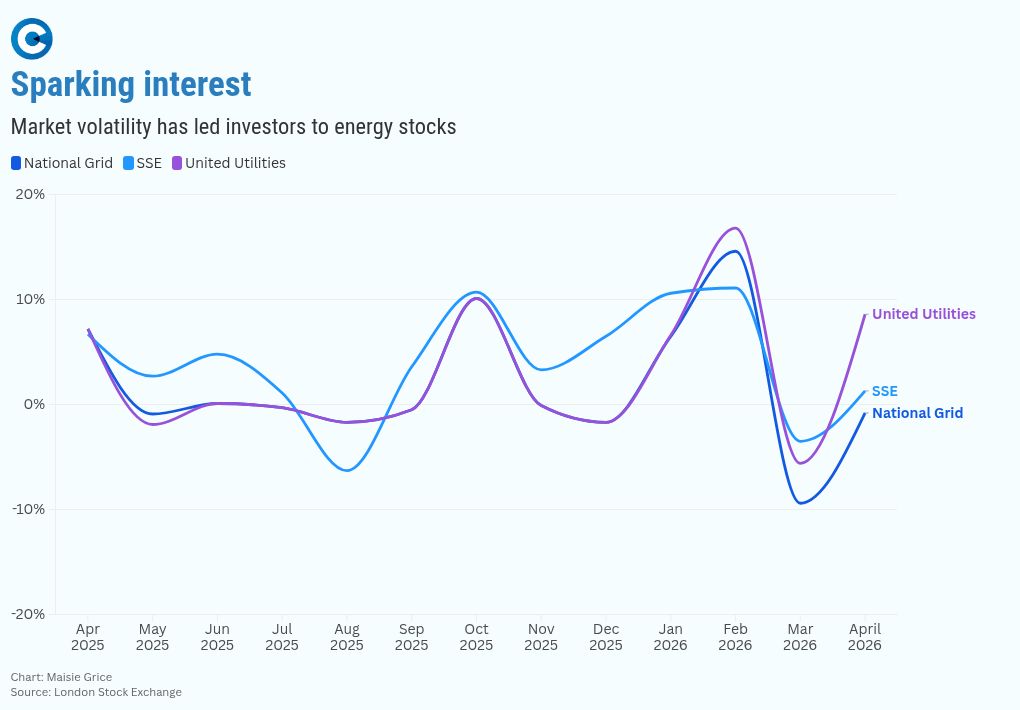
The sector’s opportunities go beyond the conflict, with the National Grid up 20.7 per cent over the last year and water services provider United Utilities up 30.9 per cent.
#mc_embed_signup { background: #fff; clear: left; font: 14px Helvetica, Arial,sans-serif; width: 100%; max-width: 600px; margin: 20px 0; } #mc-embedded-subscribe-form { margin: 20px 0 !important; } .newsletter-form-flex { display: flex; gap: 0; align-items: center; margin-top: -10px; } .newsletter-form-flex input[type=”email”] { flex: 1; padding: 2px 10px; border: 1px solid rgb(18, 22, 23) !important; border-radius: 12px 0 0 12px !important; } .newsletter-form-flex input[type=”submit”] { padding: 4px 10px !important; margin: 0 !important; background-color: rgb(18, 22, 23) !important; color: rgb(255, 255, 255) !important; border: 1px solid rgb(18, 22, 23) !important; border-radius: 0 12px 12px 0 !important; } .newsletter-banner-content { margin-bottom: 15px; } .newsletter-banner-content h2 { margin: 0 0 10px 0; font-size: 18px; font-weight: 600; } .newsletter-banner-content p { margin: 0 0 10px 0; line-height: 1.5; } .newsletter-banner-content ul, .newsletter-banner-content ol { margin: 0 0 10px 20px; } .newsletter-banner-content a { color: #0073aa; text-decoration: none; } .newsletter-banner-content a:hover { text-decoration: underline; } .newsletter-banner-content img { max-width: 100%; height: auto; margin: 10px 0; } #mc_embed_signup #mce-success-response { color: #0356a5; display: none; margin: 0 0 10px; width: 100%; } #mc_embed_signup div#mce-responses { float: left; top: -1.4em; padding: 0; overflow: hidden; width: 100%; margin: 0; clear: both; }
Russ Mould, investment director at AJ Bell, said: “Utilities this year have generally done pretty well… we’re all particularly fearing uncertainty.
“We don’t know what the outcome of the war is going to be or the knock-on effect of high oil and gas prices. So investors have sought out a bit of defensive stodge, businesses that are relatively insensitive to the economy…that’s near-term backdrop to a degree favours utilities.”
Attractive valuations
Away from the conflict, utility companies have been known for offering attractive valuations off the back of their defensive nature, high dividend yield and consistent cash flows.
National Grid trades on a price to earnings ratio of 21, in line with the FTSE 100’s earnings multiple, while in this financial year it is forecast to post a 14 per cent rise in earnings per share (EPS), forming a part of the company’s recently revised outlook for the five years to 2031.
Over the period the firm expects an annualised rise in EPS between eight and 10 per cent, which analysts foresee as being ahead of the growth rate of the wider index.
Meanwhile, Scotland-headquartered SSE is expected to generate underlying EPS in the top half, ranging from 147p to 152p, while United Utilities reported a 42 per cent gain in EPS to 107.1p in its latest trading update.
Investment plans
Politicians and industry figures portray certain utilities stocks, including those focused on renewables, as the future for UK energy, as the pivot away from fossil fuels continues.
This was cemented at the National Growth Debate in April when energy secretary Ed Miliband doubled down on the government’s ambitions to end the reliance on fossil fuels, citing it as the “only route to financial security”.
FTSE utility stocks are now capitalising on government growth ambitions, with Mould noting the “mad scramble” is unlikely to slow down as they are viewed as the “long-term solution”.
He said: “Centrica, National Grid and SSE, they’re seen as part of the solution to the problem.”
National Grid has shifted focus towards primarily electricity assets and has most recently completed the sale of its liquefied natural gas facility, Grain LNG to Centrica Energy.
Read more United Utilities taps shareholders for £800m as it unveils investment plans
But in 2025, Centrica confirmed its subsidiary Spirit Energy would sell its 46.5 per cent stake in the Cygnus gas field, one of the largest in the North Sea, to Ithaca Energy for £1.2m. Later that year, it sold the remainder of its stake to Serica Energy, moving it away from high-emission fossil fuel extraction.
Shifting priorities
The offloading of such assets has also been coupled with significant investment plans, with National Grid confirming a capital investment programme set to total £70bn over the next five years, with the bulk of this figure going towards electricity.
Roughly 80 per cent of SSE’s £33bn long term investment plan is also set to be allocated towards regulated electricity networks, with the investment expected to increase output 10 per cent year on year.
Mould also noted the recent move to sever the link between the price between electricity and gas as beneficial to company growth, as well as the push for more data centres.
He said: “Data centres suck up vast amounts of energy, so utilities are therefore seen as potential beneficiaries of that provided that they can provide enough grid connectivity and power in the first place, which remains an open challenge.”
Potential problems
Despite having regulated long-term growth, potential roadblocks for utility companies lie ahead.
A primary hurdle for the sector remains the energy profits levy, informally dubbed the windfall tax, which will be raised to 55 per cent from 45 per cent as of 1 July, with the levy now being extended beyond 2028 to support households amid ongoing energy spikes.
Mould noted that the rise in taxes could ground investment plans or production to a halt, forcing companies to instead use capital to fund rising taxes, with SSE likely to be caught in the cross hairs as profits from its wind farms will be taxed.
But, as the National Grid is a “regulatory hedge” due to half of its profit being within its US projects, its valuation is somewhat protected from UK regulatory shifts.
There are also other hidden financial and operational risks which could hamper growth, in particular such stocks being seen as bond proxies.
When interest rates or government bond yields remain high utility stocks can be damaged, and UK bonds have recently hit their highest levels since 2008.
Mould said: “Increased bond yields can lessen the relative attraction of equities compared to fixed income as a source of yield. For shares, it means paying a lower valuation and perhaps demanding a higher dividend yield.”
To stay attractive, utility stock’s share price must fall until its dividend yield is high enough to justify the extra risk, which throws National Grid’s strategy to grow its dividend in line with inflation into question.
Balancing act
Mould also hailed National Grid’s debt pile as a “high-stakes balancing act”, which stands at £38.4bn, making it more exposed to potential spikes in inflation and interest rates than other FTSE 100 constituents.
Other analysts have also warned of taking investment plans with caution, as the UK is facing a significant backlog in connecting new renewable projections to the grid as companies struggle to sort planning permission while grappling with supply chain issues and a lack of specialised labour.
Meanwhile, United Utilities growth could be damaged by aggressive intervention from Ofwat, with the company dealing with intense regulatory scrutiny if they fail to hit targets set out meaning they would have to return capital to customers, but the company’s headroom could allow it to absorb potential penalties, weakening fallout.
Read more OG&E to Host Bidgely EmPOWER AI 2026 Annual Conference in New York City
Similarly tagged content: Sections Categories People & Organisations Related Topics