

A Ukrainian drone got within 6km of Kremlin on Monday, as Russia prepares for 9 May parade, with Slovakia’s prime minister still aiming to go.
 admin
admin



Every day, the Ukraine Battlefield update newsletter offers a clear look at how the war is unfolding on the ground, highlighting key developments along the frontline and the shifting dynamics of the conflict.
The war is proceeding according to plan, Ukrainian drones are preparing their route to Red Square. One crashed today six kilometres before reaching it. How the frontline moved in April 2026 according to Ukrainians, Russians and independent Finns, what the trend is and how the figures differ from last year. Russian forces advanced near Kostyantynivka, the situation in the town continues to deteriorate. Ukrainians claimed they hit two Su-57s at an airfield 1,700 km from the frontline, but convincing evidence is still missing. Maps of the day – map of Moscow’s air defence; Kostyantynivka Videos of the day – another tanker of the shadow fleet hit by a drone; T-54 converted into a machine laying wire obstacles; Tuapse after the fires were extinguished
The war is proceeding according to plan – Ukrainian drones are preparing their route to Red Square. One crashed today six kilometres before reaching it. On Saturday, the Slovak prime minister, Robert Fico, announced he would travel for a visit to Kyiv. It was a surprising piece of news, because he had so far avoided any trip to the Ukrainian capital.
Tibor Gašpar, the prime minister’s closest ally, however, immediately played down Fico’s statement on Sunday, when he spoke about the possibility that the visit might take place somewhere other than Kyiv, because the city was the scene of “military operations”.
Two years ago, Fico claimed that there “was no war” in the Ukrainian capital. Gašpar’s remark was also the first to suggest that Fico was afraid to go to Kyiv because of its almost constant bombardment, even though the former Slovak president, Zuzana Čaputová, for example, had already been there, as had dozens of politicians from across Europe.
Gašpar’s argument was even more piquant for another reason. Fico had for a long time been announcing a trip to Moscow for the 9 May celebrations. The Kremlin had already officially confirmed it. Yet in Russia it was considered almost certain that the Ukrainian army was preparing a massive strike on Moscow precisely on the day when the Slovak prime minister was supposed to be there. The Russians assumed Ukraine would try to disrupt an already scaled-down military parade, which traditionally crowns the celebrations of victory in the second world war.
There were indeed growing indications that this might happen, and various Russian authors were convinced that it would. At the same time, there were signs that additional air-defence batteries were being moved to Moscow. Fico could thus find himself in the middle of a major air battle for the Russian capital.
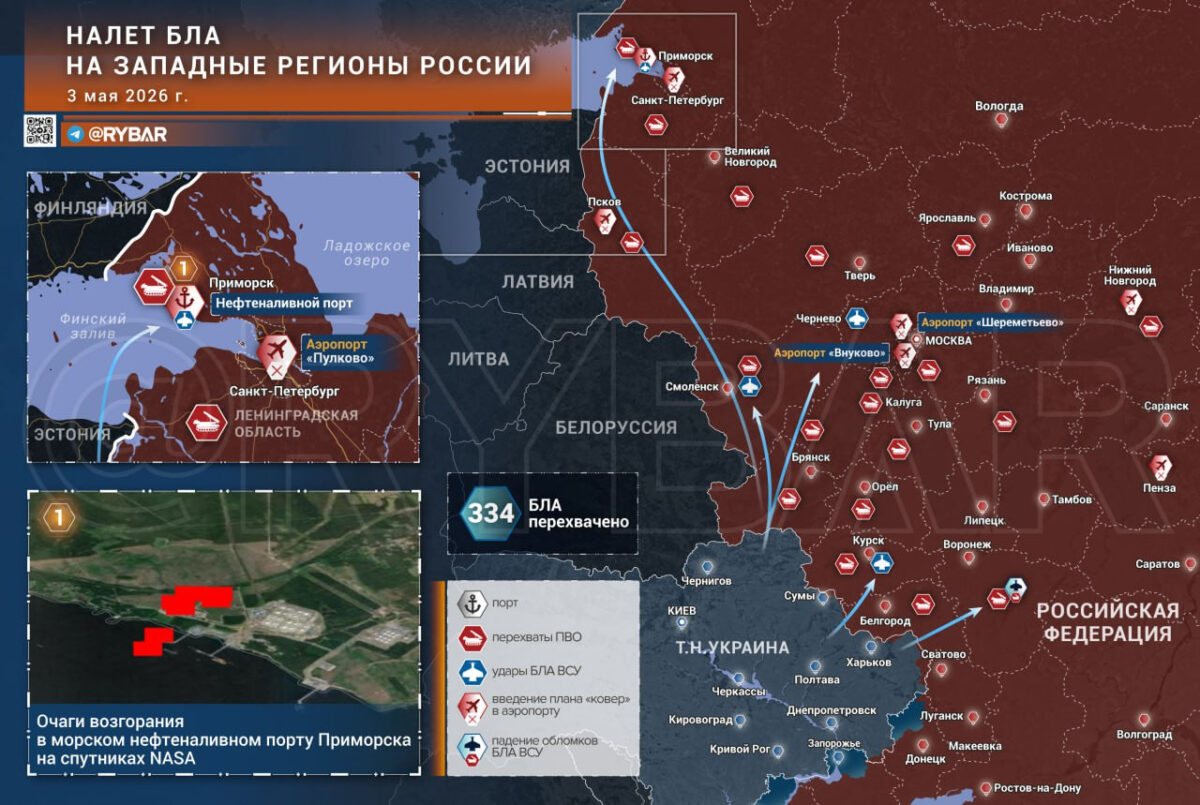
“On the previous night, Ukrainian formations once again carried out a massive drone raid on various regions of Russia,” the Russian Telegram channel Rybar wrote, citing the Russian defence ministry as saying that “unmanned aerial vehicles were being shot down almost across all of central Russia”. According to Russian figures, there were 334 in total, and the greatest attention was drawn by a successful attack on a refinery in Primorsk in the Leningrad region, part of which went up in flames.
Rybar’s map with the routes of the attacks on the night of 2 to 3 May:
On Monday before noon, however, the main topic was a Ukrainian drone that got almost into the centre of Moscow. In the following compilation you can see footage of the drone flying over Moscow, a view from the street where it hit a high-rise building in a prominent district, and at the end a look into the damaged part of the building.
At this point it is not known whether the drone hit the building deliberately, by mistake, or whether it was brought down by Russian air defence. One hypothesis mentioned is the effect of electronic jamming.
Overnight, Ukrainian UAVs circled Moscow, with one drone hitting a building located 6 km from the Kremlin and 3 km from the Russian Ministry of Defense. Moscow Mayor Sergey Sobyanin confirmed the drone strike on a building in the Mosfilmovskaya Street area. The parade is in 5… pic.twitter.com/8UJ5CxJtdi
— WarTranslated (@wartranslated) May 4, 2026
Russian journalist Mark Krutov from Radio Free Europe/Radio Liberty pointed out that the drone passed through three layers of defences around Moscow and got to within six kilometres of the Kremlin (according to the Kyiv Independent it was seven kms).
A Ukrainian drone hit a residential building in Moscow’s posh Mosfilm neighborhood (just 6 km from the Kremlin), which also hosts several foreign embassies, including Germany’s, successfully making its way through all the ‘Pantsir’ rings. https://t.co/nE4KHxERpN pic.twitter.com/t4wsBO0Z1d
— Mark Krutov (@kromark) May 4, 2026
“Russia has announced a parade for 9 May, but there will be no military hardware in it. For the first time in many years they cannot afford to have weapons on the parade. And Ukrainian drones may also be flying at this parade,” Ukrainian president Volodymyr Zelensky taunted the Kremlin.
The Russians are taking it seriously. “What was expected has happened – the enemy has amassed a large stock of drones and is now using them with the aim of breaking through to Moscow,” the Russian channel Military Informer wrote on Monday.
The author correctly pointed to the zero direct military effect of a single drone hitting a building, but also correctly highlighted much more serious indirect consequences. The first is media impact, and the second is the redeployment of more and more air-defence assets to protect the capital, which are then missing from militarily important targets in other parts of the country.
“Even without inflicting real damage, simply by the very existence of a threat to Moscow, Ukraine is forcing the Russian army to weaken protection in some directions at the expense of others,” Military Informer wrote.
Before Monday’s events, the well-known Russian propagandist and war correspondent Aleksandr Kots had also warned of an attack planned for 9 May. He is a staff writer for Komsomolskaya Pravda and was already describing the threat to the Moscow parade on his Telegram account on Saturday, when drones were flying towards Moscow: “There are seven days left until Victory Day. The current activity can be read unambiguously: the enemy is probing the various layers of air defence, looking for gaps in the system and testing the reactions of the crews. The method is well known – first reconnaissance by combat, then an attempt at a breakthrough on a symbolic date.”
Kots recalled that something similar had already happened in March. Between 14 and 16 March, air defences around Moscow destroyed 289 drones. “Even then there was a gradual ‘dilution’ of attention before a massive strike. Today’s eight drones are a probe before a major attack,” he wrote on Saturday.
It really cannot be ruled out that this will happen, but for the Ukrainians it would be of far greater military significance than merely disrupting a propaganda parade to first create the impression that they really wanted to try it, and then strike more important military targets with weakened air defences.
How the frontline moved in April according to Ukrainians, Russians and independent Finns. The short answer is: only a little, and mostly on secondary axes. All sources, however, offer different figures and, of course, the Russian ones are the highest.
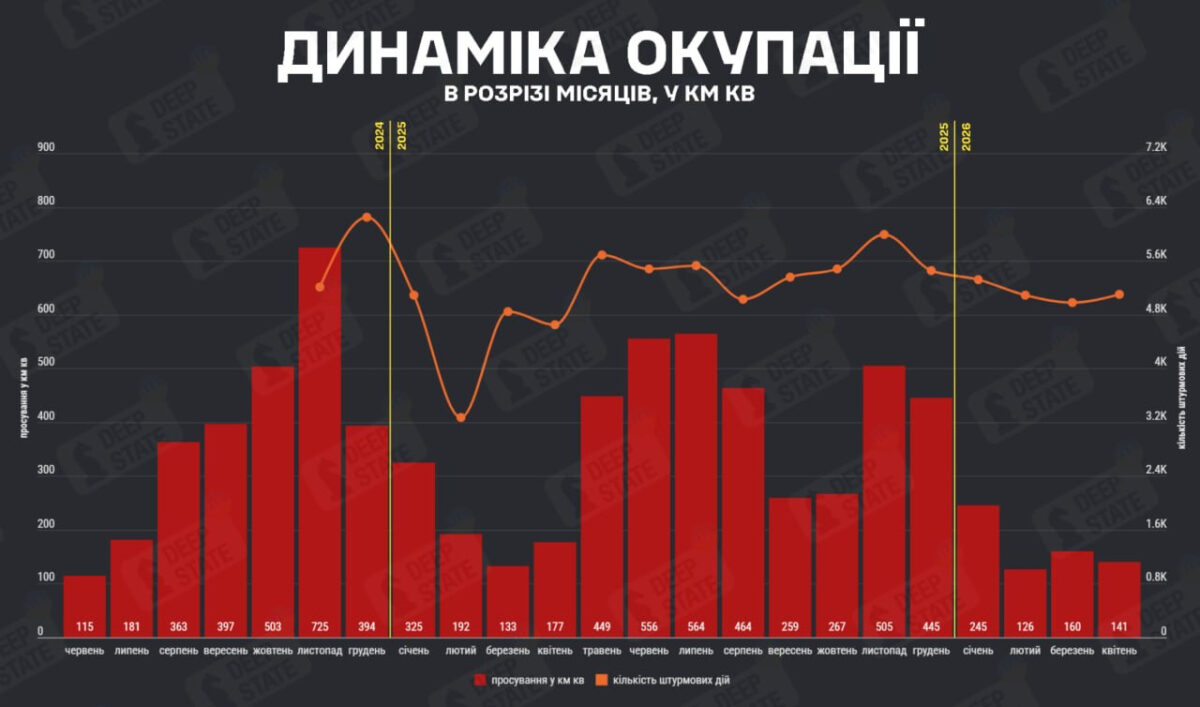
Ukrainian analysts from DeepStateUA calculated that the size of the occupied territory increased in April 2026 by 141 square kms. The overall results are lower than a year ago, and the trend is also reversed. While in April 2025 the pace of the Russian advance accelerated month-on-month, it has now slowed. “In April the enemy occupied 11.9 percent less territory than in March. At the same time, the number of assault actions increased by 2.2 percent,” they wrote.
Although Russian forces advanced the most in Donetsk region (36 percent of their overall gains), compared with December they seized 6.5 times less territory in this region. This corresponds to the picture of recent months – the Russians have in effect become stuck in Donbas. Next comes Sumy region with 30 percent and Kharkiv region with 22 percent. They did worst in the Zaporizhzhia area, where they captured not even 20 square kms, and in Dnipropetrovsk region the Ukrainians even managed to liberate part of the territory – specifically seven square kilometres.
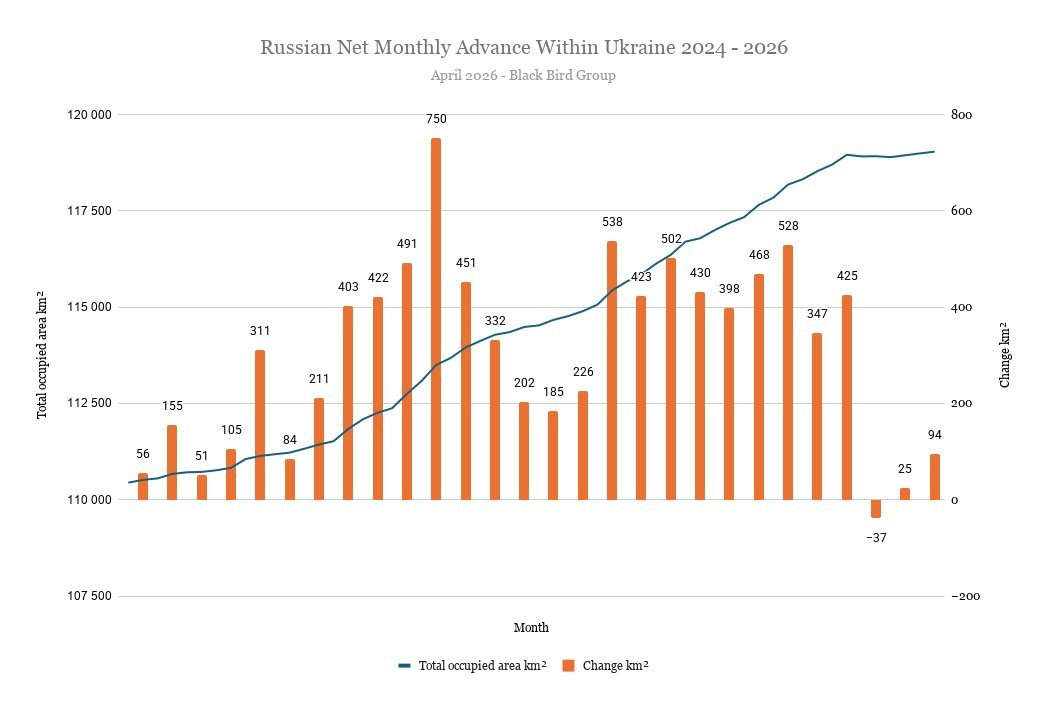
The Finnish OSINT group Black Bird Group attributed even fewer successes to Russia. Its analysts believed that in April it captured only 94 square kms, but unlike the Ukrainians they saw the opposite trend, namely a gradual acceleration in the pace from February’s minus 37 square kms.
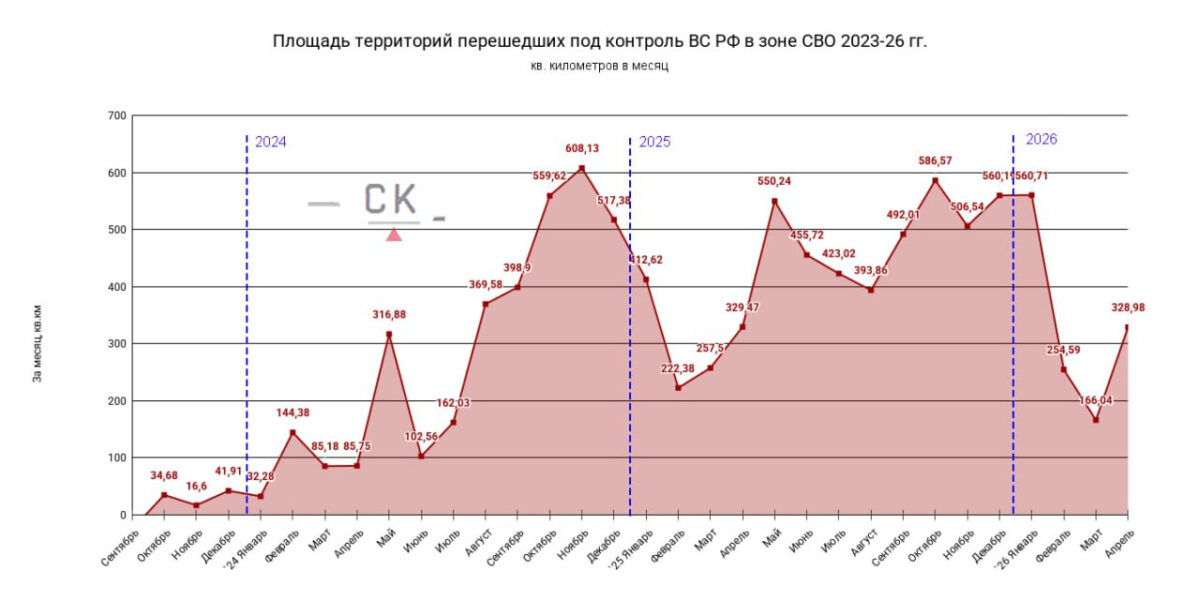
A similar project also exists on Russian Telegram; it is called Slivochnyi kapriz (something like “Creamy Whim”). For a long time its data at least resembled those of the previous two sources, but since the beginning of this year they have diverged quite dramatically. The author claimed that in April the Russians captured 329 square kms of territory.
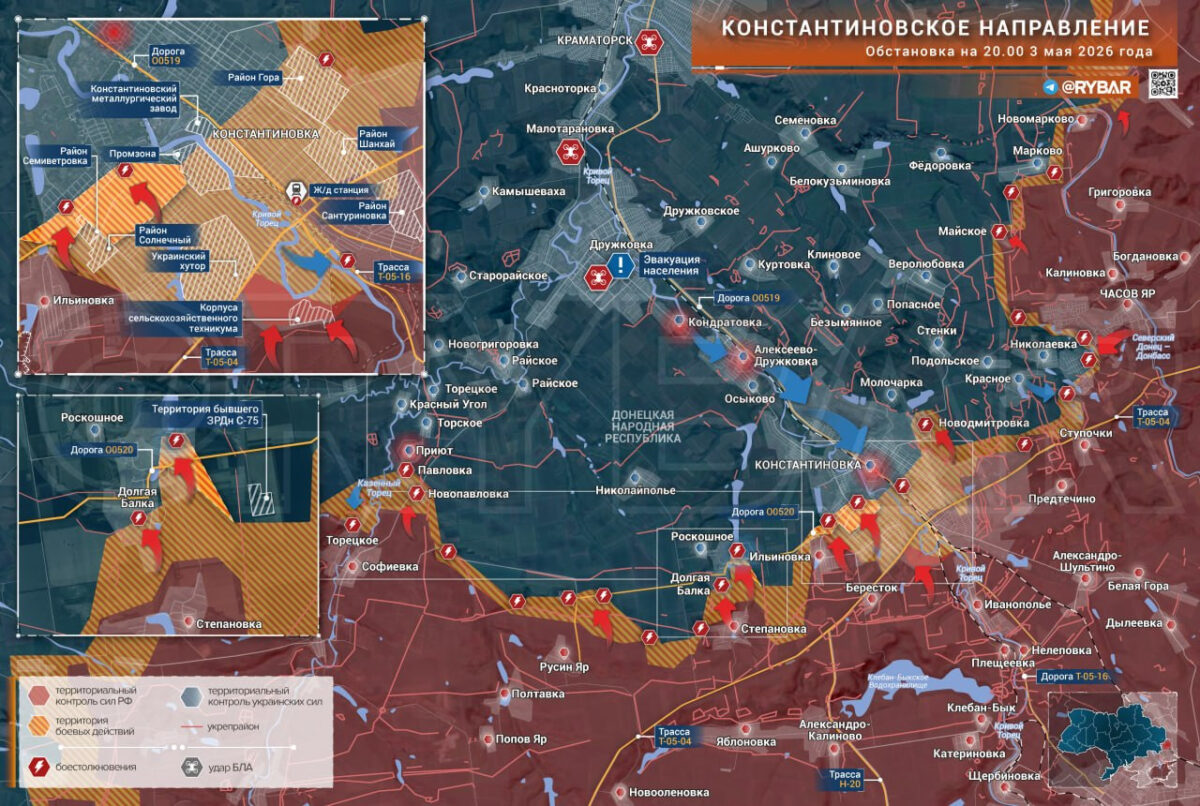
Russian forces advanced near Kostyantynivka, the situation in the town continues to deteriorate. “The enemy is penetrating the southern part of Kostyantynivka, is trying to do the same from the eastern side, and in isolated cases has already pushed closer to the centre. The situation in the town is worsening as a result of constant pressure,” analysts from DeepStateUA wrote after the weekend’s fighting.
At the same time, on Sunday they confirmed that Russian forces had advanced in the villages of Berestok and Illinivka on the western edge of Kostyantynivka.
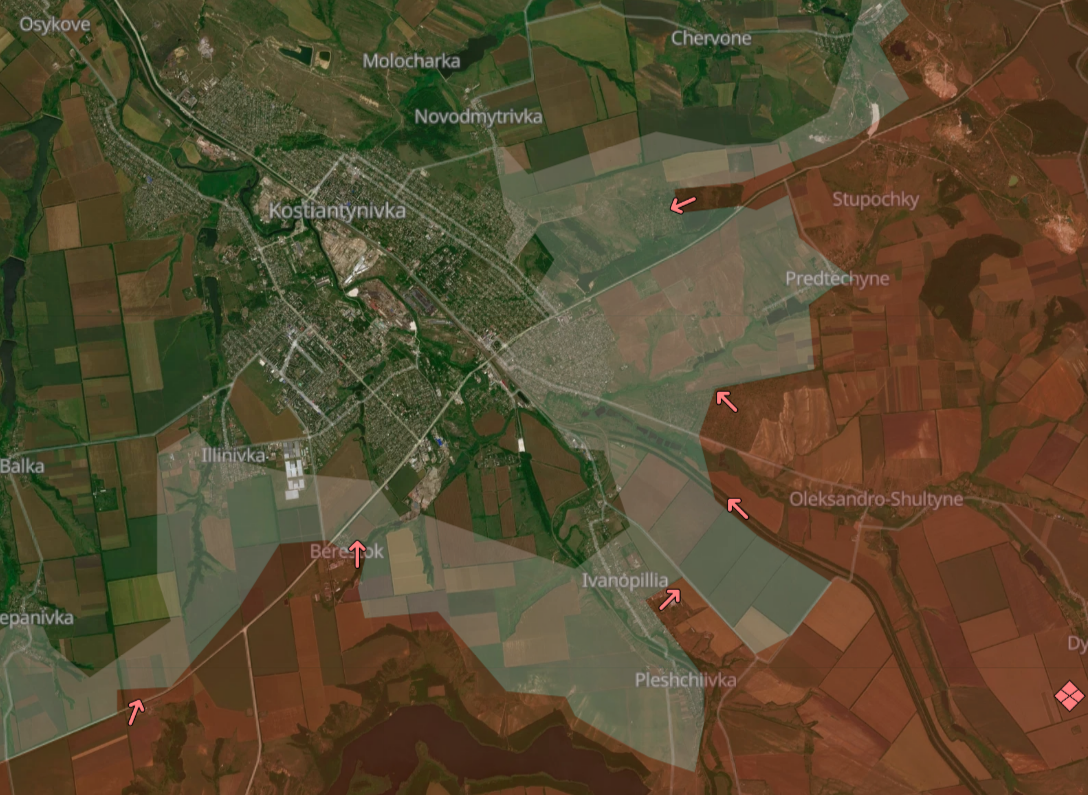
A similar picture is offered by the Russian Rybar channel, but as its map shows, while its verbal description largely matches that of DeepStateUA, visually their versions differ significantly. According to the Russian map, fighting is taking place across the entire southern half of the town, whereas the Ukrainian one shows it only in the south-eastern part. The Russians also consider Illinivka captured, while the Ukrainians mark it as a grey zone.
On the other hand, Rybar admitted problems in the direction from Chasiv Yar, which has officially been captured since last August: “The most difficult situation persists in Chasiv Yar. Ukrainian formations have managed not only to move assault groups into the town, but also to establish drone-operator positions there. This is clearly having an impact on the offensive capabilities of Russian units, which are forced to break through the enemy’s defences in extremely difficult conditions.”
The defence of Chasiv Yar is both so successful and so important because the town lies on high ground, on which the Russian offensive towards Kostyantynivka and further towards the Kramatorsk agglomeration depends.
Ukrainians claimed they hit two Su‑57s at an airfield 1,700 km from the frontline. On 1 May, Ukraine’s Unmanned Systems Forces announced that back on 25 April they had managed to hit two of Russia’s most modern Su‑57 fighter jets, one Su‑34 frontline bomber and another unidentified aircraft at the Shagol air base in the Chelyabinsk region.
They illustrated the report with satellite images of the base before and after the attack, which this time, however, could not be regarded as evidence, as none was visible on them. Russian sources also completely ignored the Ukrainian claim. Until videos directly from the attack or better images from space appear, the success cannot be considered confirmed. If it were confirmed, however, it would be one of the most important drone operations deep in Russia’s rear.
Unmanned Systems Forces struck Su-57 and Su-34 fighter jets
It has been confirmed that on April 25, at the Shagol airfield in the Chelyabinsk region of russia, operators of the 1st Separate Center struck two Su-57 fighter jets, an Su-34 fighter-bomber, and an SU of unknown… pic.twitter.com/N8KA057gGD
— 🇺🇦 Unmanned Systems Forces (@usf_army) May 1, 2026
Videos of the day
Drones hit another tanker of Russia’s shadow fleet.
Our warriors continue to apply sanctions against Russia’s shadow oil fleet – two such vessels were struck in the waters at the entrance to the port of Novorossiysk. These tankers had been actively used to transport oil – not anymore. I am grateful to Chief of the General Staff… pic.twitter.com/8aCse8h95j
— Volodymyr Zelenskyy / Володимир Зеленський (@ZelenskyyUa) May 3, 2026
Ukrainians modified the chassis of an old T‑54 tank so that it can be used to deploy kilometres of barbed wire.
A BTM-3 engineering vehicle, converted by soldiers of Ukraine’s 28th Mechanized Brigade into a machine for laying barbed-wire lines.
Originally, this ancient Soviet vehicle, built with elements of the T-54 chassis, was designed for digging trenches. However, thanks to welding… pic.twitter.com/va49qzOPQd
— Yigal Levin (@YigalLevin) May 2, 2026
There are currently no fires burning in Tuapse, but this makes it possible to observe the consequences of recent strikes in videos published by local residents.
What are the losses
Last updated on Monday (27 April).
Russia had demonstrably lost 24,487 pieces of heavy equipment by Monday morning (on Tuesday (21 April) it was 24,471). Of these, 19,123 (19,108) pieces were destroyed by Ukrainians, 976 (976) were damaged, 1,206 (1,206) were abandoned by their crews, and 3,182 (3,181) were captured by the Ukrainian army. This includes 4,389 (4,385) tanks, of which 3,292 (3,288) were destroyed in combat.
Ukraine lost 12,050 (11,977) pieces of equipment, of which 9,272 (9,224) were destroyed, 673 (669) damaged, 671 (670) abandoned, and 1,414 (1,414) captured. This includes 1,419 (1,416) tanks, of which 1,084 (1,081) were destroyed in combat.
Note: Neither side provides regular information about its own dead or destroyed equipment. Ukraine publishes daily figures for Russian casualties and destroyed equipment, but these cannot be independently verified. In this overview we use data from the Oryx project, which since the start of the war has compiled a list of equipment losses documented exclusively by photographic evidence.