The Swiss-based International Chess Federation or World Chess Federation (FIDE) rejects allegations that its president, Arkady Dvorkovich, backed Russia’s invasion or organised events in occupied Ukraine, arguing claims misrepresent his honorary CFR role and federation decisions.
 FIDE International Chess Federation



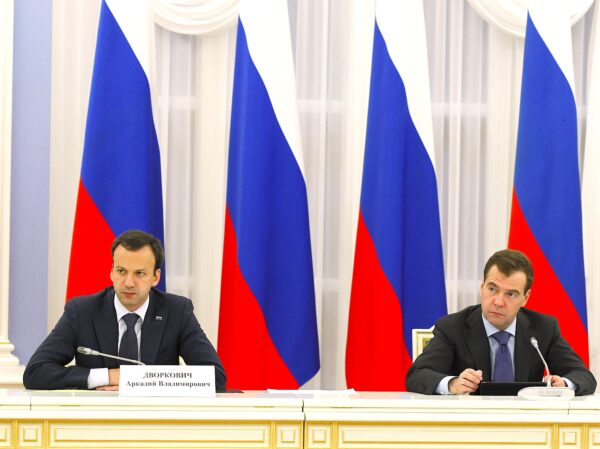
On Monday (16 February), EUobserver reported that the European Commission is considering including the president of the International Chess Federation or World Chess Federation (FIDE), Arkady Dvorkovich, in a new sanctions package against Russia, quoting specific allegations. FIDE wishes to respond to these allegations on the factual record.
The allegations concern Dvorkovich’s role in the Chess Federation of Russia (CFR) and claims that he participated in organising chess events in territories of Ukraine controlled by Russia, as well as assertions that he “championed” Russia’s invasion of Ukraine.
These characterisations are factually inaccurate, and we wish to clarify the record.
On the Board of Trustees of the Chess Federation of Russia: Dvorkovich is a member of the Board of Trustees of the CFR. This matter has already been examined in detail by the FIDE Ethics and Disciplinary Commission and is currently under consideration by the Court of Arbitration for Sport (CAS). It was established that the Board of Trustees is inactive — it has not held meetings for over 10 years — it is honorary in nature and does not make any management decisions.
Dvorkovich’s association with this body reflects his family’s long-standing involvement in international chess, including his late father, Vladimir Dvorkovich, a respected chess arbiter and organiser. Dvorkovich does not organise, direct, or oversee CFR activities or events.
The CFR is one of more than 200 national federations affiliated with FIDE, each operating independently.
As stated in the EU proposal, attributing a “key role” in the CFR to Dvorkovich based on his membership of an honorary body that has not convened in over a decade does not reflect the factual situation.
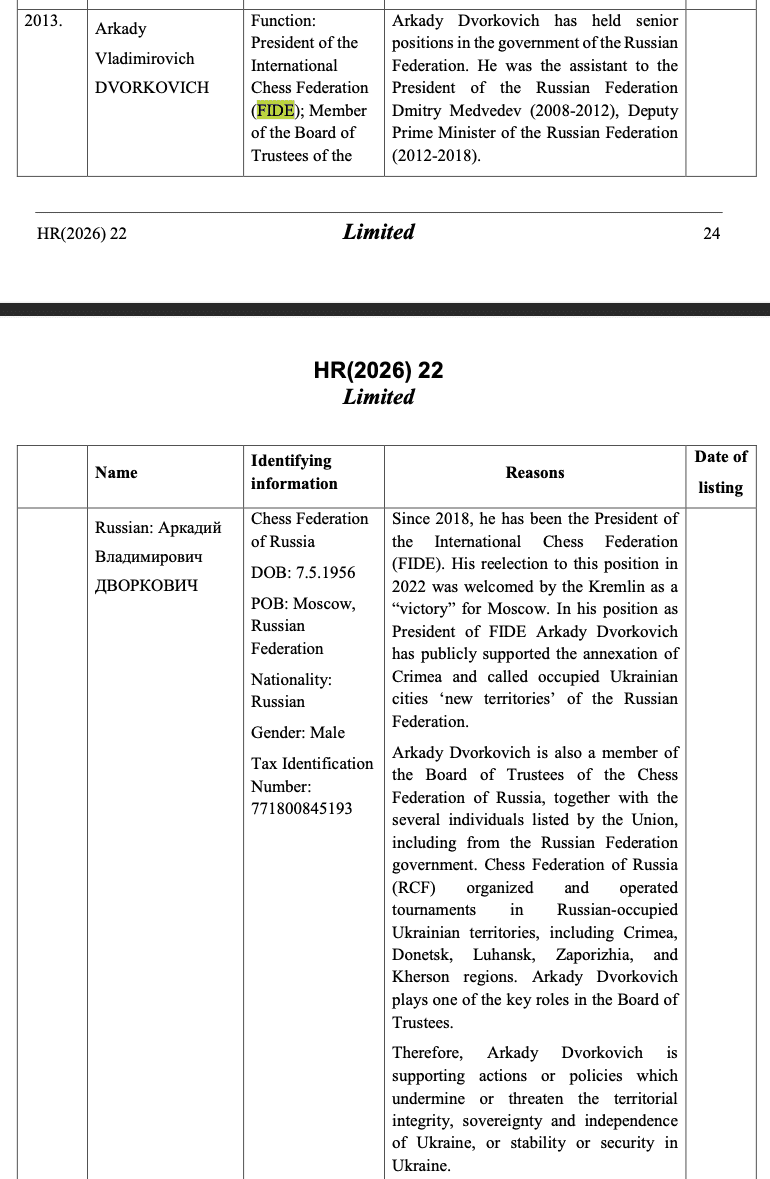
On chess events in territories controlled by Russia: It is important to distinguish between the activities of a national federation and those of the international federation and its elected President.
FIDE has not rated or recognised any chess event held in territories of Ukraine controlled by Russia (Crimea, Donetsk, Luhansk, Zaporizhzhia, or Kherson) at any point during Dvorkovich’s presidency. This is verifiable in FIDE’s publicly accessible tournament database. Any domestic events organised by a national federation fall within the responsibility of that federation.
On the claim that Dvorkovich “championed Russia’s invasion”: Within days of Russia’s full-scale invasion of Ukraine in February 2022, the FIDE Council publicly condemned the military action in Ukraine.
FIDE implemented restrictions on Russian and Belarusian participation in international chess competitions in line with recommendations issued by the International Olympic Committee. These measures included the suspension of national flags and anthems, relocation of events, and restrictions on officials. These measures were the subject of public commentary and criticism of Dvorkovich at the time.
They were adopted in accordance with FIDE’s governing bodies and remained in place for nearly three years, until a subsequent decision of the FIDE General Assembly.
During this period, FIDE also took steps to support Ukrainian players and ensure their continued participation in international competition. The record of these actions is difficult to reconcile with the assertion that Dvorkovich “championed” the invasion.
On ongoing legal proceedings: The appeal currently pending before CAS concerns procedural aspects of the December 2025 decision regarding participation status. It does not relate to any events in territories under dispute.
As with all FIDE decisions, the matter is subject to independent review under established international sports arbitration procedures.
On FIDE governance: As an international sports federation, recognised by the International Olympic Committee, FIDE operates under its Charter and Electoral rules, which require neutrality, independence, and democratic governance.
FIDE’s decisions are taken by elected bodies, subject to internal oversight and, where applicable, by the Court of Arbitration for Sport.
Editor’s note: EUobserver requested a response from FIDE prior to publication of the story. A reply was received but did not substantively address the allegations.