
Bosnian Serb wartime military chief Ratko Mladic’s plea for release on humanitarian grounds due to his deteriorating health was rejected on the grounds that he is getting high-quality medical care in detention.
 Lamija Grebo



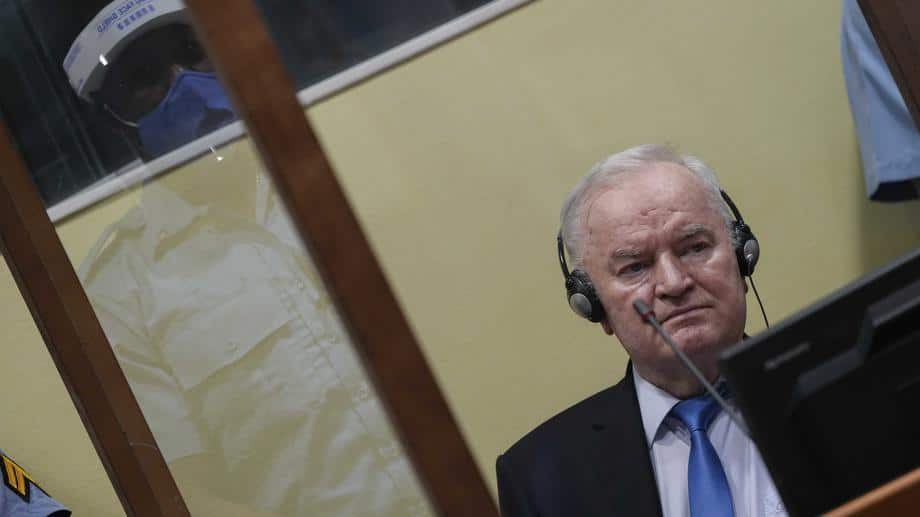
Ratko Mladic in the court room in The Hague, June 2021. Photo: EPA-EFE/PETER DEJONG/POOL.
The UN’s International Residual Mechanism for Criminal Tribunals in The Hague announced on Thursday that it has turned down a request from Ratko Mladic, who is serving a life sentence for genocide and other wartime crimes, to be released because he is close to death.
The decision by IRMCT president Graciela Gatti Santana acknowledges that Mladic’s condition is “very serious, deteriorating, and approaching death”.
The wartime Bosnian Serb military chief, now 84, recently suffered a stroke, according to media reports. His health has long been poor. But Santana argued that he is receiving the best possible treatment in detention.
“The conditions at the UNDU [UN Detention Unit] and the prison hospital are of such high quality that Mladic’s comfort can be maximally ensured, without the detention setting exacerbating the situation in a manner that results in inhuman or undignified treatment,” her decision says.
“There is no additional treatment available elsewhere that is unavailable in the Netherlands,” it adds.
Santana’s decision notes that Mladic has had “years of effective and adaptive treatment of his multiple and complex health issues” while he has been in detention, and can be visited frequently by relatives.
“He benefits from an exceptional visitation regime, which allows for frequent contact with his friends and family, including the possibility of family members to be present with him during his final moments,” the decision says.
Mladic’s lawyers had requested his immediate conditional or provisional release to a specialised hospital or hospice, arguing that he is “in a state of advanced, irreversible medical decline … and is approaching the end of his life”.
The Bosnian Serb Army general was convicted under a final verdict in June 2021 of the genocide of Bosniaks from Srebrenica, the persecution of Bosniaks and Croats across the country during the 1992-95 war in Bosnia, terrorising the population of Sarajevo with a campaign of shelling and sniping during the siege of the city, and taking UN peacekeepers hostage.