

Russia’s revenues from oil and natural gas sales fell by 47 percent compared to the same period a year earlier.
 Tomáš Vasilko



Every day, the Ukraine Battlefield update newsletter offers a clear look at how the war is unfolding on the ground, highlighting key developments along the frontline and the shifting dynamics of the conflict. This offers readers regular and detailed information to better understand the implications of the war for the country and the whole continent.
Up to 40 percent of Russian oil exports may be out of operation after Ukrainian attacks.
What Ukrainians hit in Primorsk and what in Ust-Luga, and why it matters.
Russian channels fear the attacks will continue. Ukrainians sent almost 400 drones against Russia.
Charts of the day: Russian advances remain slow.
Videos of the day: A Shahed flies low over the ground before falling into the Dnipro, Russians attack in bad weather but unsuccessfully.
Information in this text summarises events for Wednesday (25 March). The situation may have changed since.
The year 2026 did not start well for Russia’s public finances. In January and February they already ran a deficit equal to what the finance ministry had planned for the whole year, around 1.5 percent of GDP.
One of the key reasons was that Russia’s revenues from oil and natural gas sales fell by 47 percent compared to the same period a year earlier.
Then the United States and Israel attacked Iran. Iran’s closure of the Strait of Hormuz pushed global Brent oil prices above $100 per barrel, and the Americans temporarily eased oil sanctions on Russia. The price of Urals crude, which Russia trades, also rose.
All this helped Russian oil sales, although experts said it would not be enough in the short term to offset all the problems. Oil sales are the largest source of revenue for the Russian budget, helping to finance the war in Ukraine.
The Ukrainians did not intend to just watch this happen. Since Monday, they carried out two major attacks on key Russian terminals for the export of oil and oil products on the shores of the Baltic Sea. The attacks were so successful Reuters reported that, according to its calculations, “Ukraine has shut at least 40 percent of Russia’s oil export capacity.”
“This suspension of exports represents the most serious disruption to oil supplies in modern Russian history,” said Reuters.
Russia experienced a sharp decline in oil exports, for example between 1990 and 1995 after the collapse of the Soviet Union and the curbing of production. Exports also fell in 2020 during the Covid pandemic.
However, it had never happened before that someone “switched off” Russia’s oil exports so significantly in such a short time through hostile action.
And it is not just about the attacks on the ports of Primorsk (on Monday) and Ust-Luga (on Wednesday). At the beginning of March, Ukrainians also hit the port of Novorossiysk, the only oil export terminal on the Black Sea, which has a capacity of 700,000 barrels of oil per day.
However, journalist Mark Krutov wrote that he would not count the attack on the port of Novorossiysk on the night of 2 March because satellite images showed that the damage was minor.
Since January, the Druzhba oil pipeline has also been out of operation after it was hit by the Russians near the Ukrainian town of Brody. Slovakia and Hungary, which had still been receiving Russian oil through the pipeline, accused Ukraine of not trying to repair it quickly enough. Ukraine argued that repairs were difficult during a war and that it had other priorities.
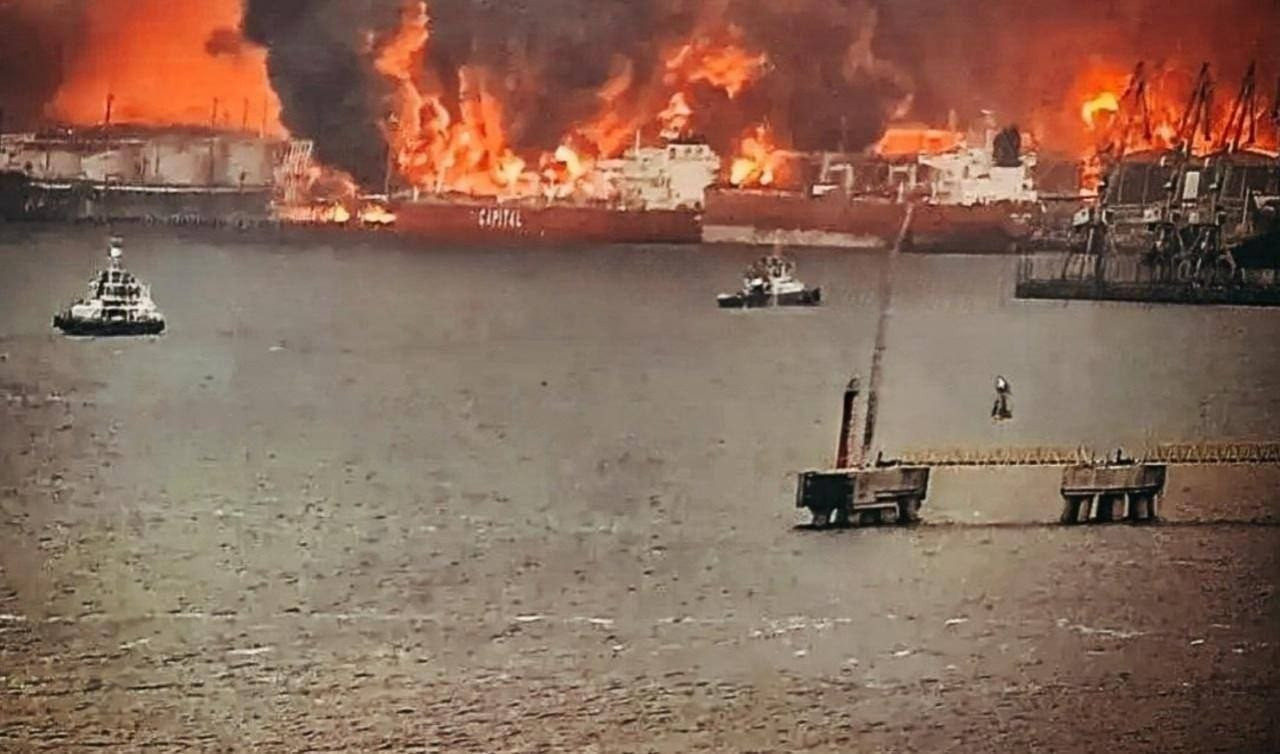
The attacks on both ports, which lie on opposite shores of the Gulf of Finland, caused serious damage. Let us start with Ust-Luga. According to Bloomberg, operations and the loading of oil onto tankers were suspended there after the attack.
Footage from the scene showed the Ukrainians hit not only the oil tanks, as in the case of Primorsk on Monday, but also the port itself and its loading facilities. There were also reports that they hit two tankers. This is well illustrated by the lead image in today’s update, which shows a large fire in the port.
The port was still burning on Thursday morning. “Novatek’s terminal has completely lost the ability to ship gas and oil products. All equipment was damaged. There were also at least three hits on the tanks of Ust-Luga Oil. The tanks are still burning. According to reports, two tankers that were being loaded at the time were also hit,” the Russian channel Romanov Lajt wrote.
Footage from the attack on Wednesday night
The port was still burning on Thursday morning
This was also confirmed by the NASA FIRMS website
It looks like the cloud cover eventually became thin enough for NASA FIRMS to finally detect an ongoing fire at the Ust-Luga port following a Ukrainian strike on March 25. pic.twitter.com/wshD8CXIl2
— Mark Krutov (@kromark) March 26, 2026
Monday’s attack on the oil terminal in Primorsk hit oil storage tanks; satellite images showed fires in six of them and at least four burned out completely. The Ukrainian account Dosye špiona wrote that, in addition, Ukrainians targeted berths 1, 2, 4, 8 and 9. “Fires broke out on oil tankers at berths No. 2 and 4,” it added.
The fire in Primorsk was so intense that, as satellite photos showed, its smoke spread 300km to the southeast. It was also visible in Finland.
The smoke plume from the fire at the Primorsk port oil depot after Ukrainian drones attack exceeds 220 km (!) and extends as far as Novgorod Oblast, according to the NASA Worldview image taken today. pic.twitter.com/JWn5wqRt8R
— Mark Krutov (@kromark) March 24, 2026
How significant is this? The oil export terminals of Primorsk and Ust-Luga are key to Russia’s westbound oil exports.
In 2025, Russia exported 216 million tonnes of crude oil. That corresponds to 4.3 million barrels per day.
According to Bloomberg, over the past month 450,000 barrels of oil per day passed through the port of Ust-Luga, accounting for around 10 percent of Russian exports. Its capacity is 700,000 barrels.
According to Ukrainska Pravda, an average of 932,000 barrels of oil per day and another 300,000 barrels of oil products passed through Primorsk last year.
This means that almost one-third of Russia’s exports went through these Baltic ports last year. If we add Druzhba (an estimated roughly 250,000 barrels per day last year), it may approach the mentioned 40 percent.
Russia exports most of its oil by sea on tankers. Ust-Luga and Primorsk account for 60 percent of Russia’s seaborne oil exports.
The oil pipelines towards Europe are currently completely shut down and, even before that, only part of Druzhba, running through Slovakia and Hungary, was still in operation.
Russia can replace these exports eastwards via oil pipelines to China or to the oil export terminal near Vladivostok. China takes one-quarter of the oil that passes through the now-blocked Strait of Hormuz, so it would need an alternative.
However, as Reuters wrote, these pipelines and terminals have limited capacity.
“The recent recapture of roughly 400 square kms (by the Ukrainians – editor’s note) was operationally insignificant; this, by contrast, was a Ukrainian strategic move,” Czech colonel Ivo Zelinka, commander of the 91st Information Warfare Group, wrote.
Map of Russian oil exports by Reuters
40% of russian 🇷🇺 oil exports are currently stopped after Ukraine 🇺🇦 attacked the Primorsk, Ust-Luga and Novorossiisk crude oil ports.
At the same time, the Druzhba pipeline remains closed and multiple refineries have been hit. This is a big blow to Russia.
🧵THREAD🧵1/15 ⬇️ pic.twitter.com/VMaBi6tH2Z
— Clément Molin (@clement_molin) March 25, 2026
Of course, we do not know how long these terminals will be out of operation. Ukrainians had already hit them last year.
But it is quite possible that the attacks will continue. According to Russian authorities, 389 Ukrainian drones flew towards Russia, and at least 56 were shot down over Leningrad region. According to the Russian news agency TASS, this was the highest number since March 2025.