
Javier Milei’s reforms to the law will open up high-altitude areas to mining and risk water reserves already strained by the climate crisis, say activistsSaul Zeballos was born and raised in Jáchal, a community tucked into the foothills of the Andes in Argentina, drinking water from the river that bears
 Natalie Alcoba in Buenos Aires



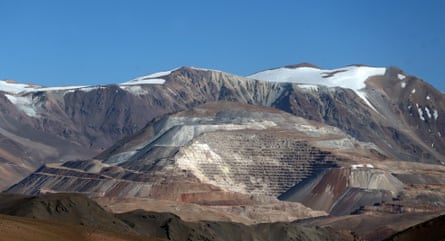
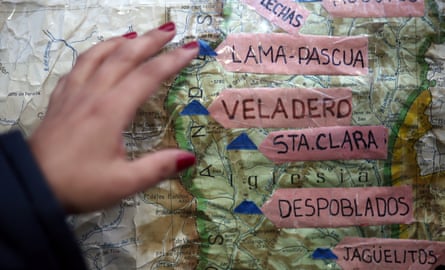
Saul Zeballos was born and raised in Jáchal, a community tucked into the foothills of the Andes in Argentina, drinking water from the river that bears the town’s name. That changed in 2005, when the Veladero gold and silver mine started operating in San Juan province.
A decade later, a major cyanide spill from the mine polluted the rivers in the San Juan region, raising fears it could affect waterways downstream in the Jáchal basin, although further studies have shown that cyanide levels remained at safe levels. Two further spills were reported in 2016 and 2017 and are still under investigation.
Environmentalists and community members such as Zeballos, a 51-year-old accountant turned activist, have long alleged that Veladero, owned by Canada-based Barrick Mining Corporation and China’s Shandong Gold, is operating illegally in an area considered off-limits by Argentina’s Ley de Glaciares – or glacier law.
Now, a reform to the glacier law driven by the far-right government of Javier Milei will relax restrictions, paving the way for mines in high-altitude areas blanketed with ice and snow, which are sources of water.
The new law, approved on Wednesday by 137 votes to 111, with three abstentions, will enable provincial authorities to decide which glaciers are protected and which are open for development based on whether they represent a “relevant water function”.
For Milei, the reform represents a crucial tool in his quest to attract more international investment, and cement Argentina’s position as a leading exporter of critical minerals amid global demand driven by the energy transition.
On Thursday, Milei celebrated the end of “ideological distortions and artificial obstacles that impede progress”. He said the original wording of the law was “confusing” and led to “absurd interpretations that prohibited mining even in areas where there was nothing to protect”.
Yet, according to campaigners, the reforms erode what many say is an important tenet in Argentina: a minimum environmental standard that applies equally across the entire country.
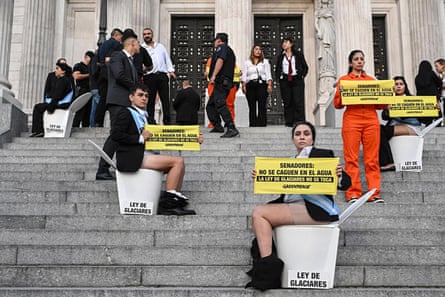
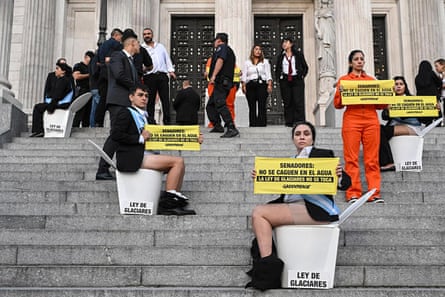
The reform has sparked a wave of protests. Greenpeace activists who staged a demonstration on the steps of the National Congress were detained in February, along with a TV camera operator, the day the reform was passed by the Senate, 40 votes to 31, with one abstention, before being approved by the Chamber of Deputies.
“What is at stake is the protection of key water reserves in Argentina,” says Andrés Nápoli, a lawyer and executive director of the Foundation of Environment and Natural Resources (Farn), an environmental and human rights NGO. “Saying that you have to destroy glaciers to guarantee the energy transition is an oxymoron.”
About 7 million people, 16% of the population in Argentina, live in areas that depend on glaciers, according to environmental organisations. Glaciers don’t just feed rivers; they balance fragile ecosystems hit hard by a heating planet. In Argentina’s northwest, scientists say they have shrunk by 17% in the past 10 years.
Argentina’s glacier law has been in effect since 2010, and was the first legislation in Latin America to protect glaciers. It has been a point of contention for mining companies and provincial authorities ever since.
The law bans “any activity” that can affect the “natural condition” of a glacier or the periglacial frozen land surrounding it, or that results in “its destruction, movement or interferes with its advance”.
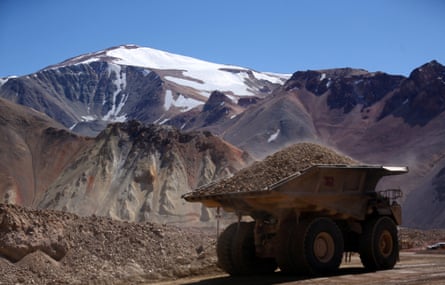
That includes the construction of infrastructure not for scientific purposes and any industrial activity. Mining companies, including Barrick, have previously sought to have the law deemed unconstitutional, but the supreme court rejected the challenge.
Barrick declined to comment. The company has previously stated that it is not in contravention of Argentina’s glacier protection law. A 2017 lawsuit brought against Argentine government officials over the 2015 spill alleged that they had failed to properly document glaciers in a national inventory, thereby allowing the mine to operate. The case has yet to go to trial.
Shandong Gold has yet to comment.
Meanwhile, governors of provinces rich in copper and lithium have continued to push for changes to the law, which they say is too broad and blocks major economic investments in areas without crucial water reserves.
“To pit mining against the environment is an error that has no relation to reality,” said Luis Lucero, Argentina’s mining secretary, during a committee hearing in December. “It’s a myth that we have to remove from public debate because it’s simply a mistake.”
Milei’s government has offered tax breaks and other incentives to attract large-scale mining and energy investments. In February, Vicuña Corp, a joint venture between Australian BHP and Canadian firm Lundin Mining, announced the largest investment to date: $18bn in two gold, copper and silver projects in San Juan province.
In March, Ron Hochstein, chief executive officer of Vicuña, said that while the company fully supports the reforms from an industry perspective, this is not a criterion for the project to advance.
“These changes will enable the regulatory authority, the provinces, to play a greater role in decision making,” he said. “They are the key stakeholders who would really be impacted by those decisions in terms of water sources, glaciers and investment.’
According to company sources, the Vicuña project will not affect the periglacial area known as GE-110, nor will there be any “intervention” by project equipment. The company is conducting a water study in the area.
Alfredo Vitaller, a geologist and member of the Chamber of Mining Companies, said Argentina has a “unique window of opportunity” with its vast deposits of the minerals essential to the energy transition.
Lucas Ruiz, a glaciologist at Argentina’s National Scientific and Technical Research Council (Conicet), says that while the proposed legislation would protect glaciers with significant reserves for human consumption, it doesn’t define what constitutes a significant reserve or how it would be determined.
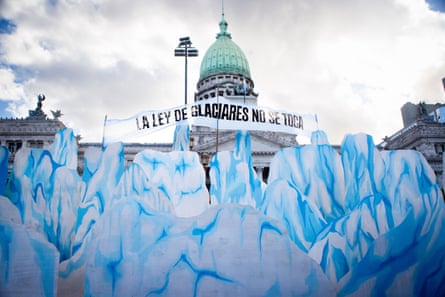
“It doesn’t take into account all the other roles that glaciers play,” he says, adding that some years the glacier may be a critical source of water for a community, and other years it may not, according to its dynamic. “We’re talking about an ecosystem in the high mountains where we need an integrated and holistic vision.”
According to Ruiz, the reform is not a technical discussion “around what is a glacier and what is not”. “It’s a political discussion around who defines what we protect and what we don’t. But that debate isn’t happening,” he says.
In Jáchal, the reform is about water and survival. “We know that if we don’t defend our water, we will have to leave,” says Zeballos, who has stopped drinking water from the river. “Or resign ourselves to being poisoned.”