
The idea of a fast-tracked Ukraine accession to the EU, as early as 2027, is gaining ground in Brussels. But urgency must not come at the expense of principle. The greater risk today is not moving too fast but moving halfway, warns the European Policy Centre.
 Janis A. Emmanouilidis



According to recent reporting, EU leaders are considering ways to bring Ukraine into the European Union as early as 2027 – before all technical accession requirements are formally completed.
The proposal, described in Brussels as “reverse enlargement”, reflects a growing conviction that Ukraine’s place in the EU can no longer be treated as a distant aspiration, but as a matter of geopolitical urgency.
This conviction is justified.
After four years of Russia’s full-scale war of aggression, Kyiv’s path into the EU is inseparable from Europe’s own security and credibility.
As argued in the report A Test of Times, published last year by the European Policy Centre (EPC), a faster EU accession for Ukraine — and other clearly committed candidates — is not only the right thing to do. It is the strategic response demanded by the uncertain and dangerous world Europeans are confronted with.
But urgency must not come at the expense of principle.
If “reverse enlargement” becomes the organising logic of the Union’s next enlargement, it risks solving one problem while quietly creating another.
The challenge is not whether to enlarge faster, but how to do so without undermining the meaning of EU membership and the European integration process itself.
In this context, three fundamental principles should guide Ukraine’s fast-track accession.
Second-class membership?
First, accelerated accession must not create second-class membership.
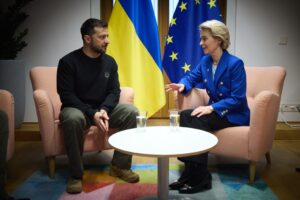
President Zelensky has been explicit that his country will not accept a permanent halfway status inside the Union — and he has the right to draw that line.
EU membership has always meant equality: equal rights, equal obligations, and an equal voice in shaping common decisions.
Any model that formally admits new members while limiting their influence, representation or participation risks turning membership into a multi-tier operation.
Temporary differentiation will be unavoidable during transition periods. But it must be clearly defined, strictly time-limited and (geo-)politically credible.
Europe has learned before that provisional arrangements tend to become permanent. But that must be avoided in this case. An EU that creates internal tiers would weaken its democratic foundations and fuel the perception that principles do not determine who truly belongs to the club.
Second, fast-tracking Ukraine must not become a limited, fig-leaf enlargement.
Sidelining Western Balkans and Moldova?
There is a real danger that the current debate will produce a bespoke solution for Ukraine while quietly sidelining other candidate countries. That would be a strategic and moral failure. Enlargement has been most successful when it remained open, predictable and grounded in shared rules – not when it became selective or opportunistic.
Countries across the Western Balkans as well as Moldova have invested years, often decades, in aligning with EU norms. Many have done so in difficult domestic and geopolitical conditions, precisely because they believed the promise of membership was real.
If they now conclude that accession depends less on reform and commitment than on geopolitical urgency, trust in the European project will erode even more.
Reverse enlargement, if pursued, must therefore remain open and scalable. It should allow other willing and capable candidates to advance as well, rather than closing the door behind Ukraine.
An enlargement that merely includes one country risks weakening the very stabilising force the EU claims to offer.
Third, a speedy enlargement process must go hand in hand with internal EU reform.
An EU of 30-plus members?
This needs to be a necessary part of the debate — even if many EU governments do not want to hear it. An EU of 30 or more members cannot function effectively on the basis of an operating system designed for a much smaller club. The Test of Times publication made this point bluntly: enlargement without reform risks paralysis; reform without enlargement risks irrelevance.
The solution is not to delay enlargement until the Union is ‘ready’. Nor is it to ignore institutional weaknesses in the name of urgency. Instead, the EU and its members must accept that enlargement and reform are inseparable processes.
A larger Union requires changes to how decisions are made, how budgets are equipped and allocated, and how collective action is organised, even if not all EU governments are always ready to progress ambitiously at the same point in time.
That does not mean completing a grand institutional overhaul before any new member joins. Reform can be gradual, pragmatic and politically anchored in the enlargement process itself.
Ukraine’s accession could and should serve as a catalyst for starting to adapt the Union’s operating system to the realities of an EU30+.
Some will argue that the EU is attempting too much at once: supporting Ukraine in war, enlarging the Union, and reforming its governance. But these times are historic and the EU has rarely advanced by waiting for perfect conditions. It has moved forward by responding to crises with political courage and decisive leadership.
The greater risk today is not moving too fast but moving halfway. A Europe that offers Ukraine symbolic inclusion without equality, or geopolitical reassurance without institutional adaptation, will disappoint both new and existing members and their citizens.
Ukraine’s path to the EU is a test — not only of its ability to adhere to Europe’s enlightened self-interest, but of its confidence in its own objectives, values and principles.
If enlargement is accelerated while membership or the Union itself is diluted, Europe will emerge weaker, not stronger.
But if the EU enlarges with openness, equality and a willingness to reform itself, pro-European liberal democratic forces can turn this moment of crisis into one of renewal.