

Eighty-five countries have sought a roadmap to phasing out fossil fuels. A conference this month offers hope they could uniteThis article is published as part of the global journalism collaboration Covering Climate NowThe Iran war is also a climate war. Beyond its terrible human costs, the war’s disruptions of oil,
 Mark Hertsgaard and Kyle Pope



The Iran war is also a climate war. Beyond its terrible human costs, the war’s disruptions of oil, gas, fertilizer and other shipments is another reminder of the risks inherent in basing the world economy on fossil fuels. The war’s jets, missiles and aircraft carriers, and the tankers, refineries and buildings they blow up, represent millions of tons of greenhouse gas emissions that further imperil a climate system that is already “very close” to a point of no return, scientists say, after which runaway global warming could not be stopped. Nevertheless, petrostate leaders around the world continue doing their utmost to stave off a desperately needed course correction.
Now, a little noticed ray of hope may be peeking over the horizon.
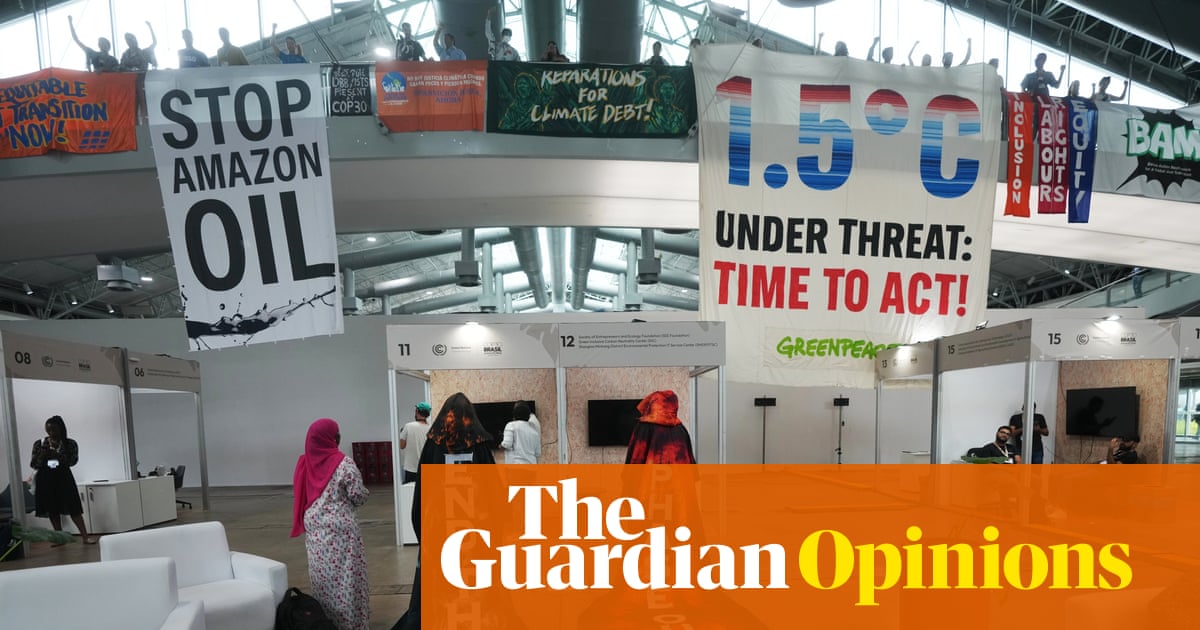
At the UN Cop30 climate summit last November, Saudi Arabia led a group of petrostates in vetoing calls to develop a “roadmap” to phase out fossil fuels globally; indeed, the words “fossil fuels” were not even mentioned in the final text agreed at Cop30. But the 85 countries on the losing end of that veto may soon turn the tables.
Many of those governments will gather in Colombia on 28-29 April for a conference to begin a global transition away from oil, gas and coal. Critically, the First International Conference on the Just Transition Away from Fossil Fuels will not be governed by UN rules, which require consensus, but by majority rule, thus preventing a handful of countries from sabotaging progress as petrostates did at Cop30. What’s more, the underlying terrain of this conference will no longer be principally politics, but economics: not the words that canny negotiators can keep in or out of a diplomatic text, but the implacable market forces that shape the world economy, including the potential emergence of a de facto economic superpower.
The conference is co-sponsored by Colombia and the Netherlands, a pairing rich with symbolism: Colombia is the world’s fifth-largest coal exporter, Royal Dutch Shell one of the world’s biggest oil companies. Conference organizers confirm that they have invited countries that endorsed the roadmap proposal at Cop30, as well as high-profile leaders of sub-national governments, including the California governor, Gavin Newsom, a presumed 2028 US presidential candidate.
The conference aims to begin drawing up the roadmap blocked at Cop30. Energy and environment ministers of governments comprising a “coalition of the willing” will share plans to transition their economies away from oil, gas and coal without leaving workers and communities behind. Joining them will be climate activists, leaders of Indigenous peoples, trade union representatives and other civil society voices, sharing ideas and experiences on how to make the abstract goal of phasing out fossil fuels a practical reality.
The goal of the conference is to agree on “actionable solutions” that follow-up meetings can refine so governments around the world can implement them. One area of focus will be how to phase out the $7tn a year governments spend subsidizing fossil fuels – but to do so without punishing communities, workers and tax bases that rely on such subsidies. The UN secretary general, António Guterres, has urged the International Energy Agency to help create a “global platform” where public and private sector actors can “sequence the decline of fossil fuel investment with the rapid scale-up of clean energy”.
The secret weapon of the “coalition of the willing” gathering in Colombia is its potential to function as an economic superpower.
At least 85 countries at Cop30 backed developing a roadmap to phase out fossil fuels. Included among them were the global north powers Germany, the United Kingdom, France and Spain – the world’s third, sixth, seventh and 12th biggest economies. The major global south countries Brazil and Mexico, the world’s 10th and 13th biggest economies, also backed the measure.
Combine the gross national products of those 85 countries and the total is $33.3tn. That’s larger than the $30.6tn GNP of the US, the world’s biggest economy, and considerably larger than the $19.4tn GNP of China, the world’s second-biggest economy.
That amount of economic heft gives those 85 countries enormous potential leverage. If those attending the Just Transition conference can outline a credible roadmap for phasing out fossil fuels for the wider group to unite behind, it could send shock waves through financial markets, government ministries and C-suites around the world. “A coalition of that scale signaling its intent to move beyond fossil fuels would send an unmistakable message that the age of oil, gas, and coal is ending, and the smart money is shifting,” Mohamed Adow, director of the non-profit Power Shift Africa, said in an interview.
Money follows money. If a huge chunk of the global economy announces that it intends to leave fossil fuels behind – and releases transparent, convincing plans for doing so – private investors and government planners everywhere would have to question whether sinking new money into oil exploration, coal mining, or gas terminals makes financial sense or would instead leave them with virtually worthless stranded assets.
Much the same thing happened after the 2015 Paris agreement. When governments pledged to limit temperature rise to “well below” 2C and to aim for 1.5C, public and private sector leaders began changing course. Fossil fuel expansions were scaled back, renewable energy investments boosted. Before the Paris agreement, the planet was on track toward a hellish 4C of temperature rise. Five years later, the emissions curve had bent to a 2.7C future – still much too high, but a big step in the right direction, and proof that change is possible.
The scales could tilt even further if California joins the “coalition of the willing”. Adding California’s $4.1tn GDP to the $33.3tn of the 85 countries that backed a roadmap at Cop30 – and subtracting that $4.1tn from the rest of the US economy – yields an economic superpower worth $37.4tn, not far behind the $50tn combined GDP of the US and China.
Newsom has given every indication he supports phasing out fossil fuels and wants to be seen as a global climate leader. “Don’t let what happens in Washington DC, shape your perception of my country,” he told a packed press conference at Cop30. Newsom noted that during his years as governor, California had grown from the world’s sixth to its fourth largest economy even as two-thirds of the state’s electricity came from non-carbon sources. Calling Donald Trump’s withdrawal of the US from the Paris agreement “an abomination”, Newsom vowed that California “will fill that void” by competing for the global market in green technologies.
The Just Transition conference underscores a point often missed in the usual narrative on climate change: the overwhelming majority of the world’s people – 80-89% of them – want their governments to take stronger climate action. Scientists have long been clear that phasing out fossil fuels is imperative to limit global warming to an amount our civilization can survive. This conference is an opportunity to flip the narrative and begin that urgent task.
Mark Hertsgaard and Kyle Pope are co-founders of the global journalism collaboration Covering Climate Now