
Russia’s full-scale war against Ukraine shows how the continent has not yet solved the problem of what order comes after imperial collapse
 Hugo Blewett-Mundy



Some 110 years on from the Battle of Verdun in 1916, it is hard to underestimate the magnitude of the tragedy that World War I inflicted on Europe, sowing the seeds of today’s Russo-Ukrainian war.
Not only did the conflict claim the lives of a generation in a bitter stalemate, but it also created a power vacuum out of the demise of four empires, Germany, Austria-Hungary, Ottoman Turkey and Tsarist Russia, into which violent ideologies filled.
In western Europe, German resentment towards the terms of the Treaty of Versailles of 1919, combined with economic collapse, created the political conditions for national socialism.
Hitler came to power intending to reverse Germany’s territorial losses and wage a genocidal war to create ‘living space’ for the German people. The result of Hitler’s actions was a level of destruction and human suffering on an unbearable scale.
In a continent reduced to death and rubble, postwar Germany and France committed themselves to freeing their populations from the perils of nationalism.
The European project was born, which made another war between the western European powers inconceivable. The photograph of French and German leaders Francois Mitterrand and Helmut Kohl in 1984, clasping their hands in commemoration of the fallen at Verdun, became a powerful symbol of Franco-German reconciliation.
From imperial collapse to ideological extremes
But the fallout from World War I still plagues the politics on the eastern side of the German river Oder.
The Treaty of Westphalia of 1648, which established a regulated system of sovereign states, made it relatively straightforward for western Europe to accept the loss of imperial status. It was a different story in the east. In a region dominated by empires, the concept of the nation as an expression of popular sovereignty was undermined.
The fall of the four great European powers in WWI unleashed a chaotic process of nation-building that sowed the seeds of the Russo-Ukrainian war today.
A window existed to construct a post-imperial Russian identity when tsardom was overthrown in 1917. But this was derailed by Lenin’s seizure of power.
An autocracy built on wars of conquest was simply replaced with another in the form of Bolshevism.
In the Russian civil war (1917-22), Lenin authorised a wave of violence to suppress his opponents and used external aggression to spread his revolution.
He reconstituted all the lands of the former Russian empire into the Soviet Union – except Poland, Finland and the Baltic states, which secured their independence.
Lenin’s defeat in the Polish-Soviet war (1919-20) crystallised the Kremlin’s paranoia that Russia was surrounded by hostile ‘anti-revolutionary’ powers.
Russia’s unresolved imperial legacy
Stalin sought to reassert Soviet control by employing a cynical campaign of terror and suppression. He engineered a famine that killed at least 4 million Ukrainians in the space of just two years (1932-33).
It was an act of unparalleled brutality that attempted to ‘Russify’ Ukraine and make it impossible for an independent Ukrainian nation to exist.
In 1939, Stalin signed a pact with his ideological enemy Nazi Germany to dismember Poland and annex the Baltic states.
Stalinist totalitarianism was presented with an opportunity to legitimise itself when Hitler invaded the Soviet Union in 1941. The existential threat of fascism galvanised the multi-ethnic and oppressed Soviet population to fight a ‘Great Patriotic War’ (1941-45) and ‘liberate’ the European continent from ‘the German-fascist yoke’.
The truth was that the Red Army committed unspeakable atrocities and communist rule was imposed on the states of central and eastern Europe.
But the crimes of Soviet occupation were never held to account in an international criminal trial, as the Nazi horrors were in Nuremberg.
Instead, Stalin’s legacy has become the organising principle of post-Soviet Russian society and influenced how Russia sees itself in the world.
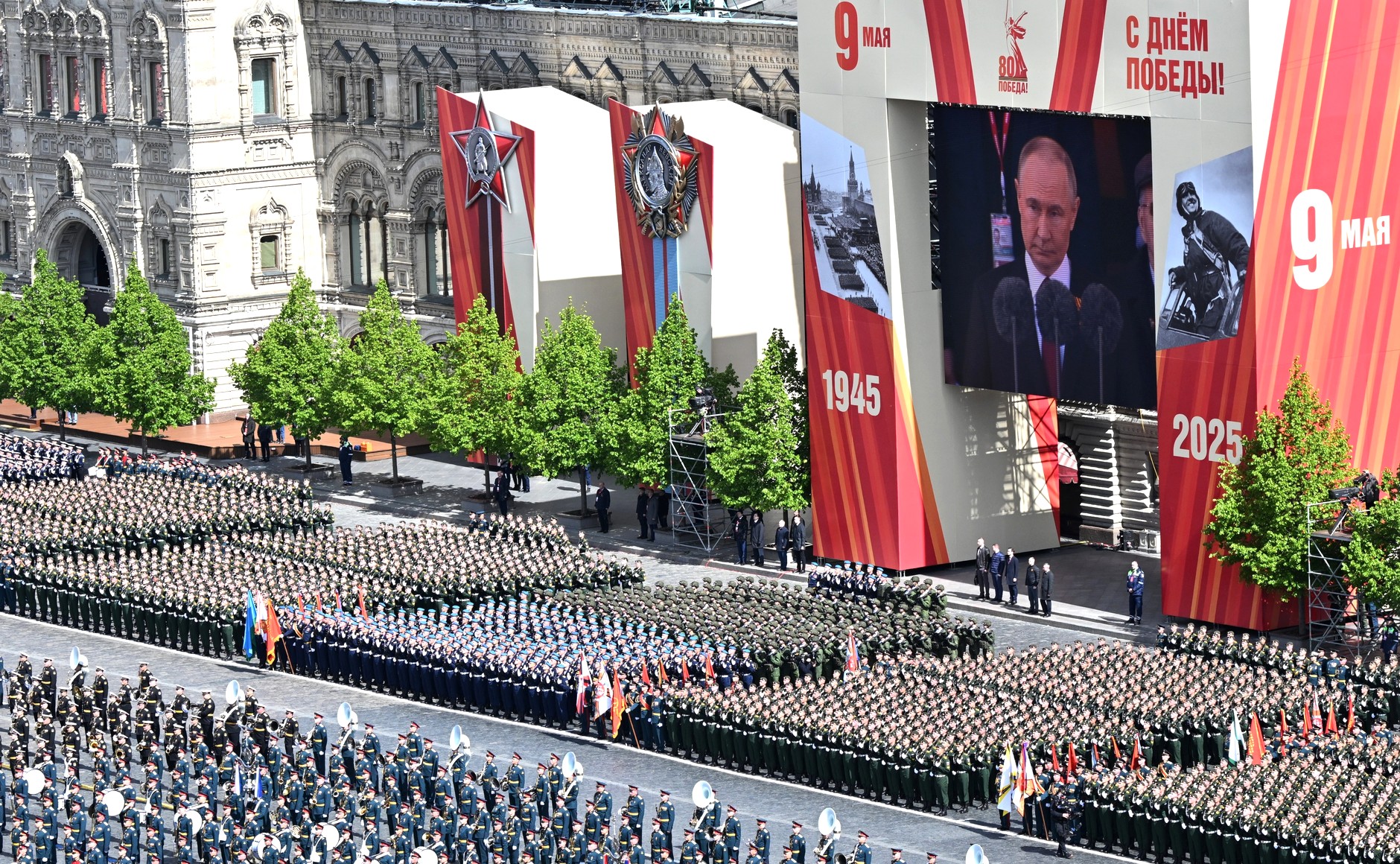
At the annual Victory Day parade in Red Square, Russian president Vladimir Putin justifies his all-out invasion of Ukraine in 2022 by invoking the sacrifice that millions of Russians made to defeat the Third Reich.
Ukraine’s resistance is falsely portrayed as a Western-backed neo-fascist plot to weaken and ultimately destroy Russia.
It took the overwhelming loss of life in two world wars for Germany and France to find a way to build a peaceful future.
Russia’s war against Ukraine will not come to an end until a complete Ukrainian victory on the battlefield forces the Russians to reckon with their colonial criminality. But as the conflict drags on into its fifth year, the quest for a Europe free from wars of conquest is still in doubt.
Russia has failed to achieve its aims in Ukraine, but the Ukrainians are under increasing pressure to compromise with Moscow and Nato’s cohesion faces hybrid Russian warfare that involves sabotage, disinformation, and cyber attacks.
China’s purchasing of Russian oil and gas is also keeping Putin’s war machine afloat.
How European leaders respond and continue to support Ukraine in the months and years ahead will decide the continent’s trajectory.