
In the first week of Hashim Thaci’s trial for obstruction of justice, the prosecution alleged at the Hague court that the former Kosovo president attempted to influence witnesses during his now-concluded trial for war crimes.
 Xhorxhina Bami



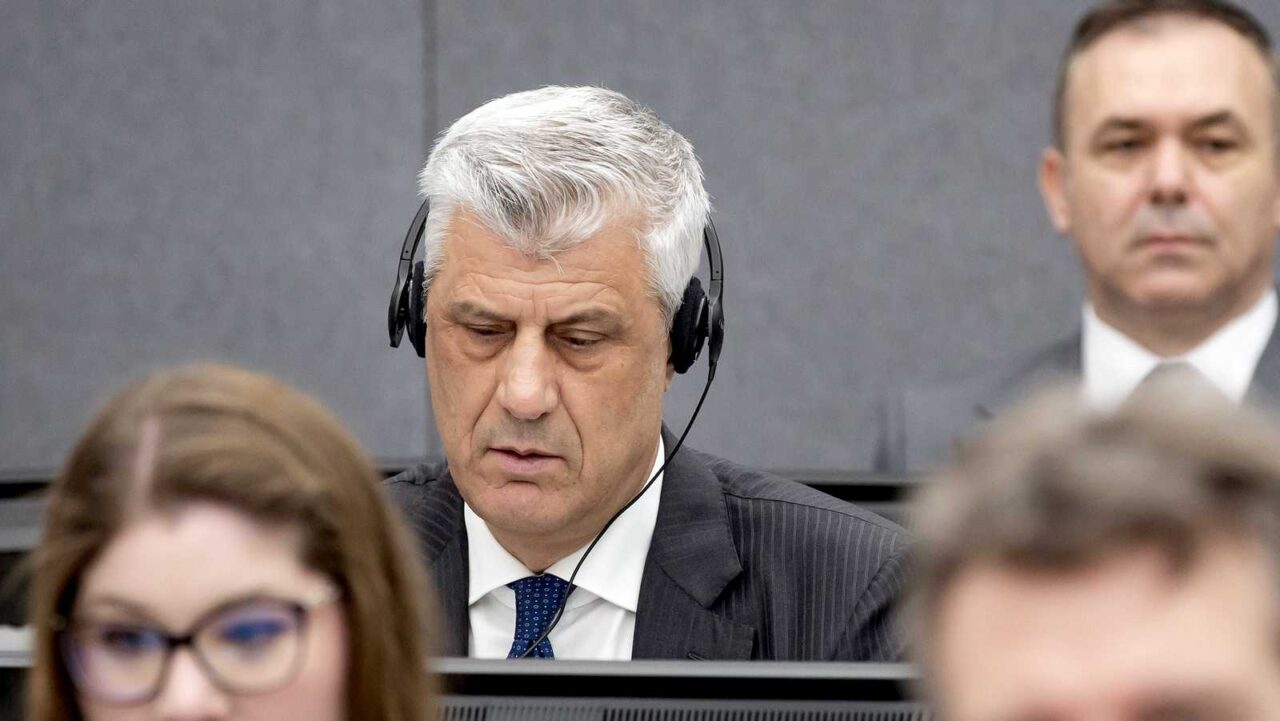
Former Kosovo president Hashim Thaci in court in The Hague, April 2023. Photo: EPA/Koen van Weel/Pool.
During the first week of the trial of former Kosovo President Hashim Thaci and four others at the Kosovo Specialist Chambers in The Hague, the prosecution claimed that the defendants had attempted to interfere with witnesses in the now-finished war-crimes trial of Thaci and three other ex-guerrillas.
The prosecution claims that Thaci told the other four defendants to give instructions to certain witnesses in the war crimes case about to what to say in court.
Thaci and his four-co-accused – Kosovo’s former justice minister Hajredin Kuci, Isni Kilaj, Bashkim Smakaj and Fadil Fazliu – have denied any wrongdoing.
During opening statements, prosecutor Joshua Hafetz claimed that a letter found at Kilaj’s residence proved witness-tampering.
Hafetz said that when the prosecution carried out a court-authorised search at Kilaj’s residence in Kosovo in November 2023, less than a month after defendants Kryeziu and Kilaj met Thaci, it found torn pieces of paper from a trash bag that had been left at the entrance.
“Forensic experts reconstructed those torn pieces of paper, and the results show that Kilaj had torn up and thrown into the trash not random scraps of paper, but torn pages of two prior confidential statements of [protected] Witness Four [in the war crimes trial]… The portion of the document found at Kilaj’s residence is the same section that Thaci said the witness needed to change,” Hafetz said.
Hafetz argued that “Thaci made very clear [to the other defendants] what message he intended to convey [in court]”.
The prosecution claims that Thaci also tried to influence former Kosovo Liberation Army fighters Bislim Zyrapi and Rrustem Mustafa, who were testifying in his war crimes case. The testimony of both was favourable to Thaci’s defence.
In his testimony in 2023, Mustafa, a former KLA area commander, claimed that the KLA zone commanders made operational decisions, not the guerrilla force’s General Staff. He said the KLA’s leaders, who included Thaci, did not have control over lower-ranking fighters – testimony that bolstered the defence’s case.
Zyrapi, the former chief of the KLA’s General Staff, gave testimony in 2024. During defence questioning, he said the General Staff often was not informed of the actions of fighters in the KLA’s operational zones and that, despite attempts, it had not been possible for the KLA to fully exercise control over its lower-level units, partly because of Serbian offensives.
In Thaci’s trial for war crimes and crimes against humanity, he and his co-defendants Kadri Veseli, Jakup Krasniqi and Rexhep Selimi also denied wrongdoing. That trial ended on February 18 and a verdict is expected within 90 days.
The Kosovo Specialist Chambers was created specifically to try former members of the KLA; it is located in The Hague and staffed by international judges and prosecutors due to doubts about the Kosovo justice system’s own ability to try former KLA fighters, many of whom are considered heroes in Kosovo.