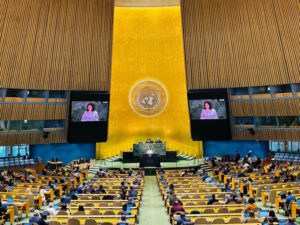
Independent polls favoured Magyar in the final stage of the campaign, but the result may be different due the number of undecided voters.
 Mirek Tóda



At 6AM, polling stations opened in Hungary and its high-stakes parliamentary elections began. Voters will decide whether, after 16 years of an increasingly authoritarian government, prime minister Viktor Orbán and his rightwing party, Fidesz, will stay in power, or the leader of the centre-right Tisza opposition party, Péter Magyar, will topple his regime.
Independent polls favoured Magyar even in the final stage of the campaign and predicted a comfortable majority. However, the result may be different, not least because of the number of undecided voters.
We look at:
how many seats Tisza needs in order to change the balance of power in the country and bring Hungary closer to the EU; how the polls have developed and whether they predicted the last elections correctly; what Hungarian observers fear the most; which constituencies to watch; how Hungarians abroad vote; when the election results are expected; and six possible post-election scenarios. The most important maths
According to calculations by the Medián agency, Magyar’s party has a chance to win between 138 and 143 seats out of a total of 199, which would give it a comfortable two-thirds majority. In this scenario, Fidesz would drop to between 49 and 55 seats.
Such a constitutional majority (Tisza needs at least 138 MPs to achieve it) is a basic precondition for the country to undergo real change and for Hungary to return to a pro‑Western course and respect for fundamental European values and democratic rules, over which Budapest lost part of its EU funds.
The latest Medián poll:
Tisza: 48%
Fidesz: 30%
Mi Hazánk: 4%
Source: HVG
How have the polls evolved?
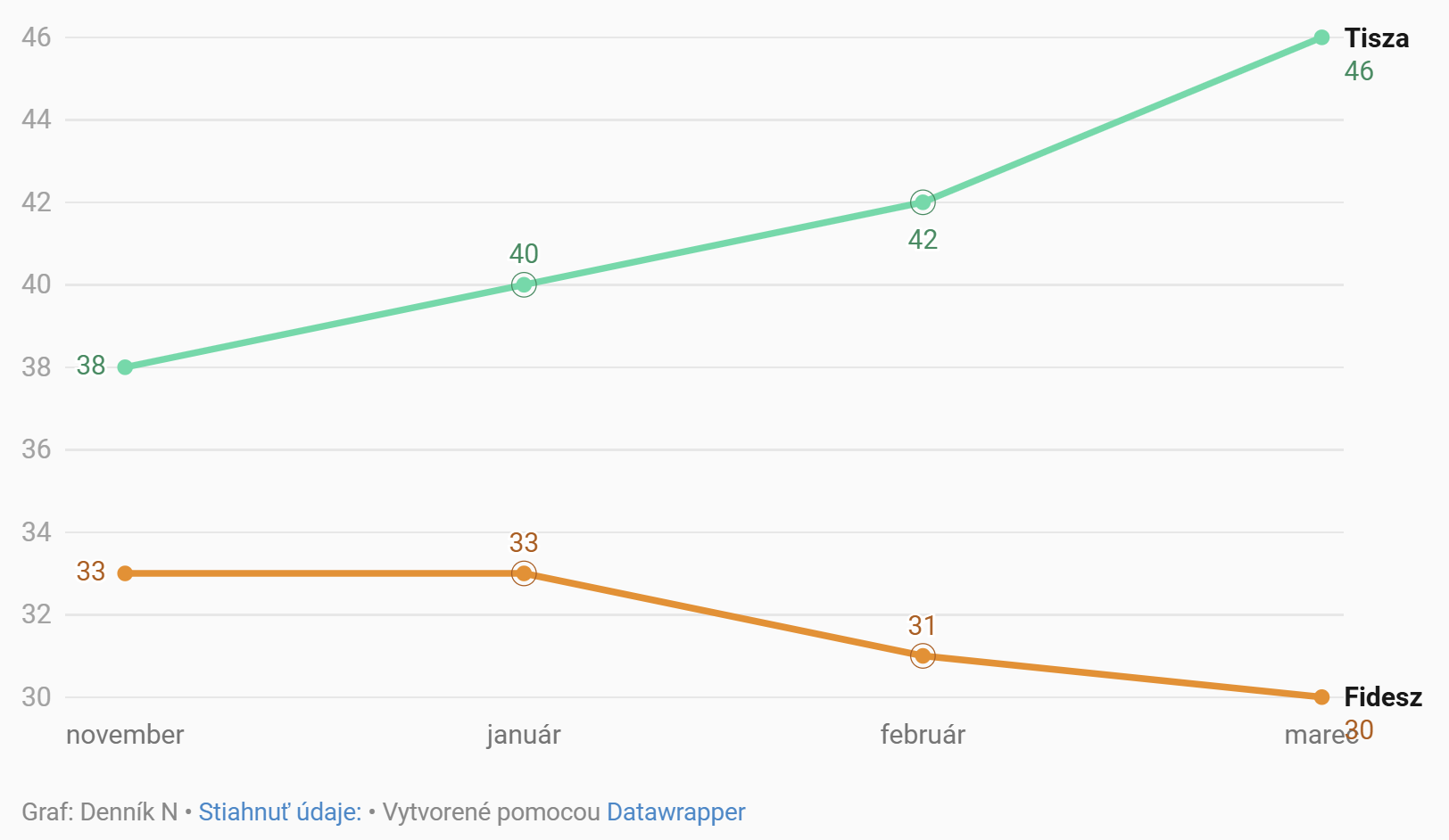
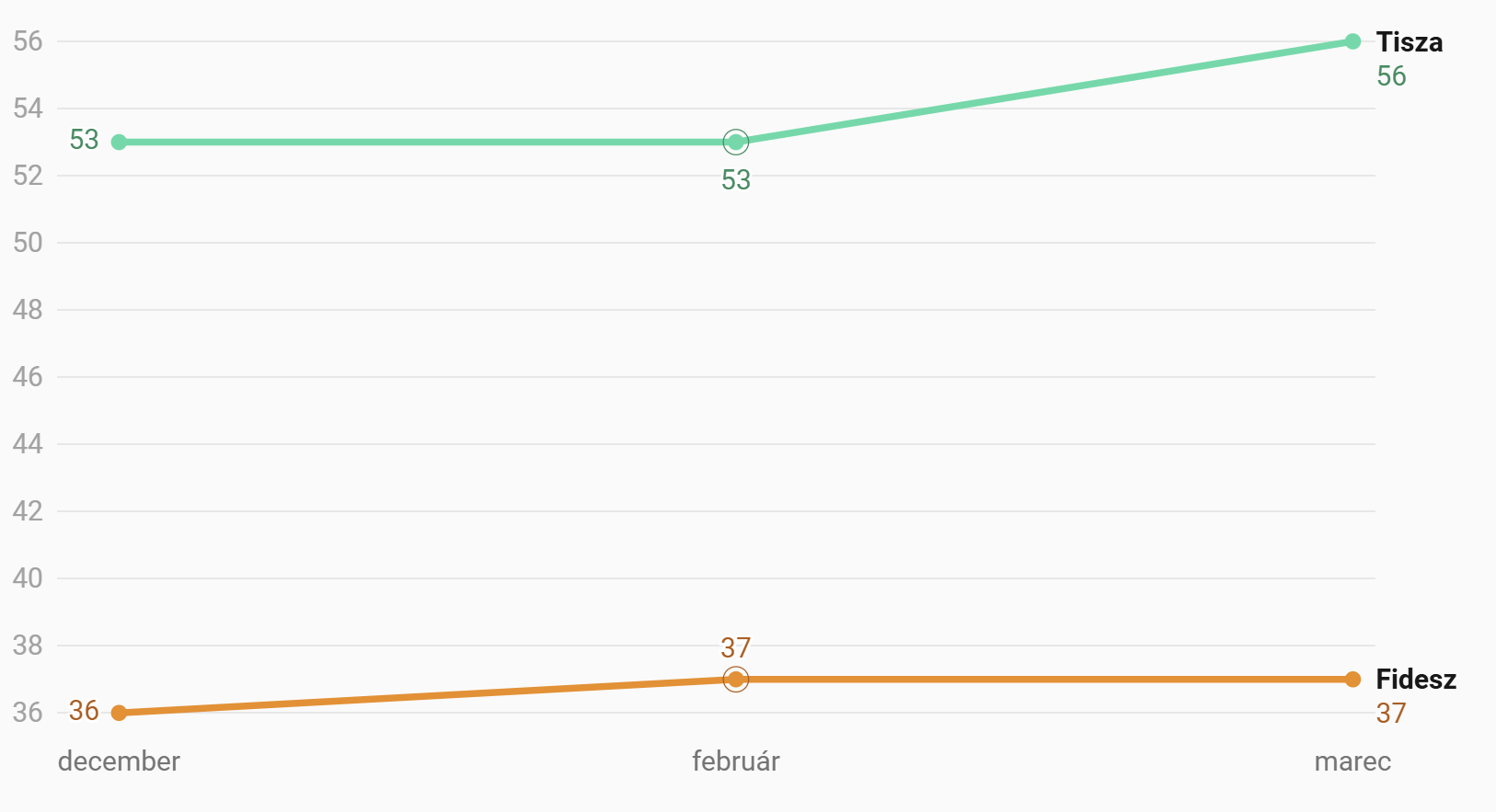
In recent months, support for the two strongest parties has not fundamentally changed in the polls. The two most accurate agencies – Medián and 21 Kutatóközpont – showed that Tisza’s lead was increasing slightly.
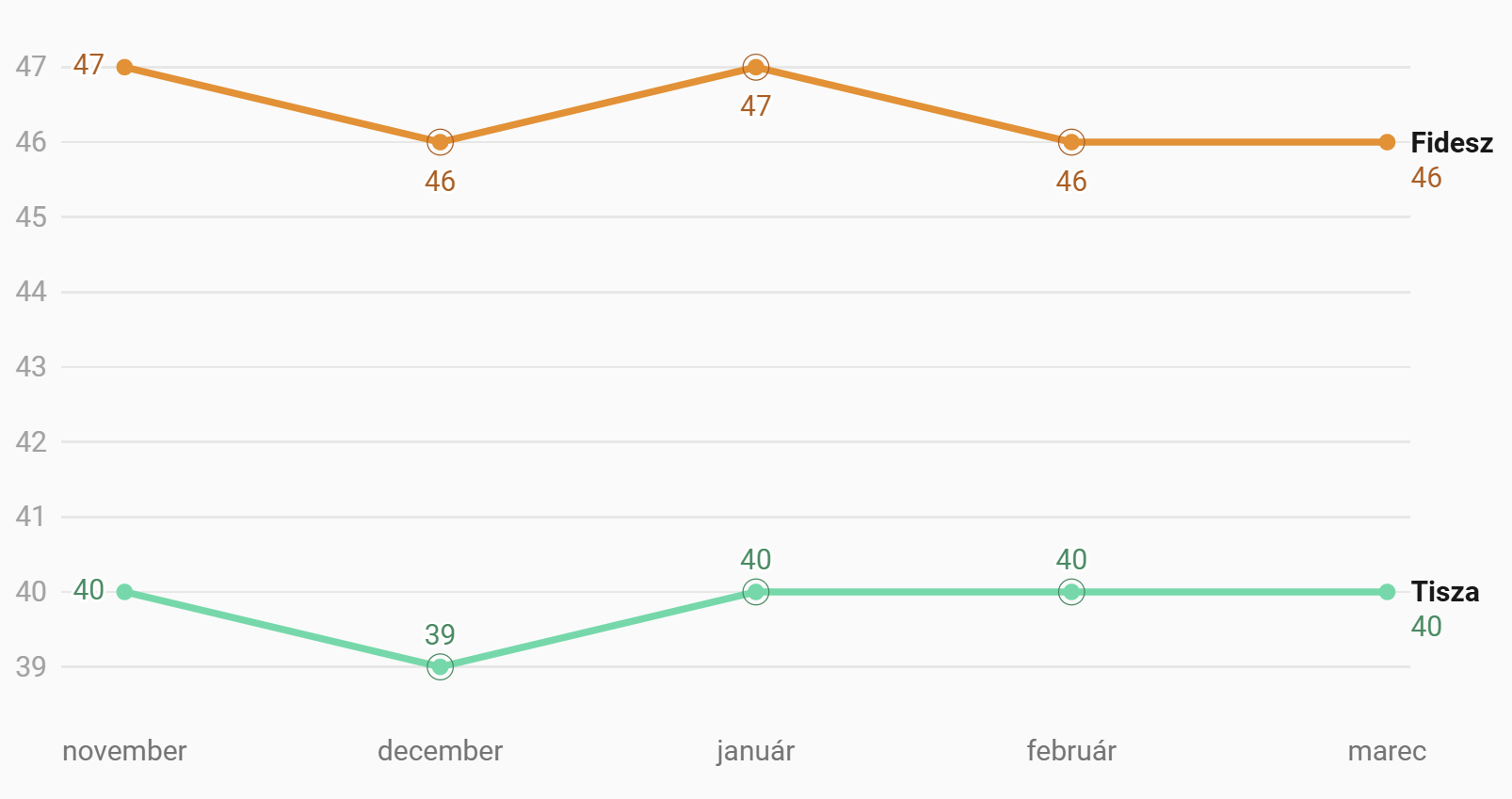
However, there are also pro-government agencies operating in Hungary that have shown radically different polling results. The best known is the Nézőpont agency, whose polls consistently had Fidesz in the lead. In the past, such large gaps between the figures of independent and pro-government agencies did not exist.
The parties themselves approach the polls differently. Tisza takes the figures of independent agencies seriously, but Orbán said he did not trust them and worked with his own numbers. In recent months, however, independent media reported that even in Fidesz’s internal polls, Tisza was in the lead.
Support of Tisza and Fidesz – Median Support of Tisza and Fidesz – Kutatóközpont
Support of Tisza and Fidesz – Nézőpont
How many undecided voters are there? A lot. As many as around 15 percent in the Medián poll did not know or did not want to say how they would vote. That is why the election results may be completely different from the polls.
How did polls estimate the results in the last elections?
In 2022, all relevant agencies had been showing a clear Fidesz victory for months before the elections. In the last Medián poll in March 2022, Fidesz stood at 50 percent and the then opposition at 40 percent. The final election result was 52 percent for Fidesz and 36 percent for the opposition.
Who else could play a decisive role?
It will also be important to watch whether the extreme far-right party Mi Hazánk (Our Homeland) makes it into parliament. It had 4 percent in the last 2026 poll, which would not be enough to gain seats. Its entry into parliament would suit Fidesz, which is closer to the extremists.

This party was founded in 2018, when László Toroczkai and other MPs left the Jobbik party, accusing it of abandoning its radical line. In 2022, with roughly 6–7 percent of the vote, it became the third strongest force in parliament (7 seats).
It is considered the most radical nationalist party in Hungary since the Second World War.
What are Hungarian observers afraid of?
Are there concerns that the elections will not be free and fair? Yes, and not insignificant ones.
As the Hungarian think-tank Political Capital explained, although voters are generally expected to cast their ballots freely, Hungary has long been moving towards elections in which a level playing field is absent. This is for several reasons:
The country has not experienced a fully open election campaign for 20 years, and the system continues to favour the ruling party. The main distortions occur even before election day, through media dominance and the use of virtually unlimited financial resources and state institutions for campaign purposes. The situation is further aggravated by targeted actions against opponents (even by state authorities) and disinformation campaigns, as was particularly evident in the biggest scandal of the election campaign – the attempt to monitor and disrupt the Tisza party from within using the secret service. Vote-buying and organised mobilisation may influence the election results.
For his part, Hungarian analyst Botond Feledy is concerned about possible electoral manipulation. He considers reports of vote-buying to be one of the most important things to watch. “Groups of many volunteers are now flocking to areas where vote-buying is a threat. The situation could escalate into violence or other unrest,” he warned.

He also said it would be important to see whether there were signs of organised interference in the electoral process, such as the coordinated transport of people to polling stations.
According to Feledy, the outcome of the elections will be decided in constituencies where the result is uncertain, so all attention will be focused there. However, he added that, for Slovak readers, the counting of votes from abroad would also be very interesting. You can find a list of the most interesting places to watch below.
When will we know the results?
Polling stations will close at 7PM and the first partial results should be known by around 8PM. The processing of results in Hungary is usually relatively quick.
In the last elections in 2022, we already knew the winner at around 11PM in the evening.
Those Hungarian citizens who have permanent residence in Hungary are allowed to vote abroad at diplomatic missions.
The votes cast at diplomatic missions will arrive only in the days after the ballot; on 17 April the election office will forward them to the constituencies, where they will be counted a day or two later.
That means we will not know the final result until 18 April.
During election night, about 95 to 97 percent of the votes will be processed. So if the race is very tight, it may happen that we will not know the winner until the following Saturday.
How do Hungarians abroad vote?
Since 2014, members of Hungarian minorities living in neighbouring countries who also hold Hungarian citizenship have had the right to vote in Hungarian elections.
We have information on their numbers from the register of the Hungarian election office.
We do not have exact figures on how many dual citizens of Slovakia and Hungary will take part in the elections. From the three countries that do not recognise dual citizenship, 38,446 people have registered, but we do not know how many of them are from Ukraine, Austria, and Slovakia.
Most dual citizens registered from Romania (311,739) and Serbia (86,168).
In 2022, 94 percent of minority Hungarians abroad supported Fidesz, but this did not give the ruling party a single extra seat. In the case of a close result, however, these votes could be important for Fidesz. In 2014, for example, it was precisely thanks to the votes of minority Hungarians that Orbán gained a constitutional majority.
How does the Hungarian electoral system work?
It is a complex, mixed system, and each voter has two votes. With the first, they vote for a specific person in their constituency, with the second they choose a political party. As many as 106 members of parliament are elected in single-member constituencies, and the remaining 93 are elected proportionally in a nationwide constituency.
In the Hungarian system, what matters above all is winning in the constituencies. Fidesz has long dominated there.
In addition, the system includes so‑called surplus votes. These are calculated as the difference between the number of votes for the winner and the runner-up, plus one. Only the votes needed to beat the runner-up are considered ‘used’. Everything above that is surplus, or unused, and is carried over into the proportional tier.
The larger the gap between the winner and the runner-up, the more votes the winner carries over. In other words: the more fragmented the opposition is, the more the party of the winning candidate benefits.
You can find an explanatory article on the Hungarian electoral system here.
Which towns are worth watching?
According to most analysts, the outcome of the elections will be decided in the 106 single-member constituencies. For Tisza to defeat Fidesz, it will need to win at least half of these seats. Last time, Fidesz took 87 out of 106 mandates and the opposition only 19.
Tisza’s victory now looks relatively certain in 16 constituencies in Budapest and in around 10 constituencies in larger towns such as Szeged, Pécs, Nyíregyháza, Tatabánya, and Szombathely.
Several analysts agree that the most interesting swing constituencies will be Győr and its agglomeration, Szekszárd, Orosháza (the area around Békéscsaba), Kecskemét, Salgótarján, Balatonfüred, and Debrecen.
If Tisza wins in more of these places, it could indicate an opposition victory.
Tisza’s good chances are suggested by the fact that, in some of these places, Magyar’s supporters have turned out in large numbers for his rallies. An example was the rally in Győr.
How will it end? Six possible post-election scenarios
The Hungarian think-tank Political Capital, in its study, analyses several possible post-election scenarios. We have ordered them according to the latest trend in the polls by the independent agency Medián, which predicted a clear victory for Tisza.
Two-thirds constitutional majority for Tisza
If Hungary aspires to real change and a genuine break with Orbán’s regime, it needs this scenario. Tisza must have a two-thirds majority in order to push through fundamental institutional reform. It is also an essential precondition for making key institutions work so that they do not serve only Orbán’s elite.
However, as Political Capital wrote, the pace of change also depends on whether current office-holders step down.
According to analysts, rapid change could generate high expectations that might be difficult to meet. In foreign policy, Hungary would move towards better relations with the West and the EU. Magyar promised a repayment of EU funds and a departure from Orbán’s pro-Russian policy.
A strong majority for Tisza
Although a strong majority would allow Tisza to implement significant changes, it would still not be a sufficient mandate for deep institutional reform, according to Political Capital. The current system would continue to constrain the government, and it would not be possible to replace entrenched pro-Orbán office-holders.
Analysts predicted that in such a case the political dynamic would remain tense and polarisation would not ease. However, improved expectations among economic actors could, according to the think-tank, create more favourable economic conditions than under a continued Fidesz government. “Foreign policy would mean a reorientation towards the West, but meeting the conditions for access to EU funds could be more challenging,” Political Capital wrote.
A narrow majority for Tisza
This would be the most problematic scenario in the event of a Tisza victory. It would amount to an unstable and fragile government. Orbán and his team could question the results and escalate political tensions. “Institutions would likely resist change and exert constant pressure on the government. This would limit governing and could lead to early elections,” the analysts predicted.
It would also complicate a return to a pro-Western orientation.
No clear winner (deadlock)
If neither side is able to form a stable government, the extremist party Mi Hazánk would become the kingmaker.
“The formation of coalitions would be uncertain and protracted. Even if a government were formed, it would probably be weak and unstable, facing constant pressure,” Political Capital wrote.
A narrow majority for Fidesz
This scenario also cannot be ruled out, given the high number of undecided voters and an electoral system advantageous to Fidesz. “A narrow Fidesz majority would lead to a new and uncertain political situation, with a fragile balance of power and increased pressure from the opposition,” Political Capital predicted.
Uncertainty could be heightened if Fidesz gained a parliamentary majority despite losing the vote on party lists. “Polarisation would deepen, which could lead to long-term political confrontation and the risk of unrest. Economic pressure, including austerity measures, could further destabilise the government,” the analysts wrote.
Foreign policy would not change fundamentally, and Hungary would “miss the chance to move closer to the main European states, while its rapprochement with Russia would continue”.
In this unstable political situation, the think-tank considered it likely that the Kremlin would support Orbán’s government in its efforts to retain power.
A strong majority for Fidesz
A less likely scenario that assumes a clear victory, but without a constitutional majority. Fidesz would comfortably maintain its dominant position. “In combination with support from Mi Hazánk, this could lead to further radicalisation of the political system,” Political Capital said. Opposition actors would remain weak, and foreign policy tied to Moscow would not change. “Hungary would continue to move closer to Russia and further away from the EU and Nato,” Political Capital said.
Source: Political Capital