
A rare, unscripted moment pierced Hungary’s tightly controlled political landscape on election day, when I found myself face-to-face with a senior Orbán minister in a polling queue.
 Veronika Munk



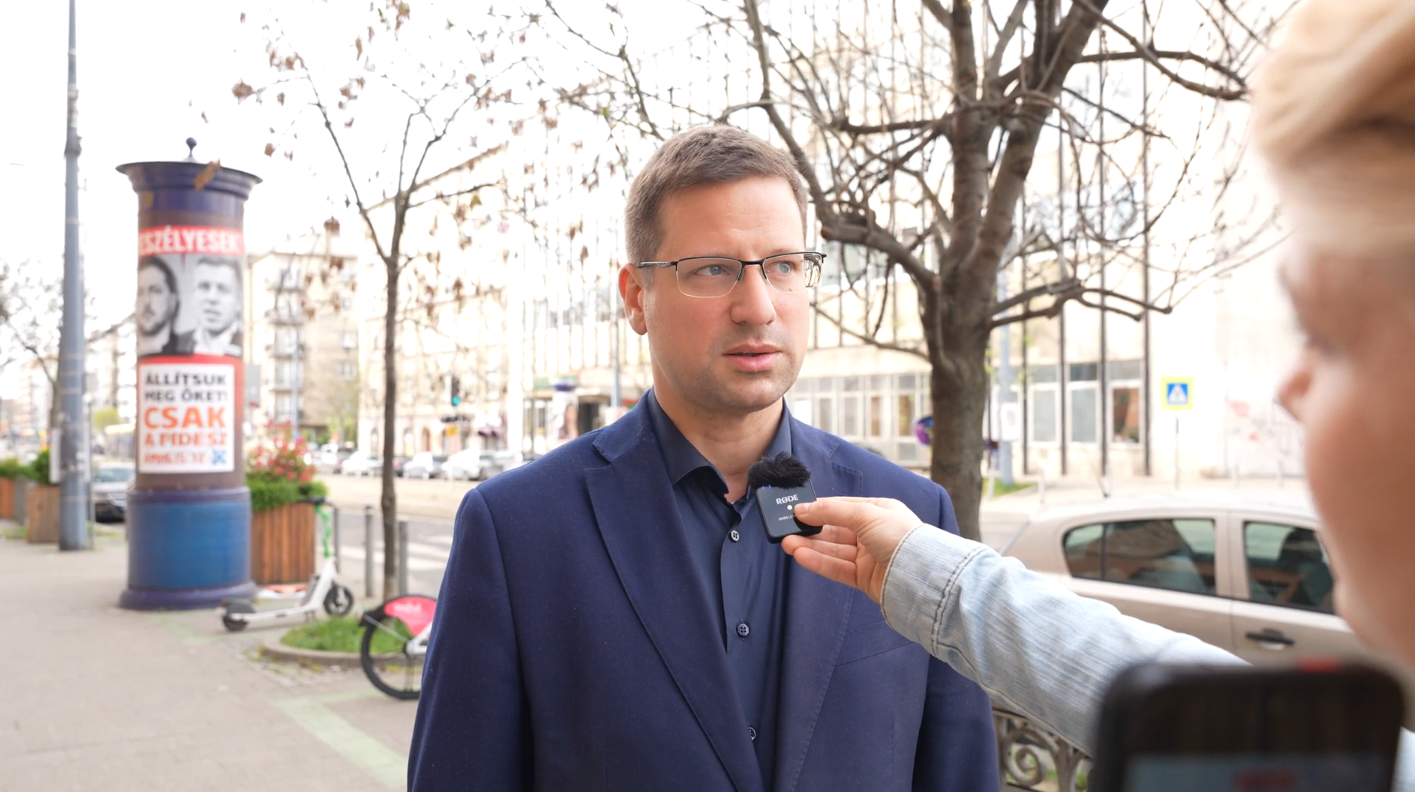
In the highly orchestrated world of Hungarian politics, where government ministers rarely stray from the safety of state-controlled media, reality sometimes bypasses the gatekeepers. On election day, while waiting in line to vote with my family, I found myself standing just paces away from Gergely Gulyás, the minister of the prime minister’s office.
What followed was a rare, unscripted exchange that captured the tension of a Sunday (12 April) that will define Hungary’s future.
Gulyás stood his ground despite the ruling Fidesz party’s long-standing boycott and restrictions of independent media.
Being barred from their election-night event is only a minor example; more serious is that five years ago I had to leave the outlet, where I’d worked for 18 years, for political reasons, after the company was sold to a businessman close to Fidesz, who promptly sacked the editor-in-chief.
We were left with no choice but to found a new outlet with my colleagues.
I have been a journalist for nearly 25 years. I know very closely the Fidesz mindset, having encountered it countless times – the habit of treating independent journalists as enemies.
I have been working at various major independent news outlets throughout this nearly two-and-a-half decades, but it took this accidental encounter for a Fidesz minister to grant me an interview for the first time in 16 years.
Gulyás is a prominent Hungarian politician and a key figure in prime minister Viktor Orbán’s administration, currently serving as the minister of the prime minister’s office.
Since 2018, he has been the primary face of the government’s communication strategy, most notably through his role as the host of the weekly ‘Kormányinfó’ press conferences on Thursdays, making him the administration’s chief spokesperson and a vital link between the executive branch and the public.
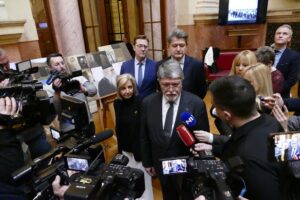
I waited for him to cast his ballot (after I had also cast mine), and he answered my questions for five minutes outside the building.
These were his responses:
1. On the unexpected rural turnout
I accidentally landed an exclusive interview with a Hungarian minister at my polling station — from our reporter in Budapest
“I have been a journalist for nearly 25 years, I know very closely the Fidesz mindset, having encountered it countless times – the habit of treating… pic.twitter.com/KrnmIv1tBu
— EUobserver (@euobs) April 12, 2026
With early data showing historically high turnout, while lower participation in rural villages – traditionally the bedrock of Fidesz support – I asked if this trend, which analysts suggest favors the opposition, concerned him. Gulyás remained outwardly defiant:
The Response: He argued that high turnout has historically benefited Fidesz, citing the 2018 and 2022 landslides. “Politics is an empirical genre,” he said. “We’ll see in 12 hours if that remains the case.” 2. On the rise of the ‘Tisza’ opposition party
The political map has been redrawn by Péter Magyar’s Tisza party. I asked if the government would follow democratic tradition and congratulate Magyar – a former acquaintance of the minister – should the challenger prevail.
The Response: Gulyás used the question to attack the opposition’s track record. “If we win, we thank the voters for their trust; if not, we congratulate the winner. This has always been characteristic of Viktor Orbán and the right wing, and never characteristic of the left,” he said. 3. On ‘war-mongering’ propaganda costs
I pointed to the ubiquitous billboards behind us featuring Ukrainian president Volodomyr Zelensky and ‘war-mongering’ rhetoric. I asked whether the massive public funds spent on this visual marketing would have been better allocated to healthcare or education.
The Response: He dismissed the premise, framing the expenditure as a necessary part of the democratic process. “Democracy has a cost… every other system that is not a democracy carries a significantly higher cost,” he argued, while pivoting to accuse his opponents of lying about their own campaign spending. 4. On media exclusion
Finally, I asked why independent outlets – including my own – were denied accreditation to the Fidesz election night headquarters at the ‘Bálna’ center in Budapest.
The Response: The minister distanced himself from the decision-making process, simply stating: “Don’t ask me, because I did not select from any of the media outlets.”