
László Mérő, the mathematician and psychologist turned public intellectual, says Fidesz’s rhetoric now echoes the language of the Third Reich and argues that the hatred shaping Hungarian politics has been consciously manufactured. In a wide-ranging interview, he reflects on Orbán’s transformation, the failures of the past 16 years, and why
 Zoltan Szalay



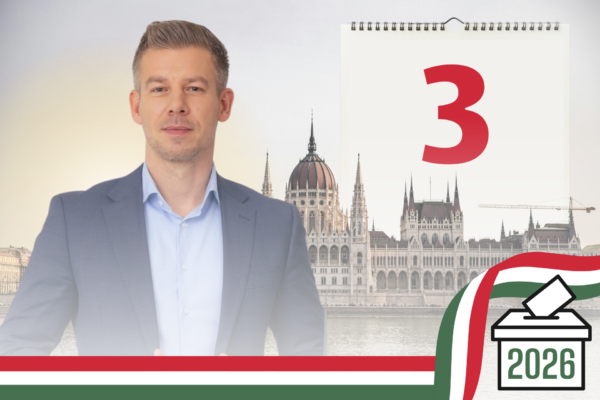
László Mérő, mathematician and psychologist: “Hungarians are an accepting, tolerant, friendly people. This hatred has been deliberately stoked.”
After the 2010 election, you responded to Fidesz’s two-thirds victory in a relatively optimistic article. At the time, you thought it might bring an end to the domestic political warfare. Looking back now, did you accept that two-thirds majority calmly and in good spirits?
No. In that article I wrote that Fidesz now had a choice between unrestrained looting and a historic role. Four years later, and again eight years later, I wrote that unfortunately it had chosen the looting.
There is also no sign in that article that you assumed the country’s prime minister would still have the same name at least 16 years later.
That never even crossed my mind. I see it the way others do as well: this is a Gyurcsány–Orbán era (ed: long period in Hungarian politics dominated by former prime minister Ferenc Gyurcsány and Viktor Orbán). We can speak of a period of 28 years in practical terms, stretching from Orbán’s first term, with a short interruption during the Medgyessy period.
After 2010, what was the first sign that made it clear Orbán and his allies were heading in the wrong direction?
There were two such things. One was what we called the ‘Muzzle Law’. In the end it was never actually applied. The point of it was that even opinions could be subjected to mandatory correction. And there were plenty of other greater and lesser outrages in it. The other was the seizure of private pension funds. Although I never voted for Fidesz, I thought that since they had won, let them be the ones to whip the country into shape. That is why I was so disappointed. I never believed in them, and yet I still managed to be disappointed in them.
The domestic political warfare in the end continued throughout the past 16 years. It seems to be essential to Viktor Orbán to keep that warfare going. Is that because of Orbán’s nature, or are the reasons to be found in the wider culture of Hungarian politics?
I don’t know. Orbán is certainly that kind of character. A lot has changed in my thinking. In 2015 I left Magyar Narancs, where I had written opinion pieces for years, because they depicted Orbán with a Hitler moustache. But now I have explicitly written that the language of Fidesz is unmistakably Nazi speech. It fully corresponds to what Victor Klemperer writes about in The Language of the Third Reich. I am not sure those who portrayed Orbán with a Hitler moustache back then were right. That had more to do with their hatred of Orbán than with the fact that Orbán’s rhetoric at the time actually resembled the language of the Third Reich.
Recently, you told Magyar Hang that the devil lives in Hatvanpuszta.
Not exactly like that. What I said was that he lives in Hatvanpuszta and Batida (ed: Hatvanpuszta is the Orbán family’s estate; Batida is linked to János Lázár, a senior Fidesz politician). The distinction matters, because I am not saying Orbán himself is Satan, but that evil lies in the system. At this moment that is why it matters so little whether Péter Magyar has a programme, and how good it is — though he does, in fact, have one, and it is quite good.
“With Orbán’s education plans, we will be the losers of the 21st century.” That is what you said in an interview in 2015. Orbán and his allies, by contrast, say that Hungary lost the 20th century and will win the 21st.
I was laughing at that the first time I heard it. It is propaganda so absurd there is no point even taking it seriously.
What was most important in education that makes it fair to say they are steering Hungary towards failure?
Essentially everything. In education, the area I really see up close is higher education. This country still believes in Europe and wants to be European, no matter how much they have spent years stuffing our heads with the idea that Europe is declining and weak. You do not need to spend much time in western Europe to see that this simply is not true. As it happens, I lived in exactly the street in Vienna where János Lázár expressed horror at how many migrants there were and how they were ruining everything. There really are a lot of Turks and Arabs there, but they are the ones who keep the best order. They are the ones most careful to make sure there is no trouble, because it is in their most basic interest. If someone does not want to see lots of Turkish and Arab faces, then they should not move there. But they should not lie and say there is chaos or insecurity. It is one thing if someone is racist, and another if they are lying. And this government lies. That is my problem with it.
I have lots of stories from there. We would laugh with one of the shopkeepers, completely peacefully, saying: fine, you are Turkish and I am Jewish, so what. It never even crossed our minds that there could be any friction because of that. There are so many lies about the world, about Europe, about Ukraine, and what is staggering to me is that very intelligent people believe them too.
Statistically it may be true that Fidesz’s main base comes from the less educated, but at an individual level it is not true. There are still very many Fidesz believers. On 12 April that will be the hardest thing. That when someone wakes up then, we should not say: good morning. Nothing could be more insulting. It must be awful to realise: my God, what was it that I believed in? There will be many such people, because more and more skeletons will fall out of the closet. Those who have long been in opposition should be helping these people to the greatest possible extent. I fear we will not be capable of that.
In that interview 10 years ago, you also said you were optimistic because of your students, because they think normally, their fears are normal, and they have had enough of both political camps. What has changed in that respect over the past 10 years?
I see only a narrow segment of young people — university students, from the three or four universities where I teach. I do not see a big difference. My experience is that students are students everywhere in the world. I have taught in several countries, and I did not see much difference between an American, a German, a Romanian or a Hungarian student. In Romania I mainly taught Hungarians, but Romanians too, in English. The latter was an economic psychology course, for which they did not have their own person. The agreement was that I would teach the course three times and then a doctoral student, who was finishing their studies in the meantime, would take it over from me.
Romania had joined the EU only shortly before that, and they were full of doubts about whether it would be good for them. I used a French example, since they know that culture quite well. I asked them whether they could name any 70-year period since Pepin the Short when there had not been some form of Franco-German war. Germany did not always exist, but one or another of the German principalities was always at war with the French. That argument convinced them it might be worth it. Then I said that perhaps even we Hungarians and Romanians would learn to live together. At that they froze, and they were unwilling to say what the problem was. The following year, one of the girls from the previous academic year brought me a book. It was Lucian Boia’s book in Hungarian, History and Myth in Romanian Consciousness. From that book I understood that in Romania it is not at all obvious to a Romanian whether they belong to the West or the East. Against that background, it is a very big thing that they have become such a European country. In Hungary, that was never in question.
Have you ever had any kind of conflict with your students in Hungary because you openly take on political positions?
I do not talk about such things in class. One engages in politics unintentionally anyway if one talks about education policy or even tax policy. But never in favour of one party or another. I explain that one side thinks taxes should be structured this way, the other thinks they should be structured that way. We talk, for example, about how the right believes in less state intervention and the left in more. From that point of view, Fidesz is not rightwing. Of course there are things the state simply has to build.
A good example is a lighthouse, which is built so that everyone can avoid it. But I would not be happy if we had private armies either. Every country spends money on public services, usually somewhere between 25 percent and 50 percent of its budget. Even the United States spends no less than 25 percent, and the Scandinavian countries not much more than 50 percent. Nor is there any question for me that stadiums are needed too. But how many? In many respects this is also why I speak of an Orbán–Gyurcsány era, because in many things they did the same. I would like political debate to be about questions like these.
For years you have also worked as a business adviser to senior executives. After 2010, how much change did you notice in the extent to which politics seeped into business?
The people for whom it did seep in do not call me in as a coach. Although I do sometimes have top executive clients — I have two even now — who are explicitly rightwing, and one of them is specifically a Fidesz supporter. He knows perfectly well that I am not. For a very long time I have thought that if a top executive is uncertain, you should not hire them an adviser, you should get rid of them. The person who should hire an adviser is not someone who is uncertain, but someone who wants to broaden their horizons. For example, because they no longer read smart, weighty books. Not because they have become a boorish manager, but because the whole country benefits more if they do not read and, if they have a little free capacity, use it to think about their company. No one else can do that for them.
What Taleb said about this, I can tell them too. They are interested in that, but strictly only in that part, not in the other 600 pages. A leader like that looks for people they accept as at least as intelligent as themselves, and whose job is to read, not to run a company. If I give them advice, it is almost certain they will not take it. Not for political reasons, but because they know a great many things I do not. What they are interested in is how they would see the business situation they are in if they had read this or that book. The decision and the responsibility are already theirs. The result of a coach’s work is not measured by whether their advice is taken, but by whether they are invited back.
Over the past 16 years, was it common for businesspeople close to Fidesz or connected to it to call on you?
If four or five occasions count as common, then yes. It is not typical. I like working with people who are curious about how I see things after reading these books. In those cases I know my place, and I know how I create value even if they do not take my advice.
When you work with businesspeople close to Fidesz, do you gain insight into how they relate to the system?
They are very professional about that. If they want me to see into it, I do; if they do not, I do not.
And do they want to?
Sometimes they do want me to understand their point of view. But mostly not. Generally they respect the fact that I see things differently, and that is not what they want from me.
So the point is not to convince one another.
It would never even occur to me to try to convince my client. The one thing I want to convince them of is that if they had read this and this, they would see things in such and such a way. That is independent of politics.
Did you come to understand anything important about the Fidesz system through these relationships?
No, hardly anything through that. If I wanted to learn something about the system that way, sooner or later they would ask who is paying whom. They are very sharp. They are paying so that they get smarter, not the other way round. But occasionally I did realise what kind of mechanism their minds run on. They genuinely believe that national capital needs to be strengthened. I could even find that acceptable, if only they did not do it on a patronage basis, but in a way that involved competition.
Have people in the business world learned to adapt to this situation, or are they waiting for the right moment to help remove it?
Those usually referred to as NER knights (National System of Cooperation, usually friends of Orbán) do not miss competition. But there is a layer of entrepreneurs who say outright that this is very much not in order. Gábor Bojár is one such example. They are not complaining because Hungarian entrepreneurs are being put in an advantageous position. They are complaining because it is not happening through competition.
How did you experience the period after 2018, when the culture war intensified and more and more institutions came under threat?
I am at ELTE University (largest and oldest Hungarian university), so I was left out of all that. We are still part of Erasmus too. If they had wanted to do to ELTE what they did to the University of Theatre and Film Arts — in 2020, in protest against the restructuring of SZFE, students blockaded the institution for seventy days — then it would have affected 35,000 to 40,000 people here. They probably did not dare take that on.
So there are still protected places.
They keep trying, with harsher or milder means, to grind it down. But in ELTE’s case it seems not to be working.
Did the eruption of the pardon scandal surprise you, or was it coded into the system that a black swan like that had to come?
The black swan was coded into the system. What was not coded in was that it would happen in the field of child protection. It became clear that the system was rotten, but that was true elsewhere as well. The fact that it exploded precisely there was a matter of chance.
What did you think of Péter Magyar when he first emerged in public?
I immediately saw that he came from there. He is one of them. He was still a Fidesz supporter when he appeared. He said he wanted to be the force that would hold the balance. There is a lot for which he has something to answer, but he seems to know whom he should listen to. He was not likeable. But my daughter wrote a good article about him, under the headline I’m choosing a politician, not a lover. She wrote that she would not want him as a lover, but as a politician she sees many virtues in him.
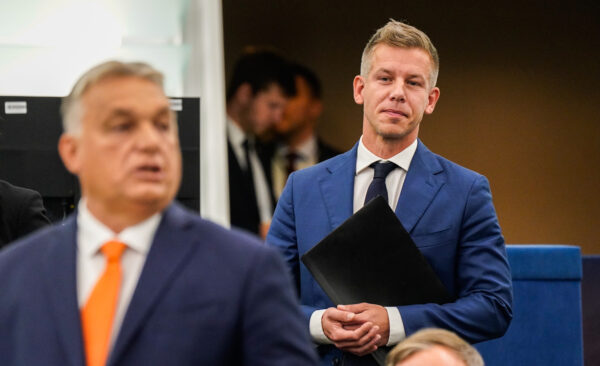
In 2022 you described Orbán as a slick weathercock who turns whichever way tomorrow’s wind will blow. Today Orbán is a symbolic figure of the international radical right, and many see him as the one who sets the trade winds. How has your view of him changed?