
Czech journalist Petra Procházková recounts Putin’s 1999 rise from obscurity, sparked by his mafioso “crapper” speech after Moscow bombings. Fueled by deep Russian humiliation from Western arrogance and guided by cunning strategists, this “rattlesnake” seized absolute power, transforming resentment into terrifying autocracy.
 Petra Procházková



First published by Deník N.
One day in the mid‑1990s, Russian president Boris Yeltsin got drunk, and journalists based in Moscow understood they had to start preparing for someone new. It would still take a few more years before Boris Nikolayevich’s heart finally gave out. Enter Vladimir Putin. In the film The Wizard of the Kremlin, a Putin is portrayed as a coldly calculating genius of power. In reality, he is a man eaten up with complexes who wants to be the Greta Garbo of world politics. So how was his power in the Russia of the 1990s born?
At the beginning of Putin’s career, his ascent to heights he himself had not initially even dreamed of, there was the word “sortir” (crapper). Crude, but uttered forcefully and with the requisite dose of malice by the mouth that had just become the second most powerful in the Russian realm. A word that soon propelled that mouth into first place.
I was sitting in my Moscow office on Gruzinsky Pereulok Street by the television. It was my eighth year working as a correspondent in the countries of the former Soviet Union, the pivotal and memorable year 1999.
Throughout my Russian period, I was accompanied through post‑Soviet reality by its main protagonist – President Boris Yeltsin. Now he was literally running out of breath.
What broke his health was long‑term stress, too much alcohol and Western support, and the botched war in Chechnya which, despite Russia’s massive superiority, simply could not be won.
And on top of that now those Moscow apartment blocks blown to smithereens.
On the screen, a head with an icy gaze and no emotion was just talking about them. It belonged to the recently appointed prime minister Vladimir Putin. I stared at him, fascinated.
Now and then determination, shot through with hatred, flashed in his eyes, but otherwise his gaze was unusually rigid. It made me pick up a pen and, on a scrap of paper – as is still my habit today – jot down: “V. V. Putin – new leader, the gaze of a black mamba.”
 Vladimir Putin in 1999. At this moment he is still prime minister. But he already knows he will soon exchange his prime‑ministerial chair for a real throne. Photo – Kremlin.ru
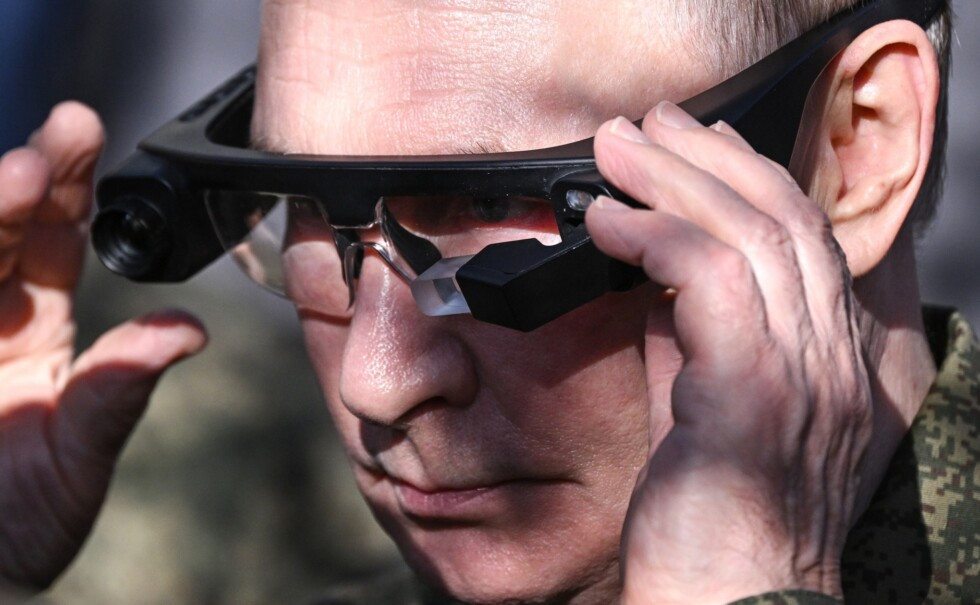 Vladimir Vladimirovich Putin. Photo: kremlin.ru
A few years later, the Swiss‑Italian essayist Giuliano da Empoli described a brief episode in a luxury restaurant in his book The Wizard of the Kremlin, where Putin was ordering plain porridge from a waiter, in similar terms: “He watched him like a small rodent hypnotised by a rattlesnake.” The rodent, of course, was the waiter; the rattlesnake was Putin.
And so Putin was suddenly here. We journalists studied him day and night. A new phenomenon, a new character.
The coming of the saviour
On 9 and 13 September 1999, bombs exploded in two Moscow apartment blocks (preceded by a first blast on 4 September near the Chechen border). I heard the first Moscow explosion while I was working at my desk, cluttered with ashtrays and half‑finished coffees; it was exactly midnight.
The second blast came four days later and did not wake me up. That was my colleague Sasha Yevtushenko from Komsomolskaya Pravda, who called me at half past five in the morning to say that “another block of flats has been blown to kingdom come, and the people with it”.
As an experienced journalist, Yevtushenko knew that whoever had placed hundreds of kilos of hexogen (a powerful, carcinogenic explosive widely used in demolitions) in the buildings’ basements, this meant that we now found ourselves in a different and more dangerous country from the one where we had enjoyed dramas, freedoms and journalistic scope for almost ten years.
More than two hundred people were killed. I remember the shock that gripped the Russian capital, which grasped that the war in the North Caucasus had reached all the way to Moscow.
The Chechens are here, President Yeltsin is helpless, the army is in a pitiful state, weakened by a five‑year life‑and‑death struggle with Caucasus partisans. The country has just gone bankrupt and panic reigns among the oligarchs. Russia needs a saviour.
The film The Wizard of the Kremlin is about Putin. And about his rise to power.
[embedded content]
We’ll get them even on the crapper
Vladimir Vladimirovich Putin was a freshly minted prime minister, and because the president was no longer physically capable, it was he who, at the critical moment after the explosions in the Moscow apartment blocks, addressed the nation.
“We will hunt the terrorists down everywhere. We’ll get them even on the crapper,” declared Putin in the argot of Petersburg thugs, the underworld slang of which he had for part of his life been an integral part.
The word “crapper” hit home. The whole of Russia froze. Then came the first shout of enthusiasm, then a second, a third… until the whole country erupted in jubilant shrieks in honour of the new tsar – strong, tough, and protecting his people. They believed him.
Even my ears pricked up at the word “crapper”. I puzzled for a while over how to translate it, before it dawned on me that this man with the stony face really was talking like a mafioso.
In The Wizard of the Kremlin, Putin’s “crapper” line is given one of the central scenes.
He delivered that speech at a moment when the country desperately needed some stability and belief that the latest attempt to create a functioning state would not collapse. In 1999 Putin stepped onto the stage, edged the dying Yeltsin off it and took complete control.
A man small in stature but big in ambition. A native of Leningrad, raised on the cruel post‑war streets of the city, getting kicked up the backside and slapped by physically stronger boys to such an extent that revenge, loneliness and hatred became second nature to him.
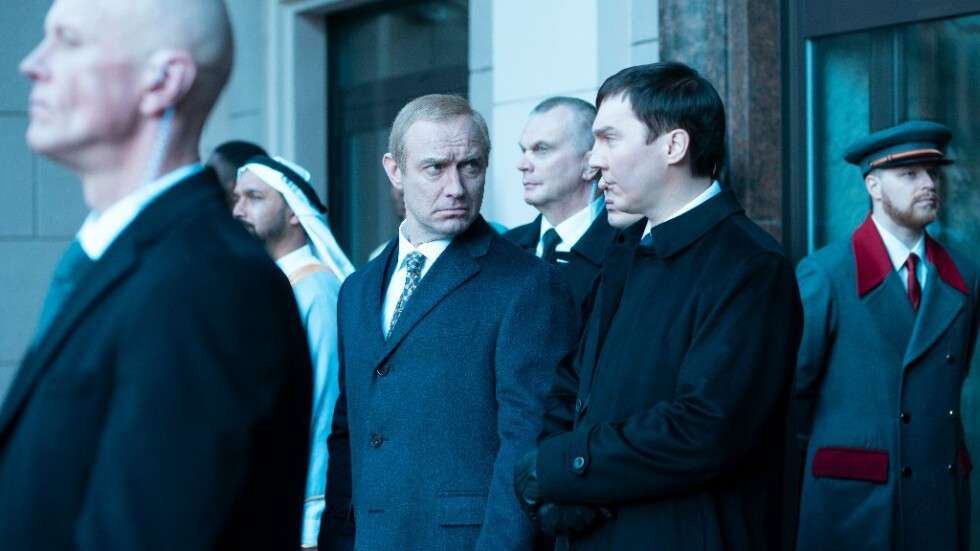 This historical moment is also captured in the film The Wizard of the Kremlin in a way that is probably fairly faithful. Putin is in New York and has to stand stock‑still as the motorcade of the US president passes along the street. He is humiliated. Photo: Carole Bethuel, Bioscop
Those of us were working in Moscow at the time wrote the first portraits of Putin and learned analyses.
We became “Russia experts” – and experts on its new leader.
Putin, had previously been head of the FSB (the Russian counter‑intelligence service). Before that he had been a bag‑carrier for the mayor of St Petersburg and, until then, a moderately successful agent of the Soviet KGB in East Germany. And in childhood, a little blond boy who desperately wanted to become a fully‑fledged member of a St Petersburg street gang, but only made it as the punchbag.
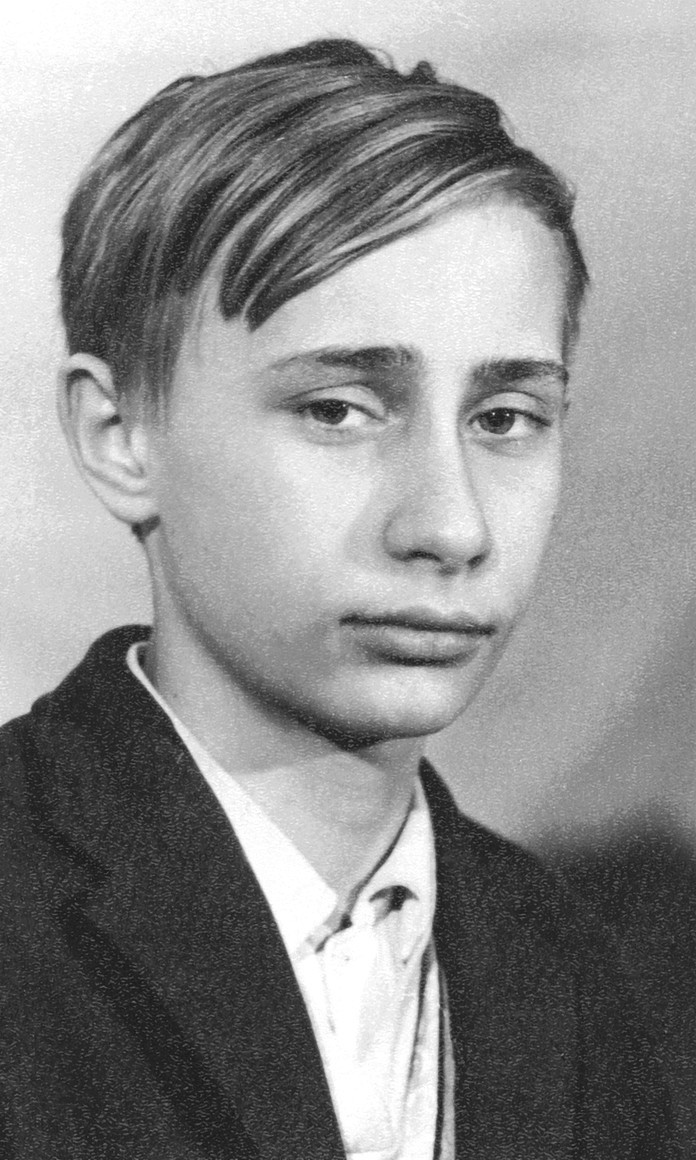 Putin comes from St Petersburg. To this day he is surrounded by the “Petersburg gang”, which protects and guards him and derives enormous benefit from his position. Photo: kremlin.ru
We did not yet know that he was not a puppet of the oligarchs who had lifted him to the top mainly because they thought he was a loyal bureaucrat who, out of gratitude, would do as he was told. We had no idea he would wield more influence than the gigantic Western aid to Moscow or the armies of foreign advisers who wanted to turn Russia into a liberal democracy.
Putin’s apparition was to a large extent an answer to European arrogance and a sense of superiority, masked as an effort to spread good.
A country where hatred is cultivated
The Wizard of the Kremlin must appeal to President Putin. In it he is elevated to the status of a demon – and that is exactly the image of himself he wants to project, though he claims he has not seen it.
It is not a documentary that faithfully maps the complex period after the collapse of the Soviet Union but a fiction based on facts, conjectures, testimonies and imagination.
It is also a kind of goulash, simplifying Russian reality right to the edge of good taste. But its final flavour reveals more about Russia than Russia itself would like. Notably, that it is a country ideal for cultivating hatred towards the world, as one of the characters says.
Because the Western world never fully accepted Russians among itself. “And we tried so hard…,” says Vladislav Surkov in the book on which the film is based. The result of Russians’ desire to become a fully fledged and respected part of the civilised world, according to Surkov, was the accession of the Baltic states to NATO.
There was no clearer way to show how little the West takes us seriously, thinks the modern‑day Rasputin, who in the film, as the guide through the story, is renamed Vadim Baranov and played by Paul Dano.
 At first glance, an ordinary blond guy. Yet capable of enormous commitment. Behind Putin, in the background, Vladislav Surkov – for many years his “Rasputin”, in the film the guide through the story, renamed Vadim Baranov and played by Paul Dano. Jude Law lends his acting talent to Putin. The film is directed by Olivier Assayas. Photo: Carole Bethuel, Bioscop
The insatiability of Russian oligarchs, but also the mistakes of Putin’s predecessors, Western strategists, domestic democrats, economists and their advisers, and top European politicians, gave Putin, at the turn of the millennium, a unique opportunity to pay the world back for all those wrongs.
Humiliation
Surkov’s book describes a period I know intimately – the collapse of the Soviet empire and the wild 1990s, when even a beginner journalist like me could simply walk out into the streets of Moscow and then write a report that would end up on the front page.
Businessmen, in the heat of competition, were sending hitmen after one another; gangsters were becoming politicians. People who could not get their bearings in the new Russia were on the verge of hunger. And former Soviet scientists who had developed dangerous chemical, biological and radioactive agents had to enter the service of the underworld because the state had stopped paying their wages.
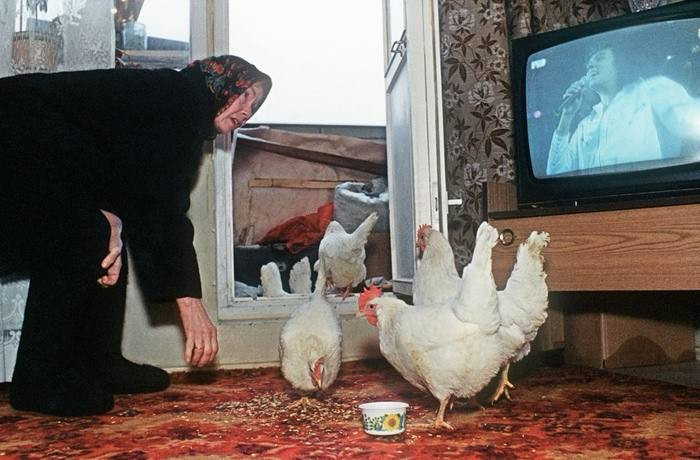 This is not a curiosity or a photo from the flat of an unhinged Muscovite, but a necessity of the 1990s: people kept poultry on balconies and loggias so they would have something to eat. Source: Fotoapparat, Telegram
I will never forget the look of the man I stopped by during my trip in a Zhiguli car to Likino‑Dulyovo, about a hundred kilometres east of Moscow. He was waving at me, somewhat shyly, bashfully, modestly, with the hand in which he held a cup painted with little red roses. In the bag at his feet he had, in a cardboard box, a pot and saucers in the same style.
“I don’t need the porcelain,” I told him then. “And here you are…” I pressed a few thousand roubles into his hand.
Along the roadside, dozens of women and men stood in a row with the same cups and teapots. They stared at him with envy, at me with hatred.
“Dulevo porcelain was world‑famous in the USSR. We won gold at the world exhibition in Paris in 1937!” my bearded man said, with tears in his eyes. We started talking. He was a workshop foreman, an engineer and a father of three. His grandfather had allegedly helped liberate Slovakia, received lots of medals and orders, and he himself was a Hero of Socialist Labour. He had not been paid for six months.
Instead of being angry with the oligarchs who had asset‑stripped plants like his, looted them and sold off what remained – or with the incompetent president and his henchmen, who had lined their pockets and built themselves villas in Spain – he was angry with me. His world has become something to laugh at, or, worse, to pity. No longer something to fear. I had witnessed his destitution, and that was unforgivable.
The vendors along the roads were the prelude to Putin’s entrée.
In the Kremlin they were still trying to keep Yeltsin alive so that everything could continue as before. But in many Russian households, poverty had arrived hand in hand with freedom. Yeltsin and his democracy became symbols of humiliation.
The centre of vice
Baba Galya was “my homeless woman” in the 1990s. A BOMZH, as such people are called – an abbreviation of bez opredelonnogo mesta zhitelstva, without permanent residence.
She used to come and help me with cleaning, getting rid of household pests and finding my bearings in a world where only those close to power thrived.
“I was a lab technician. But some Bolshevik from Yeltsin’s crowd got hold of our institute and sold it to someone from your side. Or from America. He gutted it and shut it down, and we were left without wages, and now even without pensions,” she laughed at the despair of her situation and at the fact that she had found me – with my need to listen and to have a tidy flat.
In essence she summed up, clearly and simply, what was happening in Russia, especially between 1994 and 1998.
One day Galya brought me a brand‑new frying pan, another time bed linen of poor quality. She had received it instead of a pension. “I sold one yesterday, but nobody wants the bedding,” she smiled apologetically. I gave her money for two or three shopping trips and donated the pan and the bedding to another homeless woman who slept behind Belorussky railway station in a pile of old rags.
 While the countryside was a showcase of poverty, Moscow and St Petersburg became places where absurd wealth and a glittering super‑world full of caviar collided with destitution that convinced Russians every day that democracy and freedom were not for them. Photo: Fotoapparat, Telegram
In The Wizard of the Kremlin, Russia is depicted as a monolithic, depraved power agglomeration. Moscow as the world centre of vice, politicians as similarly debauched creatures. Ordinary “middle‑statistical” people, let alone bomzhi (homeless people), are missing.
I do not hold it against the film that, apart from the mobsters and the politicians connected to them, it does not also portray ordinary, decent and courageous Russians. but I feel obliged to say that such people do exist.
But film has to simplify reality and wrap it in a format that can keep viewers’ drooping eyelids open. Two and a half hours of The Wizard of the Kremlin are more than enough for one to say: we’ve had enough Russia for today.
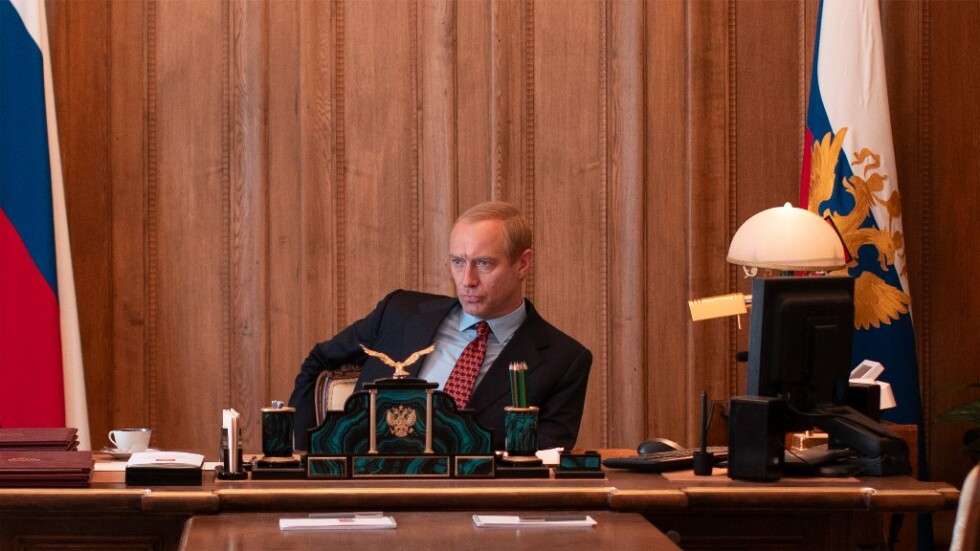 At one point, Vladimir Putin says to his Rasputin – Vadim Baranov: “I cannot be subordinate to anyone.” This is the essence of his understanding of Russia’s place in the world. It cannot be subordinate to anyone. Photo: Carole Bethuel, Bioscop
In the film, the decadence into which Moscow and other Russian cities were sinking is depicted in shorthand: young people, like dogs off the leash, pouring vodka down their throats; people ceasing to respect traditional attraction to the opposite sex; drugs being handed out at the entrances to nightclubs, of which there are more than grocery stores.
An avant‑garde artist leads a naked man onto the stage on a spiked collar. He moves like a dog, lapping up water, then growling. This is one of the main images depicting the Russian idea of what Western freedom means to them – depravity, debauchery, sexual promiscuity, loss of judgement.
And at the same time the entire film (unlike the book) is above all our Western notion of what Russia was and is. Tracksuits, gold teeth and thick chains, violence without rules, corruption, expensive cars and watches worth hundreds of thousands of dollars on the wrists of state officials, power, destitution and backwardness, but also pride, wounded vanity and arrogance.
How do Russians see us?
As debauched weaklings, too dependent on their own comfort, sexless creatures who keep banging on about human rights while forgetting Russia’s right to be respected as a great power.
They see us as hypocritical fraudsters who want to rob Russia of its mineral wealth, or even worse – to bring about the collapse and liquidation of its statehood.
The West and the oligarch on the same barricade
I remember those clubs. Some of them were reserved for the chosen few; the oligarchs had carved up not only the oil, coal, gas and car businesses, but also the cultural scene, the entertainment industry and above all – politics.
Whoever controlled the Supreme One also had the best access to select clubs, hospitals, sports stadiums, luxury saunas, and resources – both financial and natural.
Such a person enjoyed absolute impunity and influenced not only events in Russia itself, but also in the post‑Soviet space and Russia’s standing on the international stage.
That was the situation under Yeltsin.
Under Putin, the circle of the chosen few narrowed sharply – and continues to narrow. Even those closest to him do not know whether the leader’s wrath will descend on them and they will plunge – either metaphorically or for real – into the abyss.
In the film, the example of such a fall is an oligarch I met several times: Boris Berezovsky. I remember him as a hyperactive man radiating energy, brimming with ideas, some of which he managed to implement. A fascinating figure who would skewer you with his eyes until he worked out how you might be useful to him. As soon as he realised you were of no use, he lost interest. That was my case too.
To this day I do not believe that, after his forced emigration, Berezovsky hanged himself in the bathroom of his residence in Ascot near London, using his favourite cashmere scarf, which he had first tied to the shower.
Yes, he suffered from