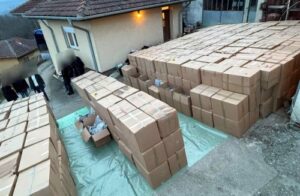

Mushroom foraging provides an income for thousands of people in Bosnia and Herzegovina, but much of the industry remains in a grey zone, where foragers work without contracts and exporters dodge forestry fees.
 Harun Dinarevic



Italy
Export value: 4,000,000 euros
Quantity: 434,502 kg
Slovenia
Export value: 2,350,000 euros
Quantity: 267,624 kg
North Macedonia
Export value: 1,400,000 euros
Quantity: 200,062 kg
France
Export value: 1,100,000 euros
Quantity: 111,623 kg
Switzerland
Export value: 1,600,000 euros
Quantity: 36,452 kg
Source: Foreign Trade Chamber of Bosnia and Herzegovina
According to mycologist Smiljan Tomic, who studies fungi and is part of the association MYCOBH, said the ecological footprint of mushroom harvesting is “minimal”.
Harvesting involves taking only the fruiting body of a fungus, leaving behind the larger part, the mycelium, which sits below the soil surface.
But there are other issues, said Dalibor Ballian, a professor at the Faculty of Forestry, University of Sarajevo.
“We harvest mushrooms that are too young, which do not have time to release spores,” said Ballian. “There is also habitat devastation: if I cut down a forest, certain mushroom species will no longer appear there.”
In the EU, he said, there are strict rules and steep fines for those who break them. In Bosnia, however, “anarchy reigns”.
“In Italy, for example, you have to pass an exam – how to handle mushrooms, how to pick them, where you can pick them,” said Ballian. “All over the world they are collected, but there are regulations.”
“Who has a licence here?” he asked, and pointed to the over-harvesting of Iceland moss in Bosnian mountains. He called for education in sustainable foraging.
“We also have a problem every year with wild garlic,” Ballian told BIRN.
“It’s mowed down, transported, exported. Exporters make millions from it, and here it will disappear. Rules of conduct need to be introduced when it comes to mushrooms and forest plants.”
This article was produced within the framework of MOST – Media Organisations for Stronger Transnational Journalism, a Journalism Partnership funded by the Creative Europe programme that supports independent media specialising in international reporting.