

Ukraine is winning war for the so‑called “small sky” – the airspace directly above the battlefield and its surroundings, Russians fear.
 Roman Pataj



Every day, the Ukraine Battlefield update newsletter offers a clear look at how the war is unfolding on the ground, highlighting key developments along the frontline and the shifting dynamics of the conflict. This offers readers regular and detailed information to better understand the implications of the war for the country and the whole continent.
Russian war reporters on new developments in the war – we can do nothing about the new drones and we are losing.
The Russian army has stalled, the large offensive is not happening yet.
The only Ukrainian‑confirmed advance is near Riznykivka on the Sloviansk axis.
Flames engulfed the port of Tuapse, there were too many drones and the defences failed to stop them.
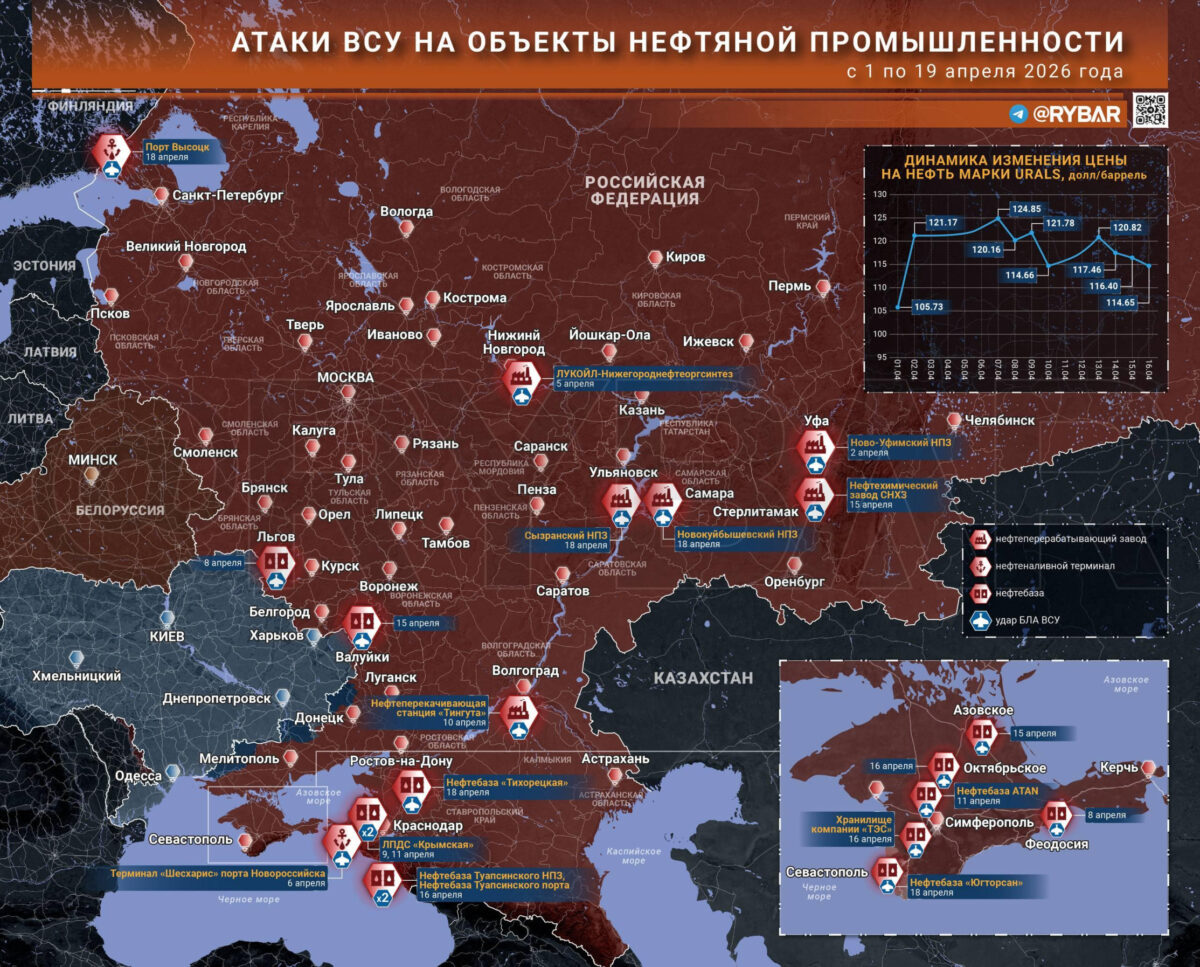
Maps of the day – Sloviansk axis, map of strikes on oil infrastructure since the beginning of April.
Videos of the day – fire in Tuapse; more air raids on Crimea – one clip already shows a ship with an anti‑drone cage; GBU‑39s miss their target – probably due to electronic jamming; a soldier shoots down a cruise missile with a man‑portable system; a surface‑to‑air missile harmlessly flies past a drone; the Sting hunter‑killer drone shoots down a Russian Geran, survives the collision and even records its victim’s fall.
Russian war reporters on new developments in the war – we can do nothing about the new drones and we are losing. Ukraine is still fighting for survival, but the Ukraine Battlefield update series may have given the impression in recent times that it is doing unexpectedly well. Today’s instalment will be no different. And as in several previous parts, Russian sources will once again predominate.
What has changed in recent months is the mood among Russian Z‑channels – various military bloggers, more or less linked to the army, who support the war and write about it regularly.
Whereas around six months ago they were markedly optimistic, they now increasingly write about serious problems and their reporting on events at the front is very limited. Often there are not even small successes they could celebrate. Since the official media are completely under the Kremlin’s control, these channels are the only pro‑regime Russian sources from which it is possible to learn anything about the real state of Russia and its armed forces.
One of the biggest, if not the very biggest, problems they see at present is that, in their view, Ukraine is currently winning the war for the so‑called “small sky” – the airspace directly above the battlefield and its surroundings. Whoever holds it controls what, and who, survives on the front line.
“I have the feeling that the ‘small sky’ is more and more under the enemy’s control every day. And it is by no means just about FPV [first-person view] drones and optical drones,” respected war reporter Alexander Simonov began his account of the situation at the front in Russia. He has an audience of 100,000 followers on Telegram.
The key part of Simonov’s testimony lies in his claim about Ukrainian drones with artificial intelligence which are “absolutely unaffected by electronic‑warfare systems. They are practically inaudible and sometimes even invisible because of their very high speed during the attack. One second is enough and you are already burning in your car. And plenty of cars are burning. Directly at the front and in places that previously were not so dangerous.”
Simonov said that the Russians had nothing comparable and he likened the situation to the battle for the Kursk region, which the Russians turned in their favour thanks to the arrival of optical drones. “Now the situation is the same, but exactly the opposite. And the advantage is on the Ukrainian side,” he added.
“That is exactly how it is. The situation is difficult,” [the channel] Notes of a Veteran confirmed the accuracy of the description. It is another major Russian Telegram channel that circulated Simonov’s words.
Notes of a Veteran, in another post, compared Russian and Ukrainian drone‑use strategies. Their analysis was based on data published by the Russian Rubikon, which is something between a military unit and the main technological innovator within the Russian army.
The author criticised this elite unit because, according to its own figures, Ukrainian soldiers make up only six percent of all targets hit. Equipment and Ukrainian fortifications predominate.
“By contrast, the enemy emphasises destroying our manpower. And that is very worrying,” Notes of a Veteran wrote, because according to them the Ukrainians attack infantry in as many as one third of cases.
They therefore suggested that Russian drones should also change their priorities: “It is much easier to manufacture a car or a tank in a factory than to raise and train an infantryman.”
Fitting into the overall gloomy tone is a text by another war reporter. His name is Alexander Kharchenko and he told Russians that, at the current trend, it would not be possible to seize control of the whole Donbas, and therefore he called for “mobilisation and total war”.
It is a perfect illustration of how the pro‑war scene in Russia works. Criticism of the war in the sense that it should be ended is not acceptable. Authors on the Z‑channels may criticise as long as they are rousing the country to greater engagement in the war. They do not consider ending it at all. And if by chance they do, they do not do so publicly.
“The enemy has mobilised its modest resources. It has switched to unmanned technologies and is trying with all its might to wage a war of robots,” Kharchenko said.
In that, he was not wrong. Ukrainians are deploying not only aerial and naval drones, but also ground drones on an ever‑larger scale. The commander of the 3rd Army Corps, Andriy Biletskyi, estimated that their wider use would lead to a situation in which the army would need 30 percent fewer people on the front line.
Russian drone developer Alexander Chadayev explained the turnaround in the ability to use drones and their impact on the war by saying that, compared with the start of winter, Ukrainians had managed to increase the number of their drones two‑and‑a‑half‑fold, while the effective range of their commonly used drones exceeded that of the most frequently produced Russian optical drones by a factor of between 2.5 and 3. And finally, he too spoke about autonomous guidance.
The Russian army has stalled, the large offensive is not happening yet. To open this section, we will quote at greater length from a Rybar report setting out the Russian view of the weekend fighting on Sunday evening.
Its opening contained a brief summary of the mutual drone attacks in the rear (before the strike on Tuapse). The second part was the following information about developments on the battlefields:
“Burluk axis: Russian units are gradually pushing the enemy out of the vicinity of the liberated Vovchanski Khutory (a village east of Vovchansk) and from other positions in further sections of the Kharkiv region border area. Evidence has emerged confirming that assault groups have entered the territory of Okhrimivka.
Kostyantynivka axis: Russian units are trying to push the enemy out of the south‑western part of Chasiv Yar and to expand the territory under their control in the Stupochky area. Heavy fighting continues in the centre of Kostyantynivka itself.
Dobropillia axis: Russian units are developing an offensive around the village of Hryshyne. At the same time, the fighting is gradually shifting towards Vasyliyivka and Novooleksandrivka.”
The problem with this list is that the Russian author has been writing for months about how their army is trying to capture Chasiv Yar (officially taken in autumn 2025), how they are trying to seize Stupochky, and how heavy fighting continues in the centre of Kostyantynivka (according to the Ukrainians, only in its south).
It is similar with the development of the supposed “offensive around Hryshyne”. At best, this means small leaps forward for the Russians; in practice, it is more like a complete halt in their advance.
The Ukrainian view of Russian successes at the front was published today by soldier Kyrylo Sazonov, who has been fighting since 2022 and has 100,000 followers on Telegram.
He posted a status in which he summed up the situation in Donbas, specifically in the wider Kramatorsk agglomeration, including Dobropillia: “Two weeks ago I assumed that the occupiers would not have enough available forces and reserves for a serious offensive and would inevitably get stuck. That is exactly what happened. On the Lyman axis north of Sloviansk they have made no progress. They have been unable to eliminate our salient, and without that further advance is impossible. The capture of Drobysheve (600 inhabitants before the war), broadcast live, was the terminus. They bogged down immediately afterwards. The occupiers’ most successful axis from Siversk has been limited to the gains they made a month ago. And the attempted breakthrough towards Dobropillia from Pokrovsk is clear to everyone. Very serious fighting is under way there and the enemy cannot even think about advancing to the north. Well, they can think about it, but they are unable to move.”
Even if Sazonov’s assessment may seem overly optimistic, it is largely accurate. The Russians really are unable to advance.
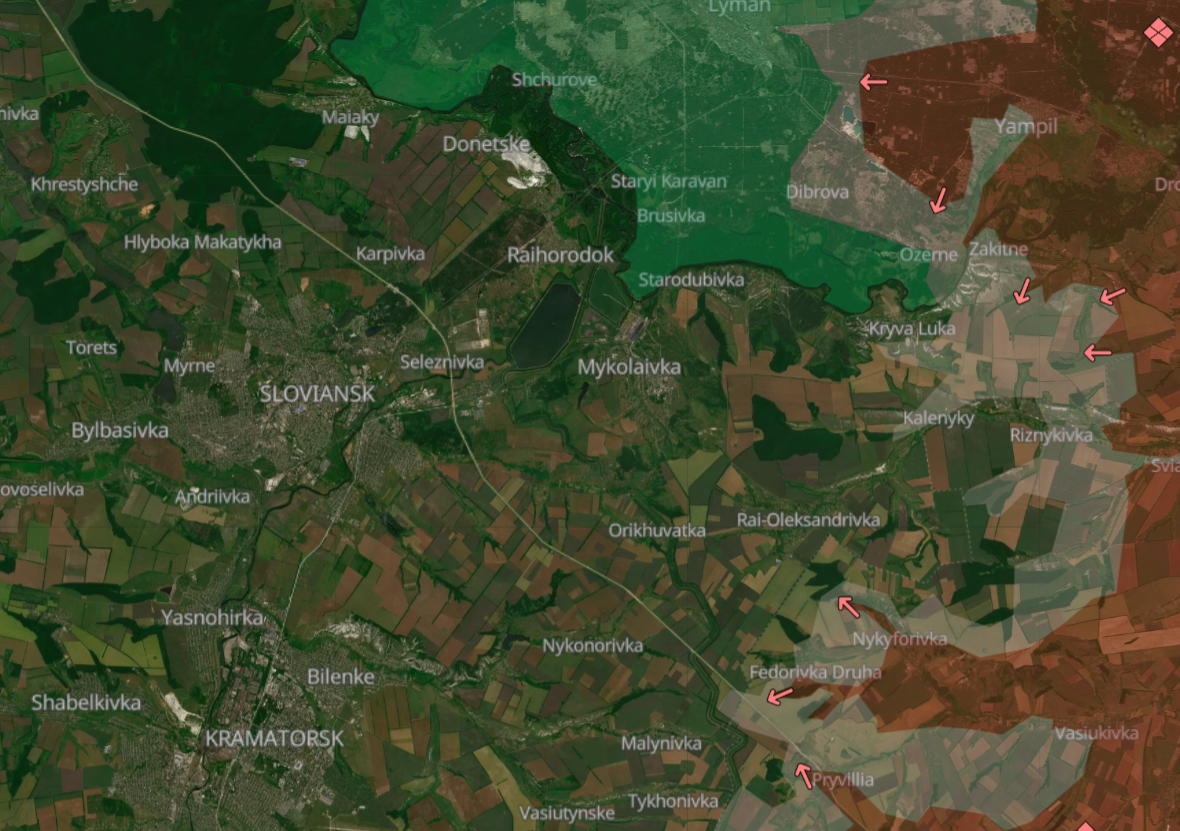
The only Ukrainian‑confirmed advance is near Riznykivka on the Sloviansk axis. Paradoxically, the only place where, according to DeepStateUA, the Russians advanced on Sunday was missing entirely from Rybar’s overview.
This was said to have happened around the village of Riznykivka on the approach to Sloviansk. On the map you can find it on the right in the centre, adjacent to the village of Kalenyky, which the Russians (almost certainly) prematurely reported last week as having captured.
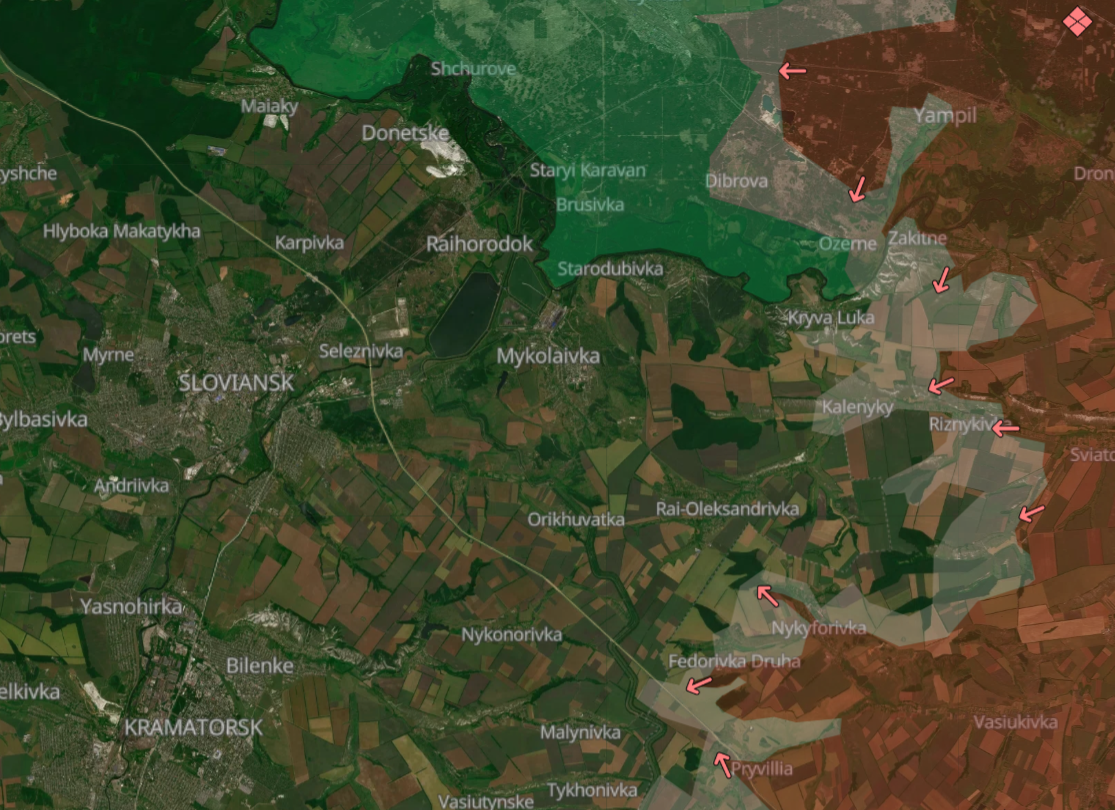
For comparison, here is a map of the same place from a month ago. The changes are minimal:
Flames engulfed the port of Tuapse, there were too many drones and the defences failed to stop them. On the night from Sunday to Monday, a major fire broke out at the refinery complex and oil‑export terminal in Tuapse, Russia. It was, of course, the result of a Ukrainian drone raid.
The footage clearly shows individual large storage tanks, several of which were on fire. According to reports from Russia, it was not only the consequences that were exceptional, but the raid itself.
The tank farm at Russia’s Tuapse oil refinery and export terminal is heavily ablaze tonight after a massive Ukrainian drone attack. pic.twitter.com/Hlulpll6tp
— OSINTtechnical (@Osinttechnical) April 20, 2026
“In Tuapse there was intense machine‑gun fire at aerial targets. The enemy broke through the defences thanks to the sheer massiveness of the raid,” [the channel] Two Majors wrote, for example.
Russia’s defence ministry claimed that during the night it had shot down 112 Ukrainian drones over various regions, but did not specify how many of them were aimed at Tuapse and how many were not brought down. Clearly, more of them reached the target.
The footage alone is enough to understand that the raid was highly successful, but this was also confirmed by Russian sources, so we quote Notes of a Veteran from Monday morning: “The fire has reached maximum intensity. So far it has not been extinguished.”
The Russian channel Rybar covered Ukrainian attacks on the oil industry in more detail. It claimed that such attacks had intensified since the beginning of April and were becoming more frequent.
“The increase in the number of attacks has logically led to a rise in the number of hits. In most cases they are not critical, but they lead to the shutdown of facilities and thus to additional costs. The more such cases there are, the higher the costs of downtime, repairs and the like,” the well‑known Russian channel wrote.
It also published a map showing the affected companies. These were predominantly not processing plants, but infrastructure for transporting oil and oil products.
Videos of the day
The drone offensive against Crimea is continuing on a massive scale. This time, among other things, the targets included landing ships. At least part of the first one is protected by an anti‑drone cage.
“Prymary” unit strikes two Russian landing ships, Yamal and Nikolai Filchenkov, as well as “Podlyot-K1” radar system in Crimea. pic.twitter.com/IIQKmtiu0z
— Special Kherson Cat 🐈🇺🇦 (@bayraktar_1love) April 20, 2026
A soldier shot down a Russian cruise missile with a man‑portable anti‑aircraft missile.
A serviceman of Ukraine’s 38th Anti-Aircraft Missile Regiment downs a Russian cruise missile using a MANPADS. pic.twitter.com/AlhBjTNzGQ
— Special Kherson Cat 🐈🇺🇦 (@bayraktar_1love) April 20, 2026
A surface‑to‑air missile misses a drone.
Russian air defense missiles do not have proximity fuzes capable of dealing with small drones. And we see them regularly fail on medium sized drones as well. pic.twitter.com/spz5Zol4NV
— Andrew Perpetua (@AndrewPerpetua) April 19, 2026
Precision‑guided GBU‑39 bombs miss their target, probably as a result of GPS jamming.
The American GBU-39 Small Diameter Bomb failed during its initial introduction in Ukraine because it could not handle Russian GPS jamming.
Here the impact of that intense jamming is still apparent in the accuracy of the improved SDBs that have since been reintroduced in Ukraine. pic.twitter.com/Q7eMQqTVeA
— Roy🇨🇦 (@GrandpaRoy2) April 18, 2026
The Sting hunter‑killer drone hits the propeller of a Russian Geran. It survives the impact and still manages to record its target’s fall.
Rare Gerbera interception by interceptor STING 💥
Operators of the 1020 Anti-Aircraft Missile and Artillery Regiment flew into the propeller of an enemy drone during a mass attack — and captured its fall on video. All done by a single interceptor STING.
Once again, we’re… pic.twitter.com/soCr0C4Cvm
— Wild Hornets (@wilendhornets) April 19, 2026
What are the losses
No update since Monday (13 April).
By Monday morning, Russia had demonstrably lost 24,440 pieces of heavy equipment (on Monday (30 March) it was 24,383). Of these, 19,079 (19,028) pieces were destroyed by Ukrainians, 975 (971) were damaged, 1,205 (1,204) were abandoned by their crews, and 3,181 (3,180) were captured by the Ukrainian army. This includes 4,381 (4,371) tanks, of which 3,284 (3,276) were destroyed in combat.
Ukraine has lost 11,923 (11,697) pieces of equipment, of which 9,175 (9,027) were destroyed, 668 (656) damaged, 666 (661) abandoned and 1,414 (1,404) captured. This includes 1,412 (1,401) tanks, of which 1,078 (1,071) were destroyed in combat.
Note: Neither side regularly reports on its dead or on destroyed equipment. Ukraine publishes daily figures for Russian casualties and destroyed equipment, but these cannot be independently verified. In this overview we use data from the Oryx project which, since the start of the war, has been compiling a list exclusively of visually documented equipment losses.