Proposal from group that worked with AOC and Bernie Sanders seeks to counter claim that climate policy is politically toxic Americans do not care about the climate crisis, only economic issues: that’s the message some wonks have put forth in the past year, as the Trump administration has dismantled environmental
 Dharna Noor



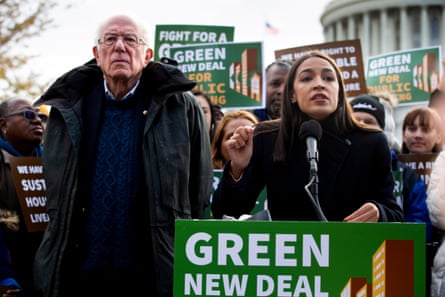
Americans do not care about the climate crisis, only economic issues: that’s the message some wonks have put forth in the past year, as the Trump administration has dismantled environmental protections. But the shift away from climate is misguided, an influential group of progressives is arguing.
“The climate crisis is a core driver of the cost-of-living crisis and instability we see across the economy,” says a new policy platform from left-leaning thinktank Climate and Community Institute (CCI).
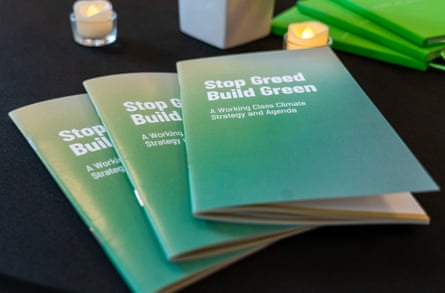
The proposal, “Stop Greed, Build Green,” outlines a framework for what its authors call “green economic populism”. Decarbonization should be understood not as a competing priority to affordability, but as a potential tool for achieving it, says the group, which has written federal bills for Alexandria Ocasio-Cortez, a representative, and Bernie Sanders, a senator, and was behind a groundbreaking New York public power law.
It’s a rebuttal to the growing Washington chorus claiming climate policy is politically toxic.
“The strength of this approach is that it directly challenges the perception that reducing emissions will make your life harder and more expensive,” said Naomi Klein, prominent leftwing author and founding advisory board member for CCI.
The thinktank unveiled its “working-class climate agenda” at a recent New York City launch event, with speakers including Louise Yeung, Zohran Mamdani’s chief climate officer, representatives from the Democratic Socialists of America and Cornell University’s Climate Jobs Institute. A week later, CCI took its message to Washington DC, meeting with lawmakers and hosting a day of panels with former White House officials, congressional staff, scholars, advocates and union leaders.
The advocates backed their proposal with new data: a recent survey by CCI and the progressive polling firm Data for Progress found that 70% of voters, including 65% of Republicans, believe climate action can lower the cost of living. That suggests working people – an audience long targeted by rightwing populists such as Donald Trump – may be receptive to green policies, they say.
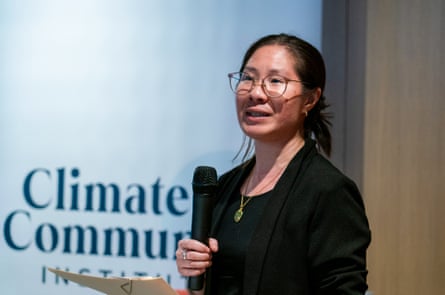
“What we have to be focused on is the real pain that people are feeling in their everyday lives right now as a result of decades of underinvestment on the part of capital and the government in working people,” Patrick Bigger, research director at CCI, said at the New York event.
Other Democrats and progressives are currently linking the cost-of-living crisis to climate. But CCI says it aims to go beyond short-term fixes, promoting economic democracy by confronting corporate power and working with unions and social movements to shape policy.
“True affordability has to fundamentally rewire the hardware that our economy runs on and not the wallets of shareholders and corporate executives,” said Rakeen Mabud, a political economist and senior fellow at CCI.
From the Green New Deal to green economic populism
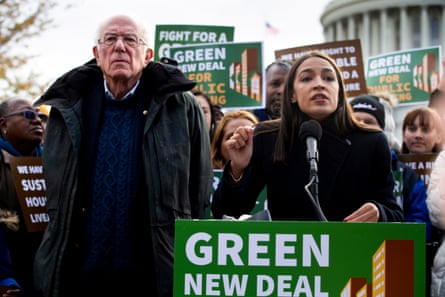
The approach builds on the Green New Deal, the sweeping framework popularized by the Sunrise Movement and Ocasio-Cortez in 2018, for which CCI served as a policy arm. That movement sought to yoke decarbonization to an extensive expansion of the social safety net, promising jobs, housing and healthcare alongside a rapid energy transition.
CCI, then the Climate and Community Project, helped develop federal Green New Deal proposals, including a 2019 public housing bill introduced by Ocasio-Cortez and Sanders and a 2021 schools bill from then-representative Jamaal Bowman and Ed Markey, a senator. It was a “moment for big ideas”, said Daniel Aldana Cohen, the CCI’s founding co-director, whose research underpinned both acts.
Those federal initiatives, while politically galvanizing, stalled in Congress. Elements of the Green New Deal were folded into more incremental policies such as Biden’s Inflation Reduction Act (IRA) of 2022, which delivered major clean energy investments yet fell far short of the broader economic overhaul progressives envisioned. After returning to power last January, the Trump administration swiftly began unraveling those gains.
The new platform aims to learn from both the strengths and limits of that era. Like the Green New Deal, it foregrounds Americans’ everyday material concerns.
Past “neoliberal climate policies” such as carbon pricing, said Klein, paid little attention to impacts on household costs.
“The Green New Deal was our movement’s attempt to correct those errors, by focusing on big-ticket infrastructure and jobs programs,” she said. “But it was so big picture that it came to seem unfeasible to a lot of people, and it was so far off in the distance that detractors could lie about what it was and wasn’t.”
Green economic populism aims to make carbon-cutting proposals more tangible, focusing not on system-wide decarbonization but “climate policy you can touch”, said Aldana Cohen.
“We need to show people: ‘Hey, these policies are for you,’” he said.
One pitfall of the Biden-era climate policy, Cohen argued, is that its benefits were uneven and often invisible. Despite its scale, only 35% of voters in a 2024 survey said they had heard “a lot” or “some” about the IRA. The new approach aims to deliver quick, observable wins: lower bills and expanded access to heat pumps, union-built affordable EVs and free electric buses.
While the Green New Deal emphasized job creation, the new framework focuses on cutting everyday costs. Underemployment remains a concern, Cohen said, but the green jobs created under Biden were a “drop in the bucket” relative to the broader labor market. All working people, he added, are feeling the cost of living crisis – especially as the Iran war drives up fuel prices, underscoring that “fossil fuels cause deadly wars and make your life more expensive”.
“Right now, we need to address the entire working class,” he said.
Organizing beyond elections
Demonstrating that climate policy can improve people’s lives, CCI says, can help build a broader political coalition willing to defend and expand it. The group says those efforts are already underway.
In New York City, Mamdani, a democratic socialist mayor, centered his campaign on affordability while integrating climate policy.
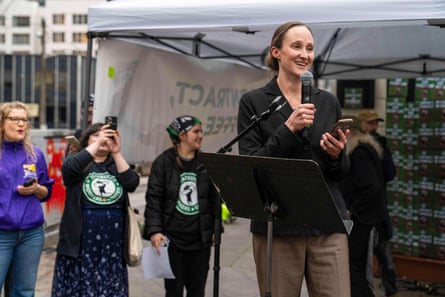
“The mayor inspired New Yorkers by putting affordability at the front and center of his administration, and that extends to how we think about climate solutions,” Yeung, Mamdani’s chief climate officer said. “I really want to make sure we are imbuing all our work with that value.”
Katie Wilson, Seattle’s new socialist mayor, ran on a populist platform that integrated climate, notably plans for green social housing. “I think there’s a lot of alignment between my priorities in office and the green economic populism platform,” Wilson said on a recent CCI press call.
CCI also points to organizing beyond elections, such as the Chicago Teachers Union linking school investment to climate resilience and tenant campaigns in Minnesota paving the way for energy-efficiency upgrades, as evidence the approach is gaining traction.
The platform calls for policies including rent and insurance caps to shield residents from taking on the costs of disasters and green upgrades, expanded free public transit and taxes on polluters to fund climate programs. CCI is also working with unions, social movements and advocates to develop proposals and engaging with federal lawmakers, from progressive mainstays to traditional Democrats.
“By meeting with folks who might not necessarily be in the left flank, we can get a better idea of what kinds of green economic populist policies can resonate more broadly,” said Ruthy Gourevitch, CCI’s housing director and former senior policy adviser for Bowman. “We’re trying to be the research arm of a majoritarian coalition.”
Raising questions
At its DC convening, CCI also solicited feedback. Labor advocates raised questions about tradeoffs between job quality and cost suppression. Sameera Fazili, who served as a deputy director of the National Economic Council in the Biden administration, questioned whether large-scale public spending plans would gain traction in a high-debt environment. And Jigar Shah, who was Biden’s clean energy loans czar, wondered if the plan leans too heavily on price controls and regulation over technological solutions and innovation.
It’s the right time to have debates and “build consensus” about the best way to frame climate policy, Shah said.
“This is why I’m so happy that CCI put out this paper … and that they want my opinion,” he said.
Though she had feedback for CCI, Fazili said she believes green economic populism could help show Americans that climate need not be a culture war issue. While the Green New Deal era encouraged green advocates to put climate first, she said green economic populism could help “tuck climate aims into other policy, into the issues that are the most salient for people”.
Experts say rapid and transformative emissions cuts are still urgently needed, but achieving them will require durable political support, said Bigger.
“The really big emissions wins come from the broader structural transformation that we need to win in the long term,” he said. “To get there, we need buy-in.”