
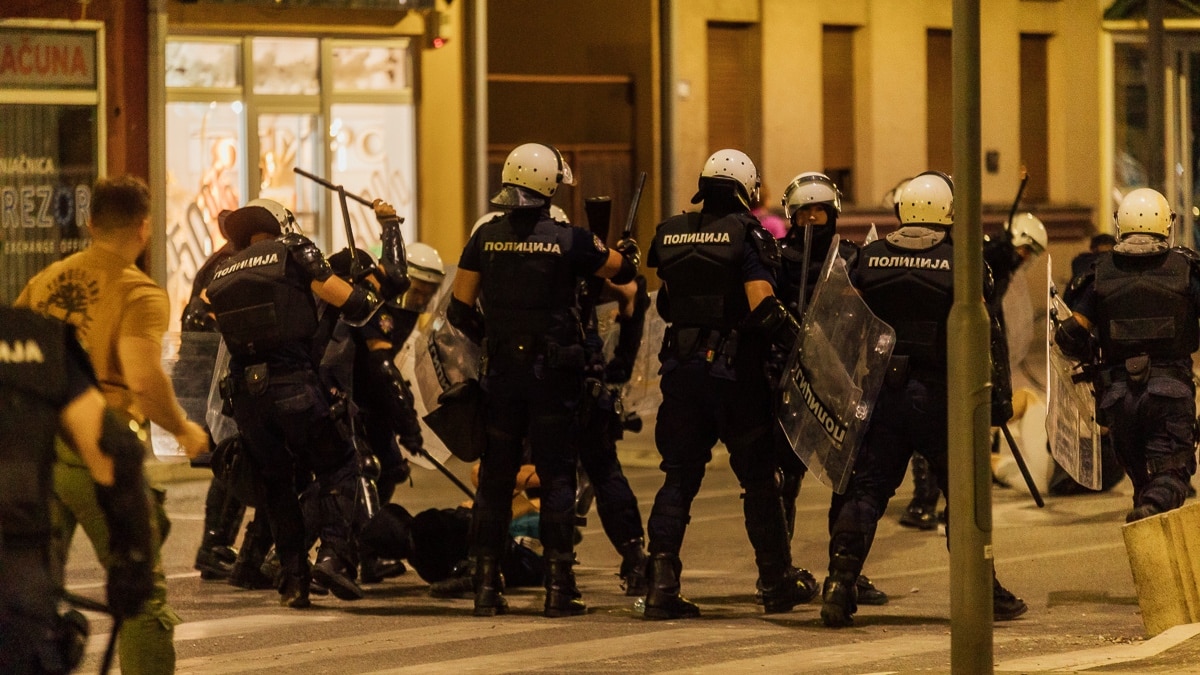
Extensive injuries sustained in a police crackdown on anti-government protesters in the western Serbian town of Valjevo in August last year show the use of force was often ‘punitive’ rather than an immediate response to danger, according to a report compiled by forensic medicine experts.
 Jelena Zoric



Alempijevic and Nikolic were commissioned to investigate by those injured or their lawyers.
Twenty-seven people filed criminal complaints against police officers from Valjevo, Uzice and Prijepolje, accusing them of abuse and torture.
The Basic Prosecutor’s Office in Valjevo told BIRN: “In the cases opened following the filed criminal complaints, as well as ex officio, a pre-investigation procedure is currently underway.”
Alempijevic said his findings showed that the injuries inflicted by police were not limited only to active participants in the protest, but to minors, first-aiders wearing clearly marked clothing, and a taxi driver, as well as people in cafes and bystanders.
This, he said, suggests police did not use force only in a narrowly defined operational situation.
The report compiled by Alempijevic and Nikolic contains one particularly chilling case – that of a minor.
“After he raised his hands and said: ‘I am a minor, I did nothing wrong!’, one member of the Intervention Police Unit struck him on the back with a baton, causing him to fall,” the report states.
“Two more officers then approached him, followed by a larger group of masked police officers who continued striking him with batons and kicking him in the head and body.”
The report also cites several cases of verbal abuse, including threats, as well as the taking of photographs and “behaviour that framed the intervention as punishment” rather than an immediate, necessary response to danger.
One of the people injured said the police threatened them with death. Several accused officers at the local police station of taking photographs of them on mobile phones. One said police demanded his signature on a document, “with a warning not to delay”.
“These elements carry analytical weight because they show that the conduct was not solely procedural or aimed at maintaining control, but also had a symbolic, disciplinary, and humiliating character,” the report states.
Shortly after midnight, a man was detained by police in a betting shop in the town centre.
Ordered to keep his hands above his head, the man said he was struck repeatedly. The beating continued as he was escorted to a police vehicle, along with verbal abuse, threats and humiliation.
“In one case, it was explicitly recorded that detainees were forced to pass through a so-called gauntlet of police officers,” the report states. “In another, testimony indicates that detainees were forced to bark like dogs and were asked, ‘Who are the dogs now?’ while being kicked in the genitals and later filmed at the Valjevo Police Department.”
In Serbian, ‘dogs’ is sometimes used as slang for police officers.
“This clearly shows that the use of force did not stop once factual control over the detainees had been established,” the report adds.
In some cases, medical examinations were conducted inside the police station, in the presence of police officers. Officers also attended later medical exams at the hospital. One person said they were denied medical care.
The police presence, the report states, “raises the question of the degree of autonomy and confidentiality of medical contact, which is especially significant given that access to a doctor is, according to international standards, one of the three protective mechanisms for preventing torture and abuse”.
Victim’s head stamped on