
Former Bulgarian president (2017 to January 2026) Rumen Radev appears to be on his way back — but this time, to the prime minister’s office. The former air force commander with pro-Russian views, who in January stepped down from the presidency in order to run in Sunday’s snap parliamentary elections, is
 Anastasiia Furman



First published in Denik N
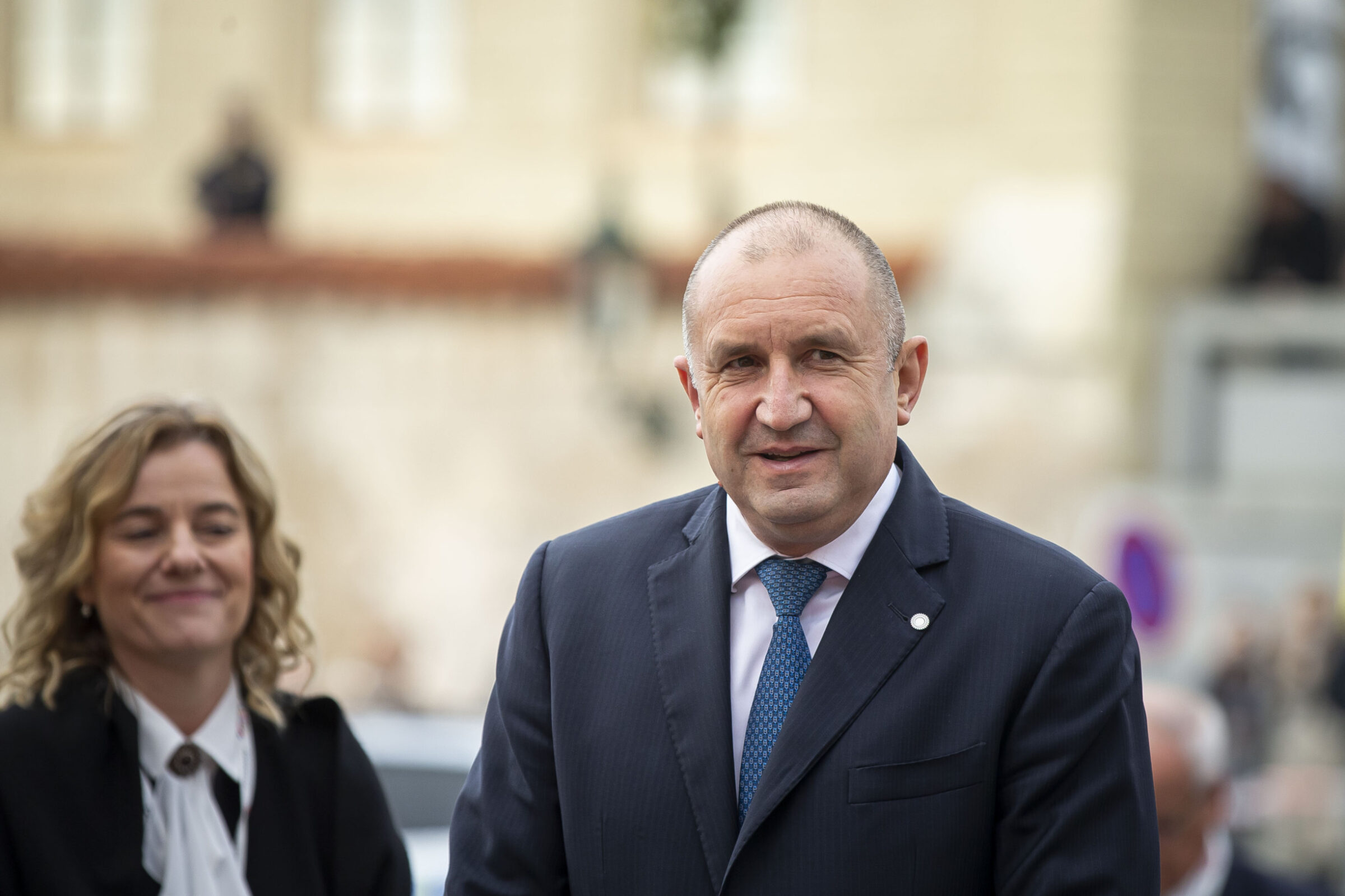
Former Bulgarian president (2017 to January 2026) Rumen Radev appears to be on his way back — but this time, to the prime minister’s office.
The former air force commander with pro-Russian views, who in January stepped down from the presidency in order to run in Sunday’s snap parliamentary elections, is promising a fight against the all‑pervasive “mafia state”, which he said was undermining the European Union’s least developed member state.
The newly formed movement Progressive Bulgaria, which he leads, could according to polls win 32–38 percent of the vote, meaning it would face the same problem as its predecessors: the difficult task of forming a coalition.
Bulgaria, Myara poll:
PB-*: 35% (+4)
GERB-SDS-EPP: 19% (-1)
PP-DB-RE|EPP: 12% (-1)
DPS-NN-NI: 9% (-2)
V-ESN: 8%
BSPOL-S&D: 4%
Siyanie-G/EFA: 4% (+2)
MECh-*: 4%
Velichie-*: 2% (-1)
APS-RE: 2% (+1)
ITN-ECR: 1%
+/- vs. 07-16 March 2026
Fieldwork: 04-13 April 2026
Sample size:… pic.twitter.com/NkB6bddVgD
— Europe Elects (@EuropeElects) April 17, 2026
The country of 6.4 million inhabitants, shaken by recurring political crises and weakened coalitions, now has an unusual combination: an interim president (Ilijana Jotova) and an interim prime minister (Andrey Gyurov).
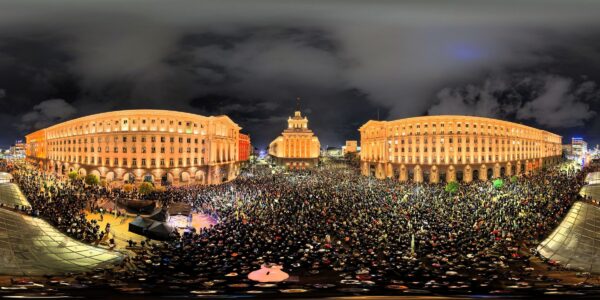
Since 2021 there have been a total of seven prime ministers, and not one has completed a full term.
It is unclear whether Radev, who is sceptical about support for Ukraine and about Bulgaria’s entry into the eurozone this year (but, for example, accommodating when it comes to imports of Russian oil), will be able to break this political deadlock.
Bulgaria is the so‑called cradle of Cyrillic, which originated there at the end of the ninth century, and a predominantly Orthodox country, which inevitably links it to Russia.
This was mentioned by the potential next PM Radev himself, who added: “We can be a very important link in this whole mechanism for restoring relations with Russia.”
The ‘new Orbán’?
That is why he is talked about as a possible candidate to become Putin’s main friend in the EU. All the more so after Hungarian prime minister Viktor Orbán – who had offered Vladimir Putin to be his European ‘little mouse’ and do whatever was needed – lost the parliamentary elections.
Radev decided in January to step down from the presidency because the president in Bulgaria, as in the Czech Republic, has very limited powers.
Radev, however, was determined to tackle the protracted political crisis that had been plaguing the country for several years and that escalated at the end of last year.
Shortly before his self-abdication, the government of prime minister Rosen Zhelyazkov resigned (in December) as a result of the biggest protests since the 1990s and allegations of corruption.
The cabinet, which had taken office the previous January, survived six no‑confidence votes before ultimately collapsing anyway.
On top of that, the fall of the government came just three weeks before the adoption of the euro.
The demonstrators initially demanded the withdrawal of the state budget — but that evolved into the resignation of the entire government. The prime minister justified his departure from office by citing a “loss of political support and the need to restore public trust”, as well as “the interest of institutional stability”.
A major factor in the protests was chronic distrust of politicians and the decision to enter the eurozone – a sensitive decision for most central and eastern European countries.
Some Bulgarians feared price rises and a loss of control over the economy, while others saw it as another step towards European integration in which they already had little faith. It was also about whether the country belonged firmly to the West, or rather to the East.
Mass protests and clashes with the police in the capital of Bulgaria, Sofia, and the Black Sea city of Varna.
The people took to the streets after the government approved a controversial budget and raised taxes. pic.twitter.com/aeur3I1SHv
— Sprinter Press Agency (@SprinterPress) December 3, 2025
The pilot who wants to overthrow the oligarchy
Radev deliberately built his political identity on his reputation as an air force pilot. Even before the 2016 presidential campaign, the air force press office took care of extensive promotion of his aerial acrobatics.
He chose a similar strategy this year: in one of the videos he appears directly in the cockpit of a MiG‑29 fighter jet.
After he took the presidential office in 2017, he used his military past to craft the image of a patriot standing outside political games. He still invokes his army experience to this day when defending the view that Ukraine should seek a peace agreement with Russia.
His political breakthrough, however, came in 2020.
The crisis at that time, triggered by the influence of oligarchs over the prosecution service, led to mass street protests. When the police raided the presidential office and detained two of his aides, Radev appeared before the crowds with a clenched fist, condemned corruption and called on the “mafia” to leave the offices.
Even now, Radev’s goal, as he said, is the “overthrow of the oligarchy”.
His main rivals are former prime minister Boyko Borisov (three‑time prime minister between 2009 and 2021) with the GERB party, and the leader of DPS – New Beginning, Delyan Peevski (sanctioned in the UK and the US over corruption).
The opposition accuses both of them of being pillars of the oligarchic state, which they both deny.
Corruption in Bulgaria is, without exaggeration, catastrophic.
Last year the country ranked only 84th, together with Hungary, in the Corruption Perceptions Index published by Transparency International.
It thus finished worse than Moldova, Romania and, for example, Kosovo, Ghana or Trinidad and Tobago.