

Ukrainian forces carried out a high-precision operation in occupied Donetsk, utilizing a “train” of eight drones to strike an apartment allegedly housing 12 FSB officers. While the front remains largely static, Ukrainian defenders in Kostyantynivka are facing a critical shortage of personnel. Recent battlefield footage highlights these dynamics.
 Roman Pataj



Every day, the Ukraine Battlefield update newsletter offers a clear look at how the war is unfolding on the ground, highlighting key developments along the frontline and the shifting dynamics of the conflict. This offers readers regular and detailed information to better understand the implications of the war for the country and the whole continent.
Drones in occupied Donetsk attack high-value Russian targets , followed by unusual Russian silence. There were not enough [drone] operators in Kostyantynivka, Russians were gradually penetrating the town. Russian report from the front – ‘we are fighting, but not advancing’. Maps of the day – Kostyantynivka; Kharkiv region. Videos of the day – precision drone strikes on Russian headquarters; what Kostyantynivka looks like during the ongoing battle for it; Russians also used naval drones in the Black Sea; Bradley shredded an MT-LB.
The information in this text was a summary of events for Thursday (23 April). The situation may have changed since.
Drones in occupied Donetsk attack Russian officers, followed by an unusual Russian silence over the incident. Over the course of 24 hours, Ukrainian soldiers published two videos from two different locations that illustrated a new way of using drones. In both cases, according to the Ukrainians, these were attacks either on a command post or on a large concentration of FSB officers in a specific building.
The first to report on both was the commander of the Magyar Birds unit, Robert Brovdi, and in both instances he published key details either about the targets or about the problems Ukrainians faced during such operations.
We will start the description with the attack in Donetsk, in which, according to the Ukrainians, 12 FSB officers were killed and another 15 were wounded.
It was remarkable because the target was an ordinary flat in a large panel building probably full of residents. Also because the Ukrainians were so confident about the accuracy of the strike and considered the target so important that they sent a “train” of eight drones to that single location. And, last but not least, because the Russians maintained almost complete silence about this incident and Ukraine’s version of events.
The air raid took place on Tuesday morning at 8:01. The target was an ordinary residential building, and eight FP-2 drones with a payload of 60 to 100kg of explosives were aimed at it. Ukrainians routinely used them to strike high-value targets behind the front. Brovdi said that in this case the operation was carried out jointly by specialists from the Unmanned Systems Forces and the 1st Army Corps.
The following video combined footage from the attacking drones and videos shot by local residents who recorded the course and aftermath of the strike. In the shots taken in the aftermath, it was clearly visible that at least two floors were heavily damaged and others to a lesser extent. It was also clear that the drones were accurately aimed.
Unmanned Systems Forces strike a command post and deployment location of an FSB special unit
On April 22, as part of a combat operation, operators of the @1usc_army struck a command post and deployment location of an operational unit of the russian FSB.
The UMD FSB RF is an… pic.twitter.com/7I8DXvDETE
— 🇺🇦 Unmanned Systems Forces (@usf_army) April 23, 2026
It was striking that Russian sources were keeping almost completely silent about the incident. One of the large Telegram channels acknowledged it, but in general Russians were not writing about civilian casualties and the usual accusations of Ukrainian terrorism were also missing. Of course, this applied to the monitored Telegram authors. It could not be ruled out that exceptions existed.
Brovdi said that members of the FSB counter-intelligence service had been present in the targeted flat. According to him, this unit “carried out sabotage and military special operations, created agent networks, searched for and detained disloyal citizens, physically eliminated opponents, and coordinated pro-Russian militants.” By the time of publication, the Russians had not refuted this claim.
In the second case, six drones attacked the headquarters of a unit subordinated to the 58th Army in Kadiyivka in the occupied part of Luhansk region. The building was located 55km from the front, and six FP-2 drones successively targeted it. At first glance, it was striking that not all the explosions reached the same intensity.
Commander of the USF, Robert “Magyar” Brovdi, publicly highlighted an issue with munitions supplied by certain manufacturers.
Effective decisions are only possible when based on real, unfiltered information. Without acknowledging, analyzing, and fixing mistakes, quality military… pic.twitter.com/zHWipcO7JM
— 414 Magyar’s Birds (@414magyarbirds) April 24, 2026
“Compare the first and second drone. Both had a 100-kg warhead. We had to use six drones to destroy that nest. Two should have been enough for complete destruction. The other four birds could have wiped out two more lairs,” Brovdi wrote under the video.
He identified the uneven quality of explosives from different manufacturers as the problem.
There were not enough [likely Ukrainian drone pilots] operators in Kostyantynivka with Russians gradually penetrating the town. “Operators from this sector talked about a shortage of people who would be able to hold back the Russian onslaught,” Ukrainians from DeepStateUA wrote, citing the battle for Kostyantynivka.
Effective drone units were among the problems. “They were constantly trying to hold back the enemy infantry, but its ‘endless’ numbers were gradually breaking through the defence of Kostyantynivka. At the same time, the Russians were razing the town to the ground, which made its defence even more difficult,” the well-known OSINT account wrote.
Russians were attacking on the flanks from the east and west, gradually trying to push into residential districts, entrench themselves there, and expand the area under their control.
Russian report from the front – ‘we are fighting, but not advancing’. The front was static and the Russians saw it too. The most-quoted morning situation report – a summary of the fighting over the previous 24 hours – was published every day by the Telegram channel Dva majory (Two Majors). Other popular sources picked it up daily, including the even larger and more influential Rybar. We are publishing the Friday morning report almost in full, with the exception of sections referring to mutual air raids.
Sumy axis – The Sever (North) group of forces was engaged in fierce fighting in Miropillia, which the enemy had turned into a fortified area. In the Krasnopil district, intensive infantry battles continued near the village of Taratutino and in Novodmytrivka. Constant pressure was being exerted on the enemy along a broad front.
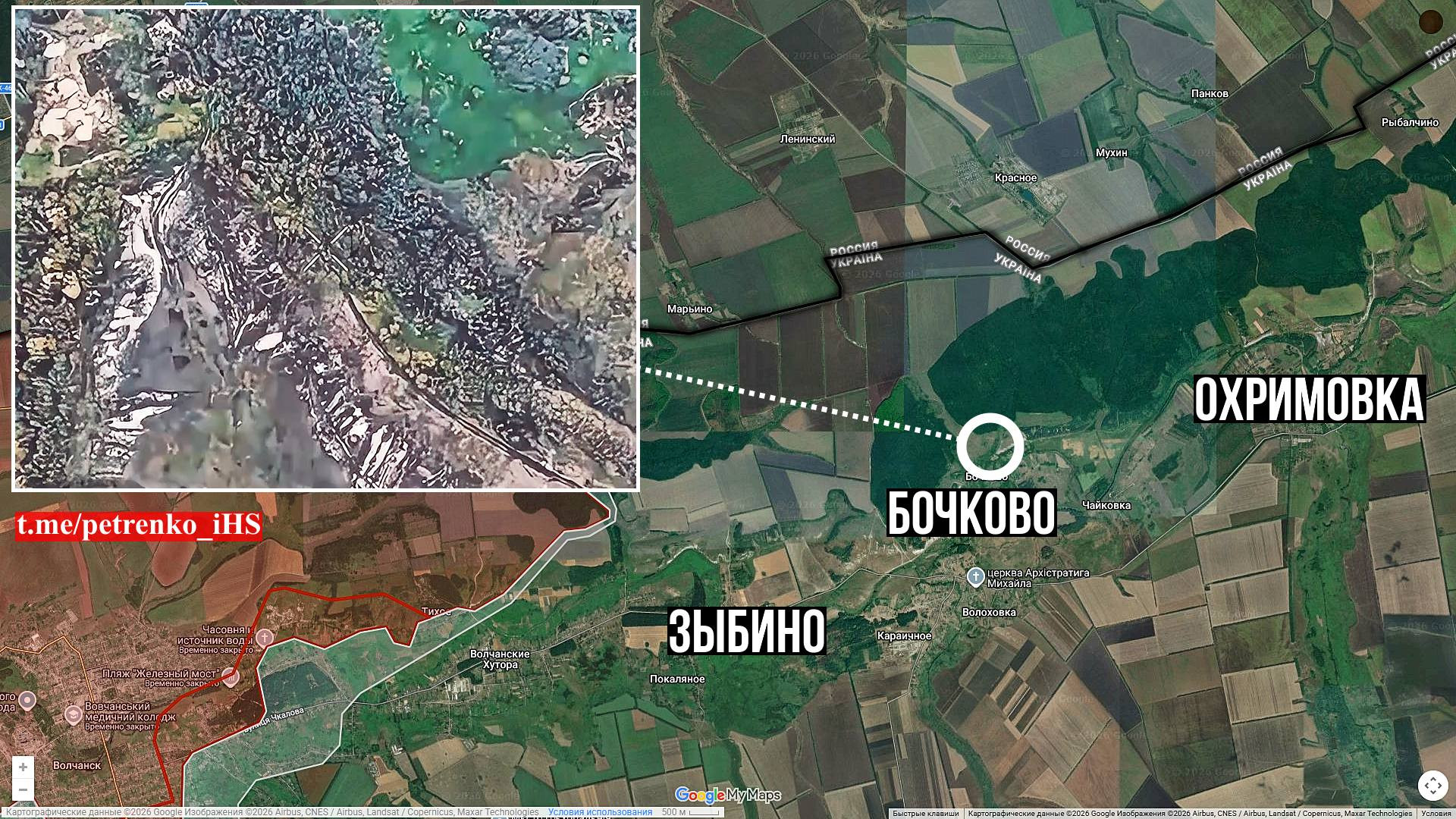
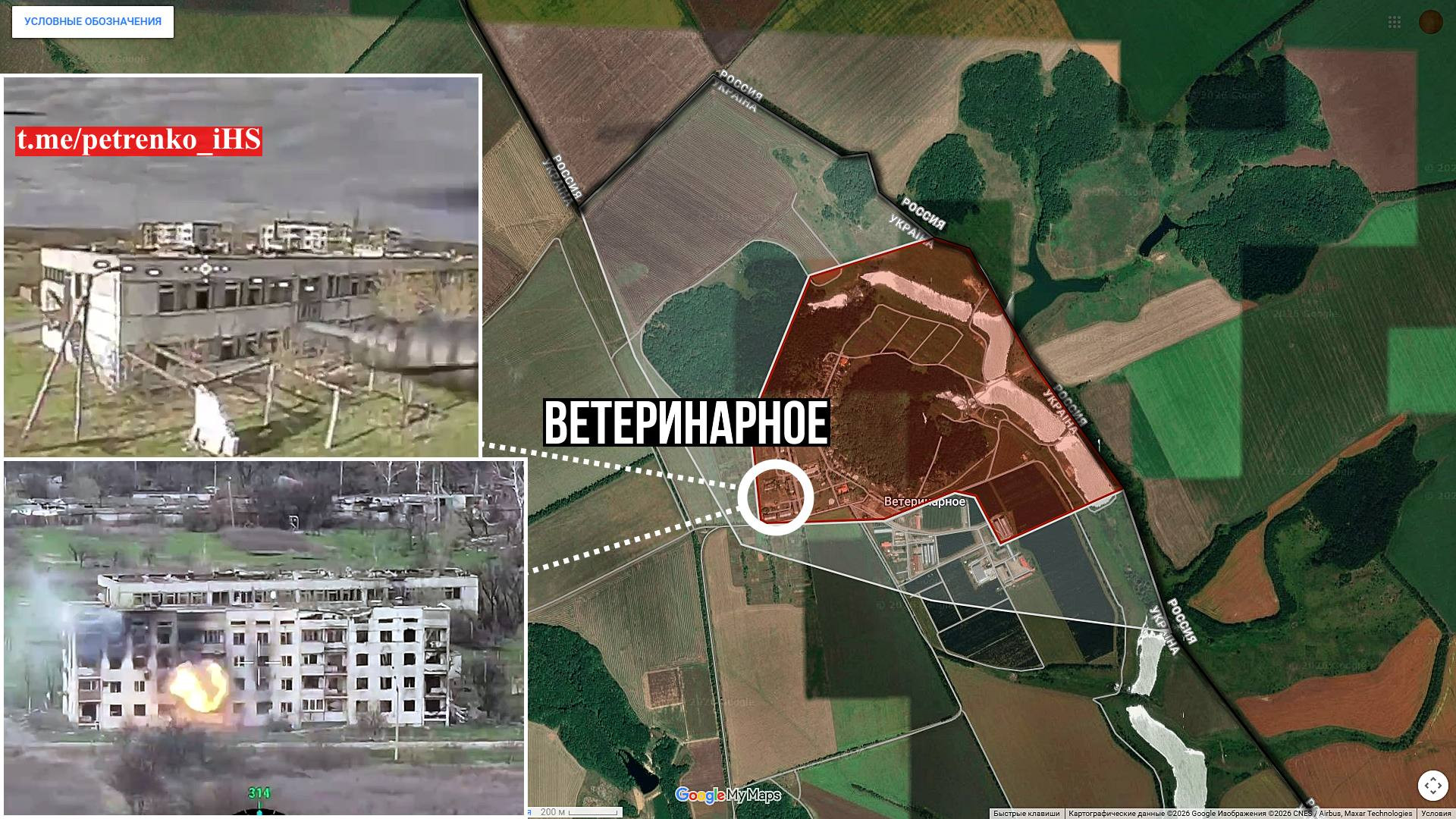
Kharkiv axis – after the “liberation” of the settlement of Veterynarne directly on the state border, the enemy was trying to build a defence in Kozacha Lopan. The command of the Ukrainian Armed Forces was moving in reserves in the form of the 58th Motorised Rifle Brigade. On the left flank of the Vovchansk sector, fighting was under way for the border village of Bochkove and in the direction of the village of Losivka.
(For illustration, we added a map by Ukrainian analyst Oleh Petrenko, who confirmed the Russian attack on Bochkove but also attached a video showing a small group of infantry being eliminated by drones. He added a map geolocated to the report. It was an example of how Russian sources worked – somewhere their soldiers appeared, who were already dead or wounded, but in their report they were still “fighting for the village of Bochkove”.)
The same Ukrainian source also questioned reports about the capture of Veterynarne. It said fighting was under way for the northern and southern parts of the village, which, according to Russian sources, was important because of its position on high ground from which Ukrainians had had an overview of what was happening on the Russian side of the border.
Kupiansk axis – on the northern flank of this axis, the Sever (North) group of forces was becoming more active. Heavy fighting continued in the area of the village of Budarky and in the north-west of the Kupiansk district. It seemed that the command was increasing pressure on this sector with the help of “neighbouring” units.
Kostyantynivka and Dobropillia axis – No significant changes. Heavy, high-intensity fighting was ongoing along the existing lines – for the outskirts of Kostyantynivka on the flanks and around Hryshyne.
Dnipropetrovsk region – The Vostok (East) group of forces continued to expand the zone under its control north-west of the village of Oleksandrohrad (located in Donetsk region – editor’s note); fighting was taking place in the forested area beyond the Vovcha river.
Zaporizhzhia front – fighting for Prymorske and Stepnohirsk.
At first glance, the report might have looked like evidence of high activity and Russian successes, but anyone who followed this or other Russian sources regularly would have noticed that sentences such as “constant pressure was being exerted on the enemy along a broad front” were not reports of advances, but rather that the front was not moving.
Videos of the day
Russians were also trying to use seaborne drones in the Black Sea. This one was heading for Odesa, but was destroyed.
A Ukrainian Bradley fighting vehicle shredded a Russian MT-LB armoured personnel carrier. Given the appearance of the cage armour above the Russian vehicle, this was probably older footage. Such simple protection against drones was rarely seen nowadays.
What were the losses
Last updated on Tuesday (21 April).
By Tuesday morning, Russia had verifiably lost 24,471 pieces of heavy equipment (on Monday (13 April) it was 24,440). Of these, 19,108 (19,079) pieces were destroyed by Ukrainians, 976 (975) were damaged, 1,206 (1,205) were abandoned by their crews, and 3,181 (3,181) were captured by the Ukrainian army. This included 4,385 (4,381) tanks, of which 3,288 (3,284) were destroyed in combat.
Ukraine had lost 11,977 (11,923) pieces of equipment, of which 9,224 (9,175) were destroyed, 669 (668) damaged, 670 (666) abandoned, and 1,414 (1,414) captured. This included 1,416 (1,412) tanks, of which 1,081 (1,078) were destroyed in combat.
Note: Neither side regularly reported on its dead or on destroyed equipment. Ukraine published daily figures for Russian losses and destroyed equipment, which could not be independently verified. In this overview we used data from the Oryx project which, since the start of the war, had compiled a list of equipment losses documented exclusively by photographic evidence.