
“The international order will be rebuilt … out of Europe,” said Canadian prime minister Mark Carney, in a sequel to his Davos speech.
 Andrew Rettman



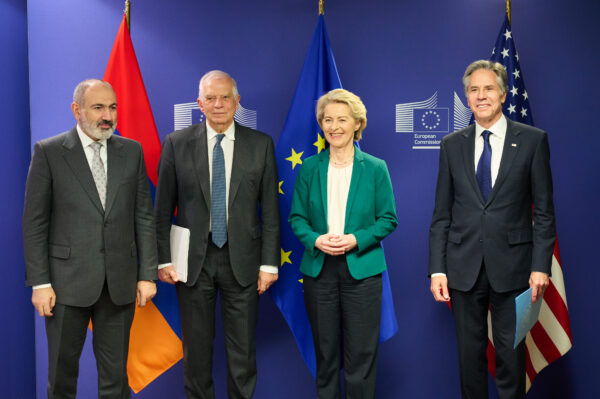
Canada, the EU, EU-aspirant, and other European states have pledged closer alignment in the face of Russian and US geopolitical threats.
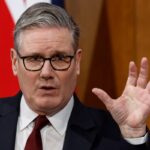
“We know nostalgia is not a strategy, but we don’t think that we’re destined to submit to a more transactional, insular, and brutal world,” said Canadian prime minister Mark Carney at a European summit in Yerevan on Monday (4 May).
“It’s my strong personal view that as the international order will be rebuilt, it will be rebuilt out of Europe. And so I’m very appreciative of the symbolism of this invitation,” he added.
“We are the most European of non-European countries,” Carney said.
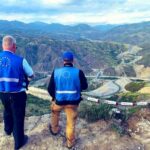
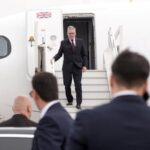
The Yerevan summit of the European Political Community (EPC) brought together mostly EU leaders, those from EU-aspirant countries in the eastern neighbourhood, such as Armenia, Moldova, and Ukraine, as well as Iceland, Norway, and Turkey.
It was held in the shadow not just of Russia’s war on Ukraine, but also of unilateral US aggression against Venezuela and Iran, as well as US president Donald Trump’s threats to end Nato.
And Carney came to Yerevan after Trump had also threatened Canada and Greenland in the run-up to the Davos World Economic Forum in Switzerland in January, where the Canadian leader inspired EU peers with a speech on the need for “middle powers” to stand together to tame unruly “hegemons”.
Carney pledged to keep Canadian troops in Nato’s Russia-deterrent multinational battalion in Latvia and to work with Europe on more secure supplies of energy, semiconductors, critical minerals, and vaccines, as well as on digital sovereignty and on US-independent payment systems.
For his part, French president Emmanuel Macron said in Yerevan: “The Russian war against Ukraine revealed our over-dependencies regarding gas and Russian gas. We are [now] experiencing the cost of our over-dependencies when we speak about the American umbrella in terms of defence and security”.
“Let’s be honest, this is the elephant in the room,” he said of Trump’s America.
“Ukraine is by far the hottest topic” on the EU agenda, Macron added, amid fears Trump might pull US troops from Europe, leaving Nato open to an attack by Russia after the Ukraine war calms down.
And the Ukrainian president, Volodomyr Zelensky, underlined that its drone-warfare capabilities could help protect the EU in a post-Nato theatre.
“They [the Russians] fear drones may buzz over Red Square. This is telling. It shows they are not strong now,” Zelensky said in Yerevan, alluding to Ukraine’s disruption of Russian president Vladimir Putin’s military parade on Saturday, designed to commemorate the end of World War 2, which Kyiv was actively trying to derail despite Trump’s demand for it to let Putin host his event in peace.
Armenia
Meanwhile, Armenia itself had been pulled into Russia’s orbit in 2014 when it joined Putin’s ‘Eurasian Economic Community’, but it broke with Moscow when Russian peacekeepers failed to stop Azerbaijan from conquering an Armenian-held region in 2023.
“Eight years ago, this country was seen by a lot of countries around the [EPC] table as a sort of de facto satellite of Russia,” said Macron on Monday.
“[Armenian prime minister] Nikol [Pashinayn] organised this velvet revolution and decided to de-risk his country from Russia. And he still gets attacked on a daily basis because of that,” Macron added, referring to the 2018 pro-democratic Armenian Revolution.