
Former European integration minister Gordana Djurovic tells BIRN that Montenegro, the frontrunner for EU accession, now has membership within its sights – but cautions that there is plenty of hard work ahead.
 Predrag Milic



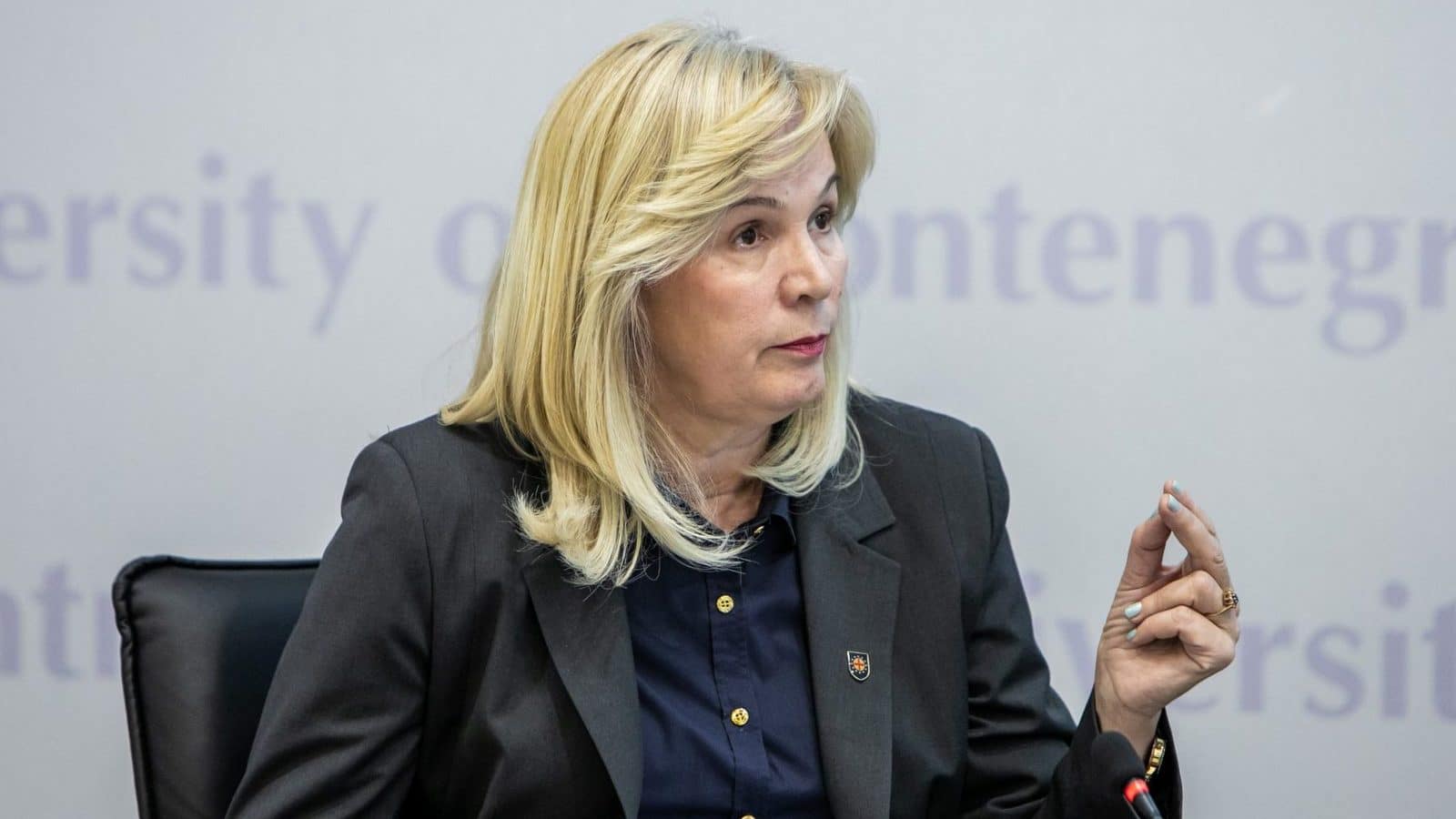
Djurovic, who has been a professor of economics at the University of Montenegro in Podgorica since 1990, is a veteran observer of the country’s progress towards EU membership. She served as deputy prime minister for European integration from 2006 to 2009 in the Zejko Sturanovic government, and as minister for European integration from 2009 to 2010 under Milo Djukanovic. Both governments were led by the Democratic Party of Socialists, DPS, under whom the integration process started back in the mid-2000s.
During this period, she also headed Montenegro’s negotiating team for the Stabilisation and Association Agreement with the EU.
Djurovic believes the year 2026 will be decisive for Montenegro.
“It is realistic to say that 2026 is crucial for completing most of the final work,” she stressed. “A more cautious assessment is that the beginning of 2027 is a more likely framework for formally concluding the negotiations, if the current pace continues.”
Djurovic said closing all the remaining negotiating chapters in 2026 is ambitious but not impossible, while key conditions for signing the treaty “remain unchanged”.
“They include a stable track record in the rule of law, especially in high-level corruption and organised crime cases, greater efficiency and independence of the judiciary, and credible protection of fundamental rights and media freedom,” she said.
“Equally important is the reliability of institutions in implementing obligations, as well as a sufficient level of political stability.”
Djurovic added that cross-party political cooperation will be important.
“In our case, there is also a need for a well-founded and necessary call from the governing coalition to the opposition to ensure that the parliament functions at full capacity,” she said.
Djurovic said the biggest challenges lie in the combination of reforms, institutions and politics.
“The biggest challenge is the combination of these […] factors, but I would still single out institutional capacity and political cohesion as decisive,” she said. “The EU now expects reforms to survive every political change and deliver continuity.”
A major motivating factor for the EU is concern about Russian influence spreading in Europe, with states in the Balkans seen as vulnerable to interference. Djurovic noted that the EU’s decisions on enlargement are shaped by regional political dynamics.
“Enlargement is seen as a geostrategic investment in stability, security and resilience in the Western Balkans,” she said. “But geopolitical momentum alone is not enough – it opens the door, but only a candidate that meets the criteria can pass through it.”
She added that resolving bilateral issues with Croatia, an EU member state, will also be important in the final phase. Montenegro and Croatia have sparred over various issues in recent years, with Zagreb fearing excessive Serbian influence on Montenegrin politics.
Djurovic acknowledged that foreign influence remains a concern. “External influence remains a serious security and political test, which is why the EU will insist on additional safeguard mechanisms,” she said.
Nevertheless, she expressed optimism: “If Montenegro closes all chapters in 2026 and works in parallel with the European Commission on the Accession Treaty, negotiations could be formally concluded at the beginning of 2027. That would be followed by translation, signing and ratification, opening the door to membership in 2028,” she suggested.
Montenegro voted for independence in a referendum held in May 2006, and the European Union moved the following month to establish relations with the country as a sovereign and independent state.
Montenegro signed its Stabilisation and Association Agreement with the EU in 2007, while the agreement entered into force in 2010 after ratification by member states.
The country applied for EU membership in 2009, was granted candidate status in 2010 and formally opened accession negotiations in 2012.