

As rising gold prices fuel environmental destruction, communities in the country’s biodiverse heartland are passing laws against mining Mahogany trees tower above Herminio Mamani as he tends his cacao farm in Bolivia’s biodiverse north-west. A former president of El Ceibo, the country’s largest organic cacao co-operative, he says the agroforestry
 Benjamin Swift in Palos Blancos, Bolivia



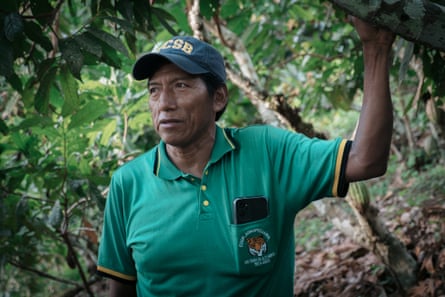
Mahogany trees tower above Herminio Mamani as he tends his cacao farm in Bolivia’s biodiverse north-west. A former president of El Ceibo, the country’s largest organic cacao co-operative, he says the agroforestry model used by its 1,300 members is vital not only to maintain the quality of the cacao they produce, but also for keeping gold mining at bay.
“We cacao producers would never kill an animal here,” he says, parrots squawking nearby. “The parcels [of land] can never be monocultures – all the crops grow together.”
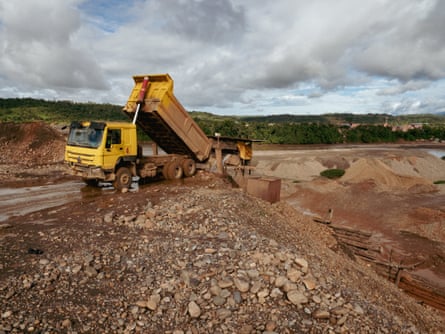
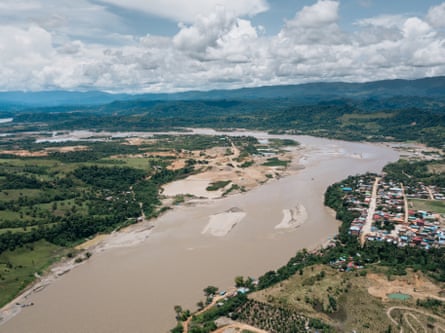
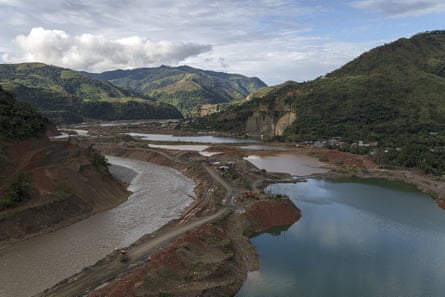
About 20 miles away, dredging boats and excavators operate relentlessly along the Kaka River, part of a gold rush that has rerouted waterways and encroached on forests in some of the world’s most biodiverse national parks. Mamani’s land remains protected thanks to local laws passed in 2021 banning mining in Palos Blancos and Alto Beni.
He was among those who pushed for the local ordinance declaring Palos Blancos mining-free, a move framed as essential for safeguarding agriculture and food security. Alto Beni, a neighbouring town, followed suit with a similar measure months later.
As gold prices surged by more than 64% in 2025, from about $2,000 (£1,465) an ounce in 2020 to record highs above $5,100 (£3,762) an ounce in January amid rising geopolitical uncertainties, other Bolivian cities are looking to these towns as models for protecting their land.
The initiative began in 2017, when a mining dredge appeared on the nearby Boopi River, which borders Alto Beni and Palos Blancos. Both municipalities, reliant on organic agriculture, had avoided mining but witnessed its devastation elsewhere.
“I’ve known Mayaya since I was young, and the river used to be deep and full of fish,” says Roberto Gutierrez, a farmer in Alto Beni, referring to a nearby town where mining dominates. “Now the water levels have dropped, pollution has seeped in, and the fish are disappearing.”
Communities reacted swiftly. “People gathered in mass protest and issued a warning: ‘Leave, or we burn your machinery,’” recalls Nancy Chambi, a farmer and Alto Beni councillor. The miners left.
El Ceibo and other co-operatives opposed mining, fearing mercury contamination could strip them of international certifications. “Even if small-scale mining were permitted, it’s a slippery slope,” Mamani says. “Contamination would be unavoidable, and if we lost our certifications, the price of our cacao would plummet.”
After four years of grassroots pressure, Palos Blancos and Alto Beni passed mining bans in 2021. A 2024 departmental law further legitimised their stance against the national government’s will.
“We showed people that mining does more harm than good,” says Ulises Ariñez, former environment secretary for Palos Blancos. “People have realised that gold is temporary, but agriculture and conservation are for life.”
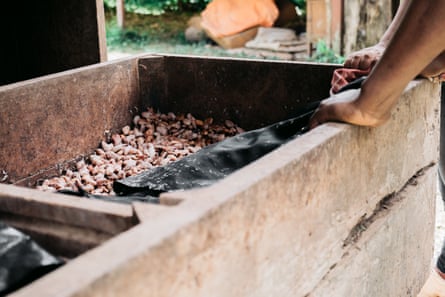
The laws have secured farmers’ organic status. In 2025, El Ceibo exported 2,000 tonnes of cacao, mostly to Europe and the US, providing some resilience amid Bolivia’s economic crisis. “With the country’s economy in such bad shape, people here are a bit more at ease,” says Jesús Tapia, an El Ceibo producer.
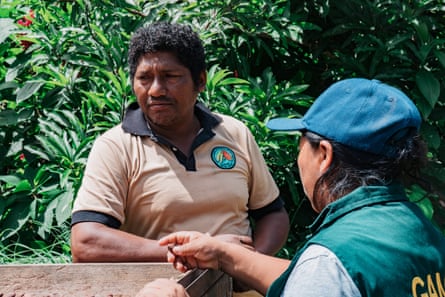
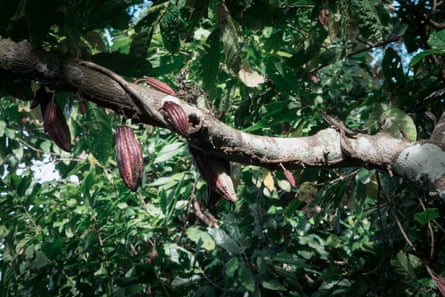
For Chambi and Gutierrez, who sell crops such as cacao, bananas and papaya through a smaller co-operative, the laws have been transformative. “If Mayaya has yellow gold, we have purple gold,” Gutierrez says of their cacao pods.
But record gold prices have fuelled illegal mining globally, driving deforestation, mercury poisoning, armed conflict and human and animal trafficking. In Bolivia, legal and illegal mining has spread into protected areas, unhindered by lax regulations. Severe flooding in Tipuani and Guanay has forced potential town relocations.
At least 10 other municipalities and Indigenous territories are now pursuing similar bans. “This is the beginning of the fight,” says Pablo Solón, an environmental activist and former Bolivian UN ambassador who has supported municipalities seeking alternatives to mining. “We have to build a wall to prevent mining from coming down the river.”
He sees the most potential for resistance in municipalities such as Rurrenabaque, which already has a strong tourism sector, and Indigenous territories like Pilón Lajas, while acknowledging that mining will continue elsewhere. “It will be a wall to prevent the cancer from spreading,” he says. “But the cancer exists.”
Cacao producers in Palos Blancos and Alto Beni access international markets, but elsewhere, farmers struggle. “We have produce, but lack access to markets,” says Karen Coata, vice-president of the Organisation of Indigenous Leco Women.
In her territory, Pilcol, people report mercury-related illnesses, such as headaches and lung pain, yet many mine to supplement their incomes. “How else will we make ends meet?” she asks.
Franklin Quequesana, a Guanay councillor, advocates regulated mining rather than outright bans. “Guanay is a mining municipality – it’s about 80% of our economy,” he says. “It would be impossible to pass a municipal law here, but we can prohibit mining in certain sectors.”
Ariñez, now a municipal coordinator for the nonprofit Fundación Natura, is working with Quequesana to pass a law designating the area of Uyapi as mining-free to protect its agriculture. The goal is feasible: in 2024, the municipalities of Guanay and Teoponte – both reliant on mining – created adjoining conservation areas. “Five years ago, no one would have talked about a protected area here,” says Ariñez.
With gold prices expected to keep rising, mining will expand. “Mining could be done responsibly, but that would mean managing waste correctly – I don’t think that will happen,” Quequesana says. “The central government keeps authorising projects, and we’re the ones affected.”
Alfredo Zaconeta, a mining researcher at nonprofit Cedla, argues that national policy is needed. “Unless the government clearly defines which areas are open to mining, it won’t have the impact people hope for.”
Solón doubts national reform is likely, citing conflicts of interest that span the political spectrum.
The Ministry of Mining and Metallurgy and the Bolivian mining authority declined interview requests. In January, the minister of mining told local media that high gold prices represent an “opportunity” for Bolivia to export up to $5bn (£3.65bn) of the metal annually. He also stressed the need to curb smuggling and improve traceability.
In February, Bolivia’s new administration considered a decree to fast-track the regularisation of non-compliant mining operations. If approved, it would reduce legal requirements for 3,982 mining projects that have failed to comply with a 2014 law, including exemptions from environmental permit requirements.
For Solón, local bans are “one of the few possibilities to protect the Amazon”. Its supporters remain hopeful. In 2025, Peru’s side of Lake Titicaca gained legal recognition, and a court suspended mining outside authorised areas along Bolivia’s Madre de Dios River. Four new protected areas were also created.
“We in Alto Beni are living harmoniously and peacefully,” Chambi says. “All we ask is that it continues.”