
Over the past two years, Péter Magyar has travelled almost constantly around Hungary, saying he would curb corruption and fix public services. On foreign policy issues, however, he was cautious. Here is an overview of the key issues that will determine Hungary’s position on the geopolitical stage.
 Anastasiia Furman



Péter Magyar promised during the election campaign that he would dismantle Viktor Orbán’s entire political system “brick by brick” — a system with which he had close ties until very recently.
Over the past two years, Magyar has travelled almost constantly around the country, saying he would curb corruption and fix public services, which propelled his Tisza party to a constitutional majority in parliament.
On foreign policy issues, however, he was cautious.
Here is an overview of the key issues that will determine Hungary’s position on the geopolitical stage.
Not a pro-Ukrainian, but a ‘pro-Hungarian’ government
A day before his victory, Magyar gave an interview in which he was asked, among other things, what his relations with Russia and Vladimir Putin would be.
“When circumstances allow, we will of course have to sit down at the negotiating table with the Russian president. The geographical position of Russia and Hungary will not change,” he said. “And our energy dependence will also remain for some time. Diversification needs to be strengthened, but that cannot be done in a single day. If necessary, we will negotiate, but we will not become friends,” he continued.
He added that in Hungary “no one wants a pro-Ukrainian government, everyone wants a pro-Hungarian one”. “It would be good to have a government that deals with the real problems of the Hungarian nation,” he concluded.
The next Hungarian leader also plans to reassess the expansion of the Paks nuclear power plant, in which the Russian company Rosatom is involved.
According to Magyar, the shift away from Russian energy sources will take until 2035, despite the EU’s plans to get rid of its dependence on Russian gas completely as early as next year.
Hungary currently imports approximately 95 percent of its natural gas from Russia. In the first half of last year, 92 percent of its oil imports also came from Russia.
Although, unlike Orbán, Magyar did not focus on Ukraine during the campaign, his government could lift Hungary’s veto on the EU’s €90bn loan to Ukraine.
The 2oth package of anti-Russian sanctions could also see its veto lifted.
In his positions on Ukraine, however, he resembles Orbán in many ways. He is opposed to deliveries of Hungarian weapons and to direct financial aid to Ukraine, and he views Ukraine’s fast-tracked accession to the European Union with scepticism. He indicated that he would subject the country’s entry into the EU to a referendum, which could block the entire process altogether.
As a nationalist who emphasises the primacy of domestic interests, he has also repeatedly criticised what he describes as the weakening of the rights of the Hungarian minority in Ukraine.
When president Volodymyr Zelensky publicly clashed with Orbán over the loan for Ukraine, Magyar even took the side of his Hungarian rival. “No foreign leader can threaten Hungary,” he said at the time.
“Péter Magyar has very limited room for manoeuvre on the issue of Ukraine,” believes András Bíró-Nagy, director of the Policy Solutions think-tank. According to him, four years of an intensive anti-Ukrainian campaign conducted by media linked to Fidesz have significantly undermined support for Kyiv.
A representative public opinion poll carried out by the European Council on Foreign Relations think-tank showed that only 26 percent of Hungarians support financial aid to Ukraine, and 56 percent are opposed to Ukraine’s accession to the EU.
Another ECFR survey also showed that 17 percent of Hungarians would welcome their country balancing between the West, Russia and China. Six percent would like to see relations with Russia and China strengthened.
A sigh of relief for the EU?
In the campaign, Magyar also promised to turn the country into a reliable Nato ally and EU member.
In the European Parliament elections, Tisza won almost 30 percent of the vote, secured seven MEPs and joined the centre-right European People’s Party (EPP).
The party programme outlined a generally pro-European trajectory. Tisza declared that it was “choosing Europe” and committed itself to joining the eurozone by 2030.
“Hungary will once again be a strong ally representing Hungarian interests, because our country’s place is in Europe,” Magyar proclaimed in Budapest after his victory.
One of the basic pillars of his plan to restart the Hungarian economy, which has stagnated for the past three years, is the unfreezing of EU funds.
According to a commission spokesperson, a total of almost €35bn remains frozen for Hungary. This amount includes €18bn from the regular EU budget, which Brussels blocked because of corruption and the undermining of judicial independence, and more than €17bn in cheap loans.
This is precisely why, after visiting Warsaw and Vienna, Magyar’s first foreign trips will take him to Brussels.
For the funds to be released, Hungary must meet 27 conditions, which include reforms ranging from the treatment of migrants to ensuring academic freedom. In an effort to convince diplomats that genuine remedies are being implemented, Magyar promised that Hungary would join the European Public Prosecutor’s Office, which investigates cross-border financial crime.
However, Tisza’s voting record in the European Parliament reflects Magyar’s ambivalence.
An analysis of data carried out by the company Eulytix for the European Policy Centre think-tank shows that although the party’s MEPs are mostly aligned with pro-European forces, on politically-sensitive issues such as Ukraine, on agriculture or migration they tactically side with Orbán’s Fidesz.
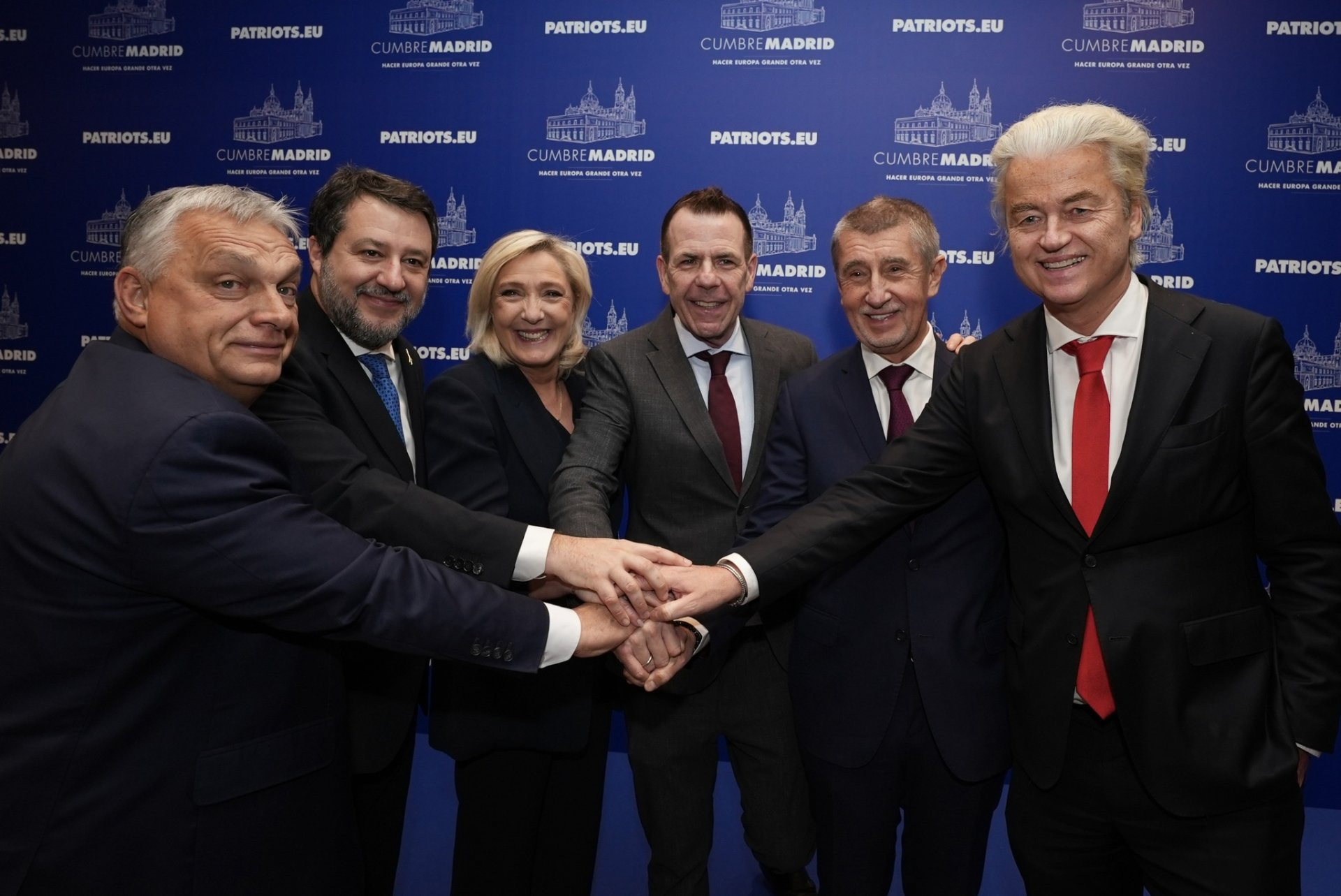
The party shows the greatest alignment with its home group (the European People’s Party, EPP) and the least with the populist Patriots for Europe group, co-founded by Czech prime minister Andrej Babiš (ANO).
Trump has lost an ally
Orbán’s downfall could prove a test of Trump’s international influence.