

“My impressions are really gloomy. It seems that when a drone chooses you as a target, the chances of survival are small,” wrote Deutsche Welle journalist Przemyska.
 Tomáš Vasilko



Every day, the Ukraine Battlefield update newsletter offers a clear look at how the war is unfolding on the ground, highlighting key developments along the frontline and the shifting dynamics of the conflict. This offers readers regular and detailed information to better understand the implications of the war for the country and the whole continent.
Journalists tried what it is like to run away from FPV drones. What not to do and, conversely, what increases your chances of survival. Ukraine experienced a massive Russian attack and is struggling to shoot down ballistic missiles. Chart of the Day: The Russian spring offensive is still “in hibernation”. Map of the Day: Frontline reports near Pokrovsk and Myrnohrad. Videos of the Day: What a drone strike on a vehicle looks like; a Russian analyst has been repeating the same thing about Mala Tokmachka for a year.
How to survive FPV drone attacks is not something that should concern only soldiers. The Russians often use smaller drones to attack Ukrainian civilians as well. In Kherson this has been common for more than a year, and increasingly Russians are attacking ordinary people with drones in other cities too, such as Kramatorsk.
Journalists are not safe either. Last year four war reporters (including one Russian) were killed in drone strikes.
For this reason, the Ukrainian foundation 2402 Foundation provides courses for journalists as well as other civilians, during which they are supposed to learn how to defend themselves against FPV (first-person view) drone attacks. One participant was Antonia Langford, a journalist with the British daily the Daily Telegraph, who has now written an article about it.
According to her, following the latest drone attacks on journalists, there has been a debate in Ukraine on whether war reporters should be armed so that they could defend themselves in similar incidents. For now, at least, it is possible to learn how to maximise one’s chances of survival.
After completing the training for the drone war, Langford wrote that the basic rule was to spread out. “If you bunch together, you can all be wiped out in a single strike. If you are alone, you are a less valuable target. The drone is forced to choose. After that, it is all down to luck,” she added.
As she wrote, if you have nowhere to hide, you should try to reduce your silhouette. If you do have somewhere to hide, run. Try to find walls that can mask your thermal signature.
A similar course was taken at the end of last year by Cristian Segura, a journalist with the Spanish daily El País. As he wrote, drones are often audible and have a characteristic sound. The FPV drones and Mavics used during the training could be heard from a distance of about 150 m.
If you hear them, given their speed, you have about 10 seconds to react, according to the Spanish journalist. Of course, there are types of winged drones, or drones loitering on the ground that you may not hear in time.
However, if you do hear drones, according to the Ukrainian instructors, the worst thing you can do is stop and start looking around to see where the drone is coming from. This can be a fatal decision, as you lose time you should be using to hide.
“According to the instructions of the 2402 Foundation, you should immediately spread out and look for cover behind a solid wall, inside a solid building, under a concrete structure; even a ditch or a hollow in the ground is better than open space,” the journalist wrote, quoting from the manual.
Similarly, when a projectile hits the ground, the best protective position is to lie on the ground with your head covered.
According to him, you should run away from a drone in such a way that you change direction every seven to 10 metres, forcing the operator to react. Taking shelter in a building may not help, because the drone can fly inside, for example through a broken window. During a simulation, a bombing drone flew into a building: half of the journalists reacted correctly and ran away, while the other half huddled together.
In a wooded area, the instructors advised people to stay under the trees. They acknowledged that this might not be effective, but said it was the best option.
The journalist also advised that people living in high-risk areas should go outside only when absolutely necessary, ideally in windy weather or when cloud cover is low. They should not wear camouflage clothing, because that could identify them as soldiers, but at the same time they should dress in neutral colours, walk inconspicuously and keeping to the shadows.
Despite all the advice, escaping a drone that can reach speeds of 70 km/h in some places is not easy. As the instructors told the Daily Telegraph journalist, they were not being taught how to survive, but how “to try to survive”.
Sometimes any attempt is futile. That may explain many of the videos showing Russian soldiers at the front not even trying to run away from an incoming FPV drone.
“Unfortunately, my impressions are really gloomy. It seems that when a drone chooses you as a target, the chances of survival are small,” wrote Deutsche Welle journalist Anna Przemyska on the 2402 Foundation website.
Training video
[embedded content]
The Daily Telegraph reporter also tried out the other side, namely the training of drone operators. The Drone Fight Club academy has trained 7,000 Ukrainian pilots. They use two types of simulations for training – one that is relatively freely accessible and another intended only for Ukrainian soldiers.
It was this latter one that Langford tried. Controlling a bombing drone over Snake Island was more difficult than she had expected.
Vladyslav Plaksin, who heads the academy, told her that it was a myth that reaction time was the most important thing for an operator. It was more about anticipation.
“When you are flying, you have to think ahead. Everything you are doing now is already in the past. You have to know where your drone will be in two or three seconds – that is why musicians make great operators,” Plaksin said.
As he said, Ukrainian drones had previously used thermal cameras only at night. Now they used them during the day as well.
“Especially in winter, because they help you find people hiding in white clothing against a snowy background, which is hard to distinguish with a normal camera. And when someone tries to hide in a field or in woodland, a thermal imaging camera gives you a really good chance of finding them,” he told the reporter.
Conversely, if you are the prey, that reduces your chances of survival.
Russians again launched massive attacks on Ukrainian cities. In total, according to the Ukrainian General Staff, they used – over the past 24 hours, from Wednesday morning to Thursday morning – 19 ballistic missiles (Iskander M and S-400), 20 Ch-101 cruise missiles, and 659 Shahed-type drones and decoys.
The attacks hit several civilian targets. On Thursday morning, reports from Odesa spoke of at least nine dead and 16 wounded, from Kyiv four dead and 54 wounded, and from Dnipropetrovsk region three dead and 34 wounded. In Kyiv, 17 apartment blocks, 10 houses, a hotel, a car dealership, a petrol station, and a shopping centre were damaged.
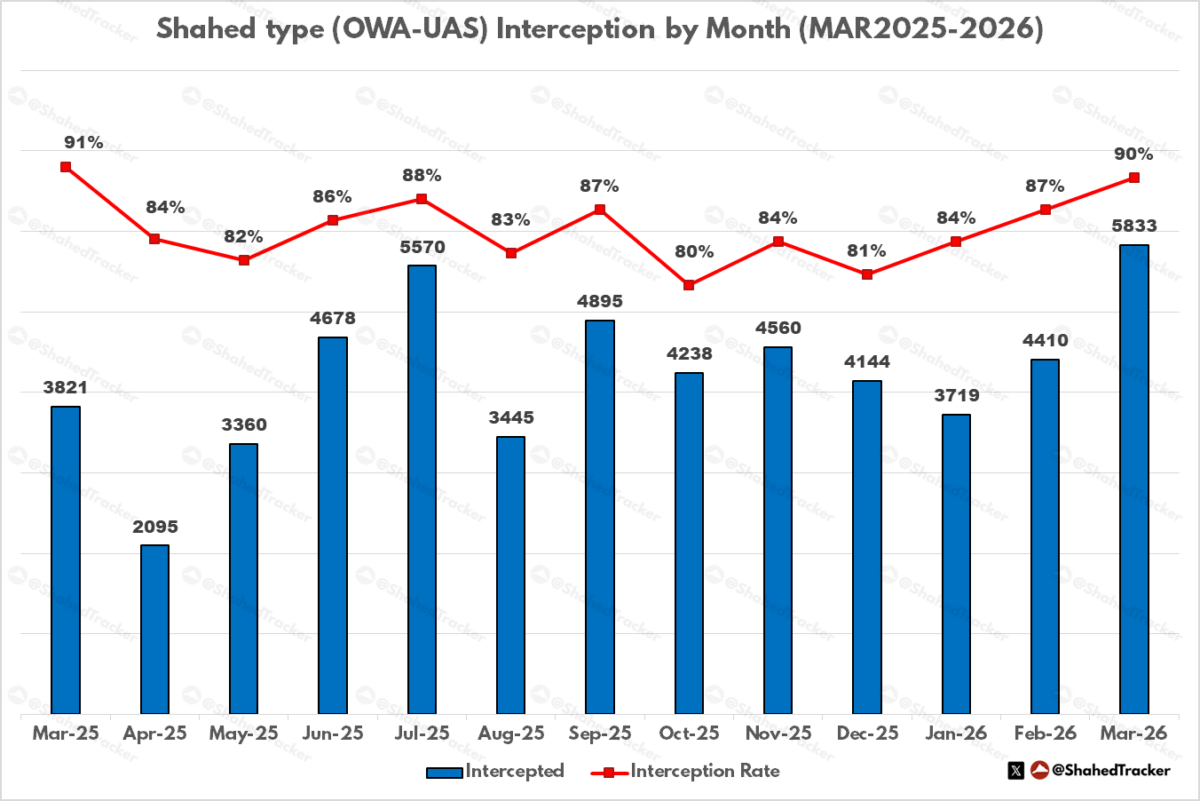
Data on downed missiles and drones bring two pieces of good news and one bad. The Ukrainians are increasingly successful at shooting down drones and cruise missiles. The interception rate for drones was 96 percent. For the whole of March, according to the Shahed Tracker account, the success rate was 90 percent. At the end of last year it was only just above 80 percent. Thanks above all to interceptor drones, Ukrainians are increasingly able to destroy this threat.
Number of drones shot down and interception rate. Source – Shahed Tracker
They are currently equally successful at shooting down cruise missiles. As the Oko Hora account wrote, over the last eight attacks the interception rate for these weapons ranged between 90 and 100 percent.
The problem, however, remains the interception of ballistic missiles. In the last 24 hours, they shot down only 42 percent of these weapons.
“Over the past day the enemy delivered painful blows with ballistic weapons and killed civilians. We lack missiles to intercept ballistic weapons. This is now a very big challenge,” wrote on X the drone volunteer and adviser to the defence minister, Serhii Sternenko.
As Ukrainian president Volodymyr Zelensky said on Wednesday, the shortage of Patriot interceptor missiles was so serious that it “could not be any worse”. The situation in the Middle East, where Gulf countries were using these missiles to defend themselves against Iranian attacks, has made Ukraine’s situation even more complicated.
Footage of destroyed apartment blocks in Odesa.
The death toll from Russia’s strike on Odesa has risen to 9, with 23 people injured. Rescue operations are ongoing, and authorities have declared a day of mourning in the city. #Ukraine pic.twitter.com/fKrbNU31tE
— NOELREPORTS 🇪🇺 🇺🇦 (@NOELreports) April 16, 2026
This is what Kyiv looked like on Thursday morning.
Map of the Day
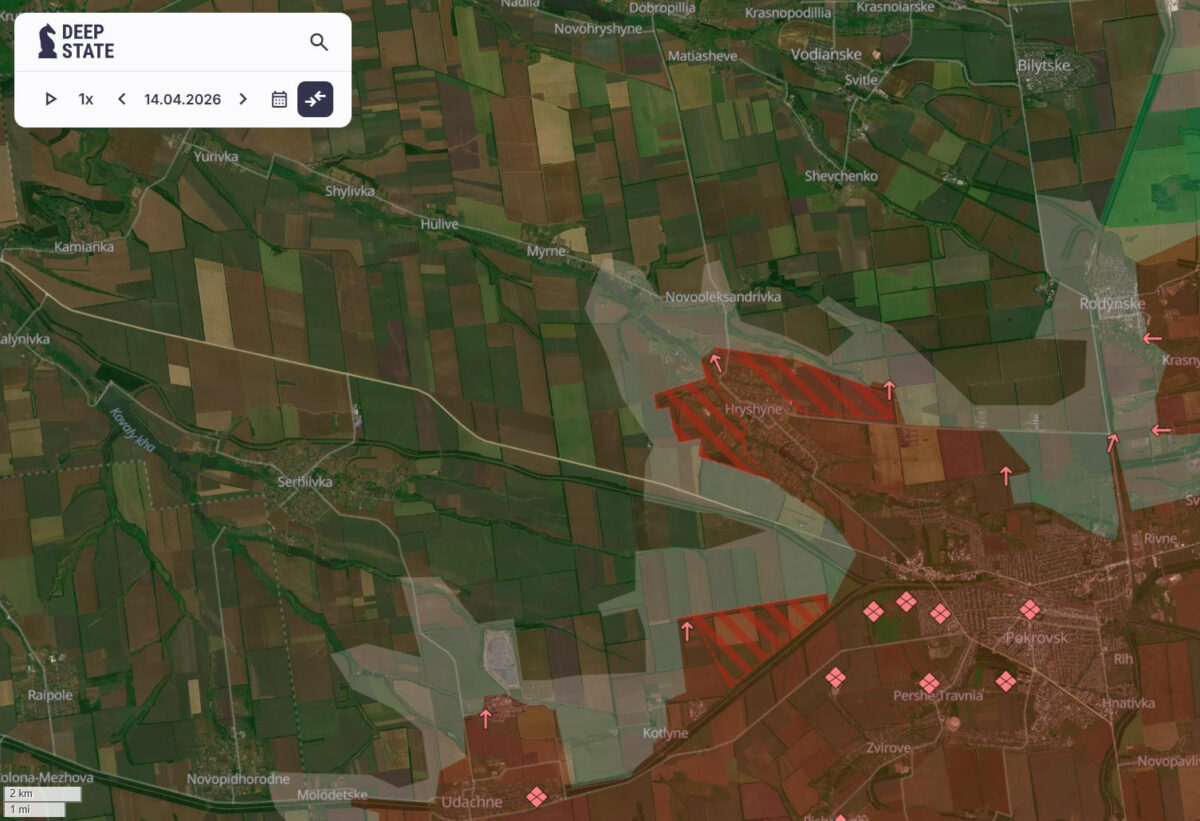
The DeepState UA account has updated the map west of Pokrovsk, showing that the Russians have expanded their zone around the village of Hryshyne. They have also moved a little further south near Kotlyne.
DeepState also analysed the current situation near Pokrovsk and Myrnohrad. According to the account, the Russians have managed to amass infantry and equipment south of Myrnohrad, mainly because Ukrainian drones cannot reach the area.
The Russians are using these resources to put pressure on the northern part of the conurbation. At the same time, they are trying to advance and consolidate their positions north of Rivne, which threatens Ukrainian defenders in the Svitle area.
“The enemy is also using drones to control a deadly zone within a 20-km radius of the centre of Myrnohrad and is attacking everything that moves, which makes any movement and activity in this area difficult,” the account wrote.
It added that the Russians had occupied almost the entire village of Hryshyne. There are also infiltrations in the Novooleksandrivka and Vasylivka area.
Videos of the Day
This video shows a relatively rare shot from inside a vehicle of a Ukrainian soldier in an armoured car being hit by a Russian drone. Despite the hit, the soldier was unharmed.
The Italian Iveco LMV armoured vehicle saved him. The vehicle also has a cage around it, which helped absorb the impact. It is not clear how much damage the strike caused to the vehicle.
As some accounts wrote, this is the main reason why, in recent weeks, Ukrainians have been losing more equipment than Russians. The Ukrainians send soldiers to the front in sufficiently protected vehicles so that, in the event of a hit – which is frequent – the soldier’s chances of survival are relatively high.
The Russians, on the other hand, send soldiers on motorbikes or in “bukhankas”, where there is hardly any protection. Moreover, the Oryx website does not count such means of transport as destroyed military equipment (because they are not military equipment).
The Russian military expert Boris Rozhin has been delivering almost identical reports for a year now, almost every week, on the fighting and Russian advance near the village of Mala Tokmachka in the Zaporizhzhia region.
In November, he even said that the Russians had captured the village (Russian propaganda uses the term “liberated”). Nevertheless, since then he has reported a further seven times that “the fighting in the Mala Tokmachka area continues”.
For nearly a year now, Russian ‘military expert’ Boris Rozhin has been saying that the Russian army is advancing in the area of the village of Mala Tokmachka, Zaporizhzhia region.
From “Kyiv in three days” to “fighting continues in the area of Mala Tokmachka.” pic.twitter.com/XeceKPfyzM
— Anton Gerashchenko (@Gerashchenko_en) April 15, 2026
What the losses are
As of Thursday morning, not updated
As of Monday morning, Russia had demonstrably lost 24,440 pieces of heavy equipment (on Monday 30 March it was 24,383). Of these, 19,079 (19,028) pieces were destroyed by Ukrainians, 975 (971) were damaged, 1,205 (1,204) were abandoned by their crews and 3,181 (3,180) were captured by the Ukrainian army. This includes 4,381 (4,371) tanks, of which 3,284 (3,276) were destroyed in combat. Ukraine has lost 11,923 (11,697) pieces of equipment, of which 9,175 (9,027) were destroyed, 668 (656) damaged, 666 (661) abandoned and 1,414 (1,404) captured. This includes 1,412 (1,401) tanks, of which 1,078 (1,071) were destroyed in combat.
Note: Neither side regularly reports its own dead or destroyed equipment. Ukraine publishes daily figures on Russian casualties and destroyed equipment, which cannot be independently verified. In this overview we use data from the Oryx project, which since the beginning of the war has compiled a list of equipment losses documented exclusively by photographic evidence.