Major Robert Brovdy, nicknamed Hungarian, commands Ukrainian Unmanned Systems Forces, responsible for about one-third of troop losses on Russian side.
 Tomáš Vasilko



Every day, the Ukraine Battlefield update newsletter offers a clear look at how the war is unfolding on the ground, highlighting key developments along the frontline and the shifting dynamics of the conflict.
Comparison of elite units: what Rubikon targets and what Hungarian’s unit targets. Ukrainian Flamingo missile resurfaced, hitting a Russian factory 1,000 km from the front line. In April, Ukrainians lost three times more equipment than Russians — and why this is not a big problem. Chart of the day: the number of Iskander-M ballistic missile attacks has fallen. Videos of the day: drones shot down with small arms and a missile whizzing right over soldiers’ heads.
Both the Russian and Ukrainian armies have two units whose role in the war is becoming increasingly important, as they focus on drone operations. On the Ukrainian side, these are the Unmanned Systems Forces (SBS), commanded by Major Robert Brovdy, nicknamed Hungarian.
These forces also include his former unit, Hungarian’s Birds, and units of drone operators such as Phoenix, Achilles, Nemesis, and K-2. The SBS is already an independent part of the Ukrainian army and is currently responsible for about one-third of Russian troop losses in the war. Regular brigades also have drone operators, but the SBS focuses strictly on ground or aerial drones.
On the other side, in the Russian army, Rubikon holds an important position. Unlike the SBS, it is not an independent part of the army, but rather a kind of centre whose aim is not only front-line operations, but also training other units, improving the skills of Russian drone pilots in the war and spreading know-how to other Russian units.
Both SBS and Rubikon regularly publish statistics on how many pieces of equipment and personnel their operators have hit. The OSINT account Vitaliy has now compared the data from both units for April, especially in terms of what targets they most often focus on. It says a lot about the current state of the war on both sides. The figures were also shared by US analyst Rob Lee.
Despite the fact that the Russian Rubikon is a smaller unit, in April its operators carried out a similar number of “sorties” as Ukraine’s Unmanned Systems Forces. Rubikon reported 79,906, while Hungarian’s SBS reported over 94,000.
The difference lies in effectiveness. While Hungarian’s units reported more than 40,000 targets hit in total, Rubikon claimed it had hit 12,604 targets. The difference in the number of targets hit is therefore 3.2-fold.
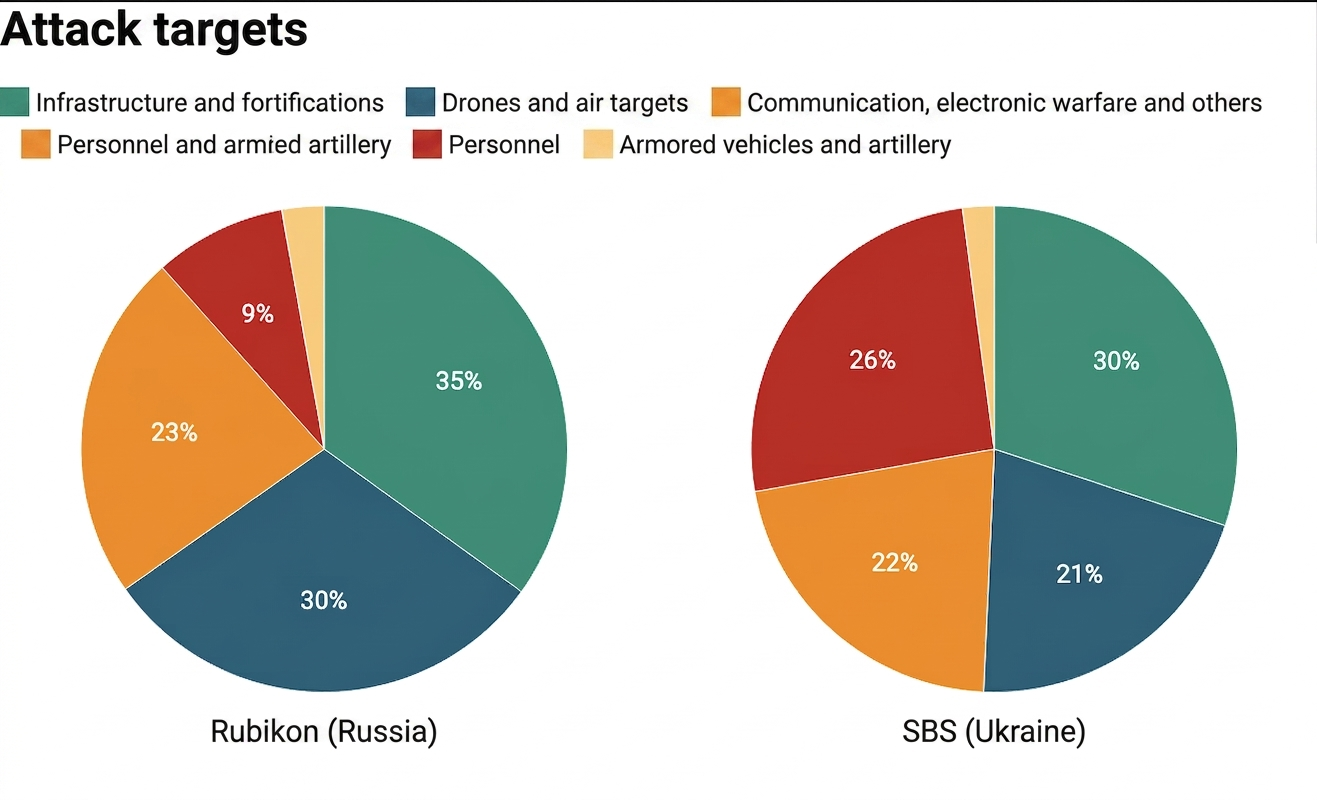
It is also interesting what kind of targets the two groups most often hit. In the case of communications equipment, electronic-warfare systems, armoured vehicles, artillery, or infrastructure, the ratios are similar. The main difference, however, concerns personnel and drones.
While for Ukrainian SBS operators Russian soldiers account for 26 percent of all targets hit, in Rubikon’s case Ukrainian soldiers make up only 9 percent. Conversely, the Russian unit attacks drones relatively more often (30 versus 21 percent).
Some Russian Telegram accounts had already complained earlier that, like the Ukrainians, Russians should focus more on attacks on soldiers. After all, they are rarer than drones and, at present, also rarer than heavy equipment. Ukraine has long had a problem bringing new soldiers to the front and has been unable to solve it.
The problem for the Russians is that the Ukrainians protect their soldiers. This is why they increasingly use drones or ground robots for logistics or for evacuating the wounded. Russian operators thus have greater difficulty finding Ukrainian soldiers they can attack. The reverse is not a problem, because Russians still attack in groups of soldiers whom they try to infiltrate into Ukrainian positions.
“Rubikon is more specialised as a counter-drone unit, while the SBS acts as a force focused on mass attrition of the enemy,” the account Vitaliy wrote.
According to Lee, the difference in the above-average share of attacks on drones also stems partly from the fact that while Ukrainian interceptor drones (designed to destroy enemy drones) are also widely used by other units outside the SBS, in Russia’s case they are concentrated mainly in Rubikon. Likewise, Russians have to destroy Ukrainian ground drones, which the Ukrainians deploy far more often than the Russians do.
The account Vitaliy also compared the Hungarian’s Birds unit (the main unit under the SBS) with Rubikon. There is a big difference in the effectiveness of attacks, that is, how many drones actually hit a target. For Hungarian’s Birds, it is 67 percent; for Rubikon, 15 percent.
Take notice at Rubicon – Birds similarity,
with almost the similar target distribution but lower personnel focus.
As Birtds were able to hit 16 500 targets in just 24 476 sorties. pic.twitter.com/j3rg7Wd7IZ
— Vitaly (@M0nstas) May 4, 2026
Can these figures be trusted? The Ukrainian SBS has all strike videos in its system, because individual units compete this way for additional drones.
We are not aware of a similar system in Rubikon’s case. However, this can be compared with data published by the Russian website Lost Armour, which maps recorded attacks. It is essentially a counterpart of the Oryx website.
For Rubikon, Lost Armour reported that this unit demonstrably hit 3,568 targets in April. That is three times less than Rubikon claimed overall, but it could support its overall figures, since there may not be publicly available video for every strike. The proportion of Ukrainian soldiers hit, however, remains similarly low (6 percent for the entire period).
Flamingo finally hit something again. Last year, Ukrainians introduced the FP-5 Flamingo cruise missile almost as if it were supposed to be a miracle weapon that would turn the war around. So far, however, it has not brought any major changes.
On Monday night to Tuesday, at least one Flamingo missile apparently hit the Russian military electronics plant VNIIR-Progres in the city of Cheboksary, about 1,000 km from the front line. Several videos showing the strike have appeared online. According to the Militarnyj website, the footage suggests that the plant was indeed hit. However, it has not been unequivocally confirmed that it was a Flamingo.
Footage of a Ukrainian Flamingo heavy cruise missile slamming into Russia’s VNIIR-Progress military electronics plant last night. pic.twitter.com/B1jYl5yBjA
— OSINTtechnical (@Osinttechnical) May 5, 2026
[embedded content]
A Ukrainian Flamingo cruise missile appears to have slammed directly into Russia’s VNIIR-Progress military electronics plant in Cheboksary. pic.twitter.com/nr4x0QM8cU
— OSINTtechnical (@Osinttechnical) May 4, 2026
The attack on the same factory continued during the day, this time using Liutyi drones.
[embedded content]
This factory is significant because antennas are produced here for GLONASS systems and satellite systems for the Russian army, such as Kometa modules, which are used in drones including Shaheds. Ukrainians have hit the factory in the past as well.
A strike on the factory with a one-ton Flamingo missile can cause greater damage than previous drone attacks. However, as Czech OSINT analyst Jakub Janovský wrote, Ukrainians would need 50 precisely aimed Flamingo missiles to completely put such a factory out of operation.
Last week, the website Oboronka published an analysis of Flamingo missile attacks confirmed so far. And although Ukrainians often show the missile taking off towards a Russian target, there are not many confirmed hits.
Oboronka wrote that launches of a Flamingo missile had been recorded a total of 23 times, but only six of these missiles reached the target area, and only two actually hit a Russian facility (the remaining four landed nearby).
The best-known hit is the factory in Votkinsk, where Iskander missiles are produced.
Launch of Flamingo missiles that attacked Cheboksary
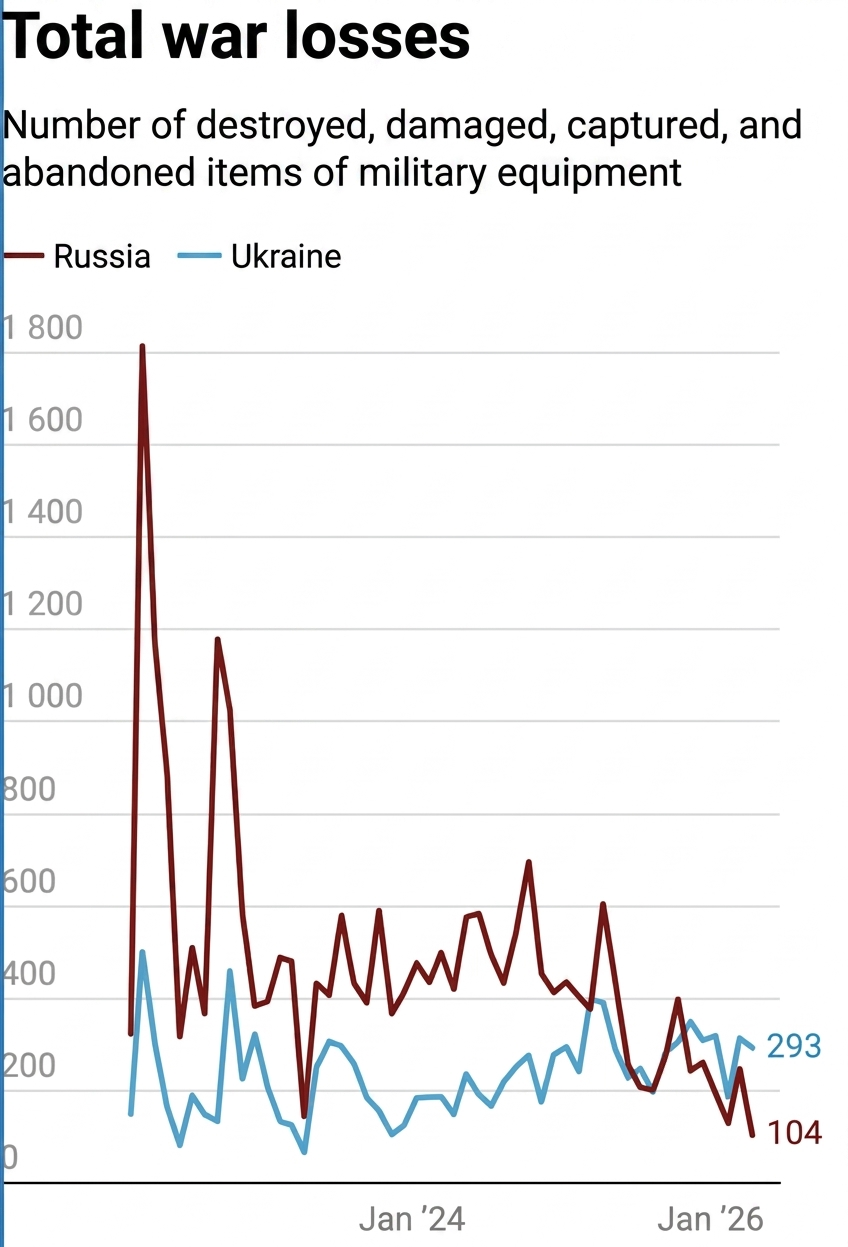
Equipment losses in April. At the beginning of the war, it was common for Russians to lose three times more pieces of equipment overall than Ukrainians. Gradually, this ratio narrowed and over the past year the losses of both armies, as counted from published photos and videos by the Oryx website, evened out.
Since November 2025, Oryx has even recorded more pieces of equipment lost on the Ukrainian side than on the Russian side.
In April, for the very first time, Ukrainians lost three times as much equipment as Russians — the opposite ratio to the beginning of the war. According to Oryx data, the ratio was 293 to 104.
For Russia, this is the lowest figure since the start of the war. For Ukraine, it is an ordinary monthly average. The reason for this new ratio is therefore not that Ukrainians suddenly started losing more equipment, but that Russians are losing a record low amount.
Czech OSINT analyst Janovský from Oryx has explained why, in his view, this is not such a big problem. The main reason for the low Russian figures is that Russians are deploying fewer armoured vehicles at the front and prefer to use motorbikes, civilian cars or other means of transport whose loss Oryx does not track.
On the other hand, Ukraine still protects its soldiers with MRAP armoured vehicles, armoured personnel carriers and light armoured vehicles. “They do lose these vehicles, but they protect their crews, and so the result is a loss of equipment instead of human lives,” Janovský wrote.
According to him, Ukraine has received 15,000 of these vehicles from its Western allies, so it can afford these losses.
Counting equipment in overall totals can therefore be slightly misleading at this stage of the war when it comes to what is actually happening at the front. “Ukraine will continue to suffer losses that are painful, but the figures only matter in the context of what they represent — whether they are easy or cheap to replace, and so on. For example, if Russia tomorrow lost 10 Su-34 aircraft and Ukraine 500 HMMWV vehicles, the loss ratio would look dire, but I do not think anyone would see those losses as advantageous for Russia,” Janovský wrote.
From this perspective, comparing the total number of equipment losses is starting to lose its meaning and it is better to focus on individual types of equipment.
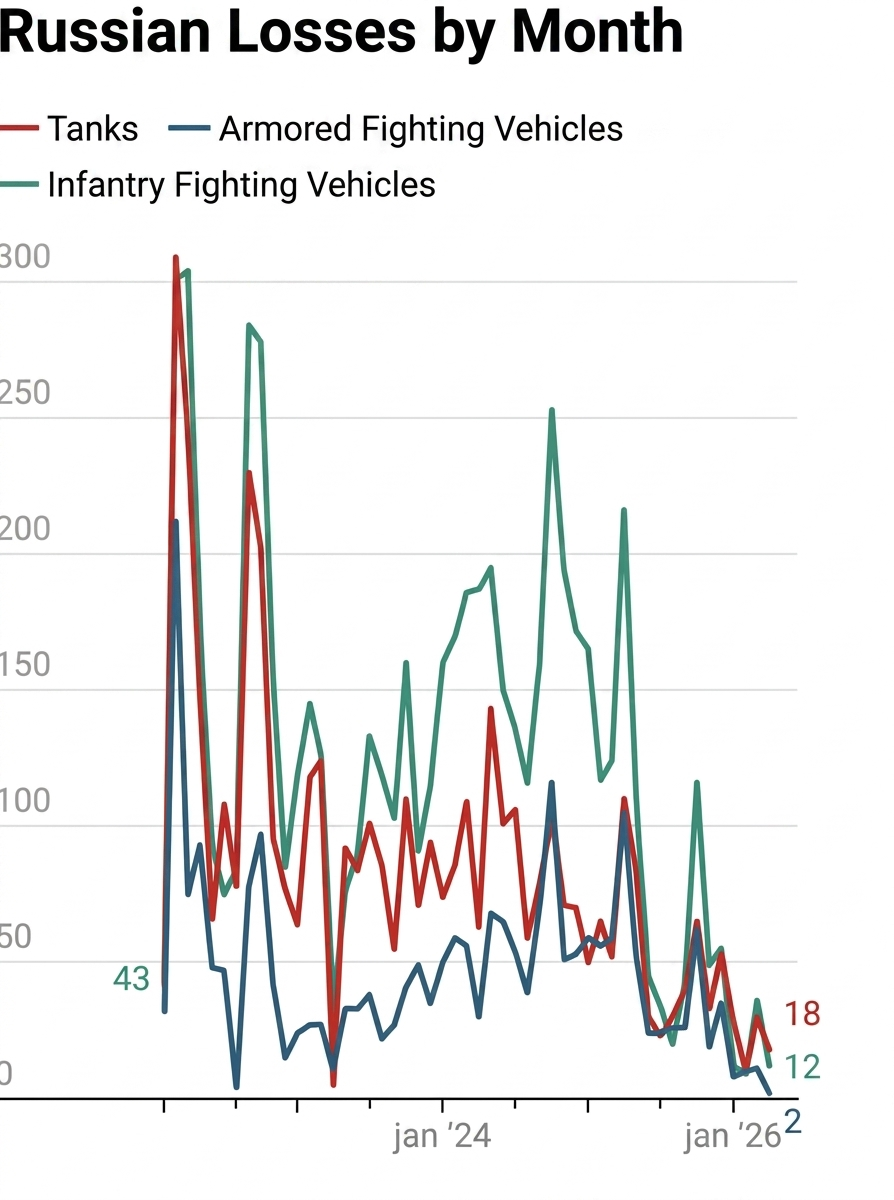
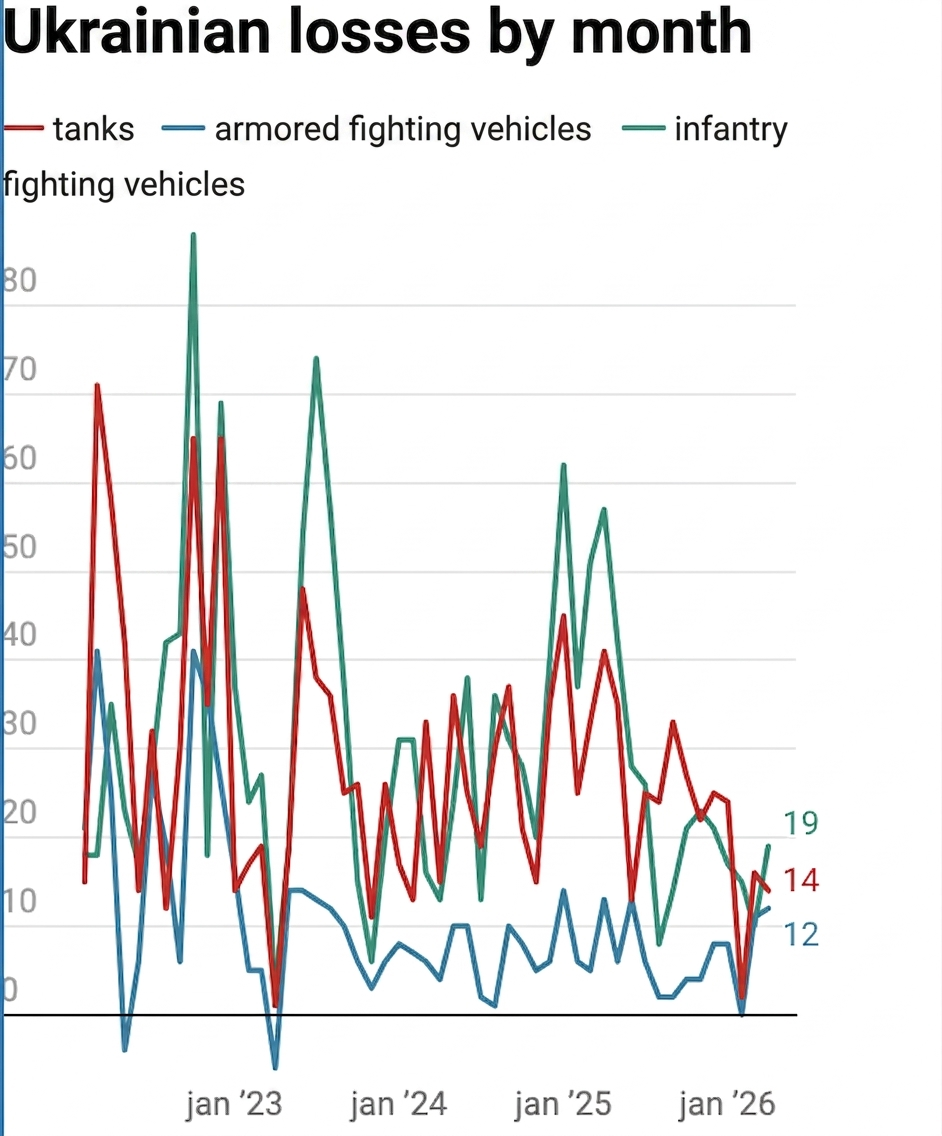
As for tanks, armoured vehicles, and infantry fighting vehicles, here too Russia has reduced its losses. The number of Russian mechanised attacks in April fell again. The figures are currently similar. For example, in April Ukrainians lost 14 tanks (Russians 18), 19 IFVs (Russians 12), and 12 armoured fighting vehicles (Russians only 2).
One more note: In the Ukraine Battlefield update we publish current losses every day. On Monday there was a significant change when the Oryx website revised the overall figures downward — on both sides by roughly 800 pieces.
As Janovský explained on X, they removed from the list equipment that is cheap and present in large numbers. This includes all reconnaissance drones, all ground drones and smaller trucks such as ULAN or UAZ‑469. There are now so many of these drones that if they recorded them all, they would completely flood the overall loss list and distort the statistics.
Chart of the day
There is no shortage of charts in today’s update, but for the chart of the day we have picked the number of Russian attacks on Ukraine using Iskander‑M ballistic missiles over recent months. These are the hardest to intercept and therefore cause the greatest damage to the defending country.
The Ukrainian Telegram account Oko Hora looked at the number of attacks launched from Crimea since December. The chart shows that the frequency of attacks has decreased significantly.
‼️ Following the start of the systematic destruction of Russian OTRK in Crimea, the number of “Iskander-M” launches from the peninsula has decreased.
Over 75 days, at least 10 OTRK positions in Crimea have been struck.
🧵Thread 1/3 pic.twitter.com/DBZBsGlnmr
— Oko Gora (@oko_gora_tg) May 2, 2026
As it wrote, over the past 75 days there have been 10 Ukrainian attacks on Iskander launchers in Crimea. In addition, in March Ukrainians attacked the Kremniy-El factory in Bryansk region, which produces electronic components that are crucial precisely for these ballistic missiles.
This suggests that Ukrainian tactics are working. If ballistic missiles cannot be stopped in the air (because there are very few Patriot interceptors), they must be destroyed on the ground — either in the launchers, or ideally still in the factory, before Russians assemble them.
Videos of the day
A compilation of videos showing soldiers from the Chyzhak brigade shooting down Russian drones with small arms.
Ukrainian Warriors shoot down 15 Russian kamikaze drones with small-arms fire in the Kostiantynivka direction, Donetsk region.
Very impressive!
📹: Khyzhak Brigade pic.twitter.com/Da5DlHfJjT
— Anton Gerashchenko (@Gerashchenko_en) May 4, 2026
A missile from a burning Russian vehicle, possibly a multiple rocket launcher, whizzed just above the heads of the soldiers filming.
A missile from a burning Russian military vehicle, likely an air defense system or MLRS, whizzes over the heads of Russians filming the scene. pic.twitter.com/HK6pvvzicP
— Special Kherson Cat 🐈🇺🇦 (@bayraktar_1love) May 4, 2026
What are the losses
Some types of equipment have been removed from the list, which is why the overall figures have dropped significantly.
By Monday morning, Russia had demonstrably lost 23,650 pieces of heavy equipment (on Monday (27 April) it was 24,487). Of this, 18,618 (19,123) pieces were destroyed by Ukrainians, 976 (976) were damaged, 1,206 (1,206) were abandoned by their crews and 3,182 (3,182) were captured by the Ukrainian army. This includes 4,394 (4,385) tanks, of which 3,292 (3,296) were destroyed in combat. Ukraine has lost 11,219 (12,050) pieces of equipment, of which 8,708 (9,272) were destroyed, 661 (673) damaged, 666 (671) abandoned and 1,184 (1,414) captured. This includes 1,420 (1,419) tanks, of which 1,085 (1,084) were destroyed in combat.
Note: Neither side reports regularly on its dead or on destroyed equipment. Ukraine publishes daily figures for Russian casualties and destroyed equipment, which cannot be independently verified. In this overview we use data from the Oryx project which, since the start of the war, has compiled a list of equipment losses documented exclusively by photographic evidence.