

German sociologist Andreas Reckwitz: “…the climate crisis has robbed many people of their belief in the future of the planet. Russia’s attack on Ukraine shook Europe’s faith in the existing security order. The pace of economic growth is very limited and, in many Western democracies, governments have lost their capacity
 Tomáš Lindner



The basic life expectation of modern society is disappearing: that tomorrow will be better than today. But that does not mean we must become pessimists and apocalyptic thinkers.
Do you feel afraid lately of where the world is heading?
No, I do not feel afraid. Rather, in recent years, I have come to realise that I had false expectations regarding social development. I and my generation were shaped by the events of 1989 and, probably under their influence, I assumed that society was changing and would continue to change for the better. That is, after all, the classic story of progress that the modern age has contained since Hegel. But it was quite naïve.
It seems you have rationally processed all the negative events of recent times and they do not affect you emotionally.
I lost my faith in the automatic nature of progress, but that does not mean I will now become an apocalyptic thinker. The loss of this essentially childlike trust in the constant progress of humankind is unsettling at first, but then one gets used to it. At the same time, we must be on our guard not to fall into the opposite extreme and replace the positive expectation of progress with the negative expectation that “everything will get worse” – such a temptation unfortunately exists. A realistic view is necessary, and this is precisely where sociology can help.
Incidentally, I am also sceptical of those commentators who suggest that we are in a transitional phase after which an entirely new social structure will emerge. I would not be so sure about that. It is just as possible that the current conflicts – both international and within our societies – will last for a long time.
ANDREAS RECKWITZ
A German sociologist at Humboldt University in Berlin, he is a successor to famous predecessors such as Jürgen Habermas and Ulrich Beck, from whom he has inherited in Germany the highly valued role of a publicly active social scientist whose task is to study and interpret our era in new and more precise ways. Particular attention has been drawn to his book The Society of Singularities, recently published in Czech, about the individualisation of Western societies, and to his current book devoted to the feelings of loss and decline spreading through Western democracies. In a restaurant in Hackesche Höfe, one of Berlin’s remarkable buildings, we discussed how populists profit from this pessimism and how the current uncertainty can be overcome.
Why do you think that?
Conflicts and upheavals in Western democracies – for example, populism – are the result of structural changes that have been underway for several decades. For instance, the transition from an industrial to a post-industrial society or the individualisation of everyday culture. Such long-term processes are often overlooked in the public sphere. The media focuses too much on events and reportorial stories. At present, we are struggling precisely with the consequences of these deeper, long-term transformations of society.
What do you see as the core of the problems facing Western democracies?
One of the central elements in describing the present moment is a widely shared feeling of loss and decline. Of course, people have always experienced losses and crises throughout history. In modern times, however, they were embedded in the expectation of progress, that is, in the assumption that the present is fundamentally better than the past – and above all that the future will be better than the present. This expectation is a pillar of the modern world. It endured even at the moment when a large part of Europe lay in the ruins of war and made subsequent reconstruction possible. In the last ten years, however, this belief in progress has been weakening in Europe and North America, so we are experiencing a kind of “meta-loss”, that is, the loss of positive expectations about the future themselves. This is a difficult situation and it can lead to a problem of legitimacy for the entire system.
When did the belief in the future disappear?
A number of factors contributed to this at the same time. For example, climate science, which has strongly influenced debates in recent years, has been preparing us for negative developments; the climate crisis has robbed many people of their belief in the future of the planet. Russia’s attack on Ukraine shook Europe’s faith in the existing security order. The pace of economic growth is very limited and, in many Western democracies, governments have lost their capacity to act; they are no longer able, as in the past, to shape and steer developments. I could continue this list, but it is clear that experiences of loss are accumulating. In this context, the aforementioned basic life expectation of modern society is disappearing: that tomorrow will be better than today.
Do opinion polls confirm this?
Yes, when we look at countless surveys in the United States and in all European countries, we see a dramatic increase in negative expectations. We no longer think so much in categories such as “improvement” or “rise”, but rather in categories of a turn for the worse. This has also changed political imagination.
Does this pessimism about the future actually correspond to reality? For example, in surveys Germans are satisfied with their personal life situation, yet at the same time they are very pessimistic about the country’s development.
This is a remarkable phenomenon: in a way, faith in progress is shifting from society into private life. Self-realisation and self-improvement are widespread ideals of personality. But the confidence people have in themselves is evidently not shared with regard to the broader society. In reality – this can hardly be denied – the standard of living and the predictability of everyday life in the West are higher than ever before. Nevertheless, I think that negative expectations about the future are not irrational; they are also fuelled by everyday experiences. Of course, also by those mediated by the media, such as problems with infrastructure, healthcare or the pension system. The rise of right-wing populism then visibly makes it harder to form functioning governing coalitions. The classic modern ideologies of progress, that is liberalism and socialism, have in the meantime lost their persuasiveness.
To what extent is the rise of populists connected with the widespread loss of faith in progress?
I think the two are closely connected. Right-wing populists are a response to feelings of loss in certain parts of society that had long been overlooked by the established political parties. At the same time, populists further inflame these losses and the emotions associated with them. They try to persuade their supporters that liberal urban elites are responsible for their losses, thereby arousing anger and a desire for revenge. And that, in turn, generates fears in other parts of society of a fundamental loss – the loss of the achievements of liberal democracy. These fears are currently strong in Germany: fears of AfD entering the first regional governments, of democracy being undermined. This development was unimaginable just ten years ago.
Populist parties to a large extent express feelings of loss that parts of society experienced perhaps twenty or thirty years ago. I have in mind, for example, eastern Germany, where AfD mobilises by drawing on repressed injustices and losses that local residents experienced in the first ten or fifteen years after German reunification. In retrospect we must also acknowledge that social development towards globalisation, an open world and the so-called knowledge society suited precisely urban, liberal circles. They were the winners of these processes. Other parts of society did not profit from them or feel they are on the losing side. This is fertile ground for right-wing populism.
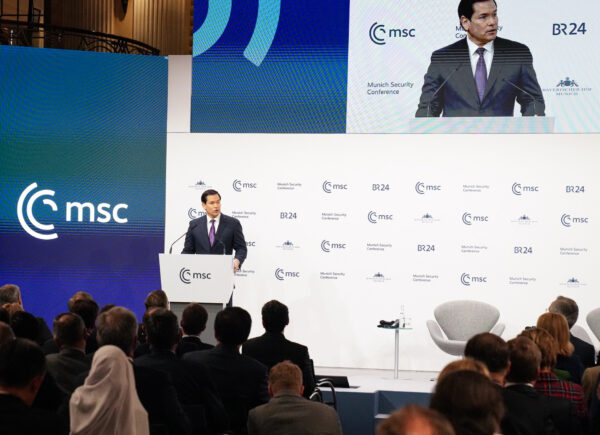
A study for this year’s Munich Security Conference describes how citizens’ trust in gradual reforms is declining and, instead, a desire to destroy established institutions is moving into the mainstream. Why? After all, over the past fifteen years Europe has gone through numerous crises and has always somehow overcome them.
It is interesting and disturbing to observe that parts of society really do harbour this desire to destroy the system. My colleagues Oliver Nachtwey and Carolin Amlinger, in their new book titled Zerstörungslust (Desire for destruction), describe the phenomenon of libertarian authoritarianism. This is a social group that wants a lean state and as much personal freedom as possible, which it did not want to see restricted during the pandemic. It is frustrated with current politics and tends to support radical politics, precisely this “destruction” of the system.
At the same time, as we have already mentioned, Western democracies have indeed entered a certain governance crisis. They are less capable of solving the problems they face, and it is appropriate to examine the causes.
Today the world is interconnected globally as never before, and we are also experiencing an extraordinary pace of technological change. Is this weaker capacity simply caused by the fact that problems are more complex than in the past?