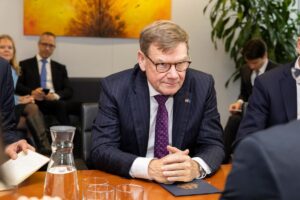

A veteran watchdog of the rule of law in Hungary, German Green MEP Daniel Freund warns that Slovakia is now going down a similar path. He said the EU Commission must trigger the conditionality mechanism immediately to protect EU taxpayer money from being funnelled into private interests, to avoid repeating
 Elena Sánchez Nicolás



MEPs are calling on the EU Commission to trigger the rule-of-law conditionality mechanism — to freeze Brussels funds for Slovakia over their possible misuse and concerns over the rule of law.
From the abrupt dismantling of Slovak anti-corruption agencies to legal changes that let convicted criminals walk free, critics say the Bratislava government is systematically dismantling the tools meant to protect EU taxpayers’ money.
German Green MEP Daniel Freund has seen this all before. A veteran watchdog of the rule-of-law problems in Hungary, Freund warns that Slovakia is now going down a similar path. He argues that while dialogue is important, the EU must actually act when taxpayer money is being funnelled into private villas instead of public infrastructure. For Freund, the situation has already crossed a line: if the money isn’t safe, the money should be frozen.
In this EUobserver interview, Freund breaks down why he believes Slovakia is undergoing a rapid “Orbánization” and why the EU can’t afford to wait another decade to act.
The European Parliament last week urged the EU Commission to consider freezing EU funds for Slovakia, over growing rule-of-law concerns under the government of Robert Fico. Having spent years tracking similar developments in Hungary, what specific ‘red flags’ do you consider to be the primary issue that justifies triggering the conditionality mechanism?
What we have seen, ever since Fico has been back in government, is quite a systematic attack on those institutions and laws that are supposed to protect public funds, including EU funds. There have been a number of developments from the dismantling of the special prosecutor for anti-corruption and the National Crime Agency. There have also been changes to the penal code, where many people convicted for corruption have walked free, and there have been more recent attacks on the whistleblower protection office.
All this taken together basically means that EU funds are now much worse protected than they were two or three years ago, and that’s why we’re saying: it should be the other way around. EU funds should be better protected. The anti-corruption infrastructure should be better functioning. But it’s precisely the opposite, and that’s why we’re saying it’s time now for the European Commission to take measures to make sure this is repaired.
So Slovakia has been moving in the opposite direction, and we have also seen that the number of indictments, for example, on anti-corruption offences has collapsed almost completely. This is clearly not working, and all this shows that EU funds are not adequately protected. And when EU funds aren’t protected, they should be stopped.
But why now?
The European Parliament already approved a resolution two years ago, where we criticised the situation at the time. In the meantime, there have been several delegations that have visited Slovakia last year, both from the budget control committee and also from the civil liberties committee, on which I was on both missions last summer. We had a debate about this in plenary in February. Since none of this so far has achieved anything, we’re increasing the pressure.

To what extent do you believe that Fico is effectively undergoing the ‘Orbánization’ of Slovakia?
He [Fico] has been himself quite open about this, right? That Orban’s model and the Orban [himself] have been an inspiration for him. So we see lots of parallels. This is like Orbán in the early years. But there are also differences.
He doesn’t have the same power as Orbán had. He doesn’t have such an easy constitutional majority. But he has also managed to change the constitution and has introduced changes that most probably violate the fundamental values of the European Union and the treaties. There is an infringement procedure already ongoing on this that will clarify. But I see quite a lot of parallels. He was closely aligned with Orbán in the European Council over recent months.
But now he also sees where this Orban playbook leads in the end. And I have to say, as a politician, if you’re thrown out of office and people dance in the street, that’s about as bad as it can get, right?
I hope that Fico also sees that message clearly, that this path… I mean, it was ‘successful’, in quotation marks, in Hungary for a long time. But now it is not anymore. And now we’ll see what Fico takes away from that.
During the plenary last week, you said that you want to avoid a repeat of the situation with Hungary, where it took over 10 years for penalties to be applied. Why should it be any different this time?
The conditionality mechanism is a preventative tool. The whole reason we did this was so that we could avoid the countries slipping into autocracy, where democracy and the rule of law are fully dismantled. And with Hungary, and to some extent with Poland, we have seen as well, we were probably late in both cases. We will see now whether Hungary manages to come back from all the damage that Orbán has done. We see in Poland the difficulty of fully restoring the independence of the judiciary. The presidents, both the previous and the current one, have refused to sign into law all the judicial reforms that the government under Tusk has passed. But it seems very difficult to repair this kind of damage.

And that is something we don’t want to wait as long for. We want to make sure that as soon as governments start thinking about these things, there should already be a message that in the European Union, the rule of law should be protected, democracy should be protected, media freedom should be protected, and minorities should be protected. We have seen pretty much in all the member states the situation deteriorating in the last few years, when we should actually improve things. We should improve the functioning of justice systems and make sure that justice is served quickly and adequately everywhere, rather than making things worse.
Everyone has seen that the way that we have dealt with the situations in Poland and Hungary was not ideal. So hopefully we learn from that and don’t repeat the same mistakes now with Slovakia or elsewhere.
Given that the commission has historically been slow to act in favour of more dialogue, do you think it will take your call to trigger the conditionality mechanism seriously?