

The Ukrainian General Staff replaced the commanders of the 14th Separate Mechanized Brigade and the 10th Army Corps following reports of severe supply failures.
 Roman Pataj



Every day, the Ukraine Battlefield update newsletter offers a clear look at how the war is unfolding on the ground, highlighting key developments along the frontline and the shifting dynamics of the conflict. This offers readers regular and detailed information to better understand the implications of the war for the country and the whole continent.
The information in this text is a summary of events for Sunday (26 April). The situation may have changed since then.
Soldiers were not receiving food, the unit’s command concealed the bad situation – the result was a loss of positions. On Friday, the Ukrainian General Staff published a report on the replacement of two senior officers. At first glance, there was nothing unusual about it. Unit commanders were changed fairly often. In this case it concerned the commander of the 14th Separate Mechanised Brigade and even the commander of the 10th Army Corps.
The 14th Brigade was one of the less well‑known formations, even though it had been fighting the Russians since 2014. Its soldiers were currently deployed on the eastern bank of the Oskil river near Kupiansk and the brigade belonged to the aforementioned 10th Corps.
It was known that the units fighting on the shrinking Ukrainian bridgehead beyond the Oskil were having supply problems. The bridges across the river had been destroyed and the Russians were shelling improvised crossings while at the same time maintaining constant pressure from the east. The defending soldiers therefore had even greater supply difficulties than in places where they were not separated from their own rear by a river.
“Systematic air and missile strikes by the enemy on the crossings over the Oskil river have significantly complicated the logistical support of the armed forces’ units in the area of the town of Kupiansk. The logistics of our troops here are provided by vessels and heavy unmanned aircraft,” the General Staff said in a statement, adding that work was under way to improve the situation.
In the next sentence the top command explained what the problem was and how extensive it was:
“The previous command of the 14th Separate Mechanised Brigade concealed the real state of affairs, several positions were lost and there was a series of failures in providing for the soldiers. Specifically, there was a problem with food supplies to one of the brigade’s positions.”
The outcome was published, among others, by defence minister’s adviser Serhiy Sternenko. On his account he showed photographs of three emaciated soldiers that had been circulating on Telegram:
Командира 14 ОМБр зняли з посади після скандалу із військовими, що залишалися на позиціях без їжі.
Учора у соцмережах зʼявилися фото виснажених воїнів, які не мали належного забезпечення їжею та водою, перебуваючи на позиціях за річкою Оскіл на Купʼянському напрямку.… pic.twitter.com/BMXnF44Bul
— Serhii Sternenko (@sternenko) April 24, 2026
It was obvious that men in such physical condition could not fight effectively, which led to the aforementioned loss of positions. The General Staff had already ordered an investigation into the situation in the 14th Mechanised Brigade and instructed the superior officer to review the provision for soldiers across the entire 10th Corps.
“Another food delivery was recently brought to the position of the soldiers of the 14th Brigade. As soon as conditions are favourable, our fighters will be immediately evacuated,” the final sentences of the General Staff’s statement said. Unfortunately, given the nature of this sector of the front, this would not be easy at all.
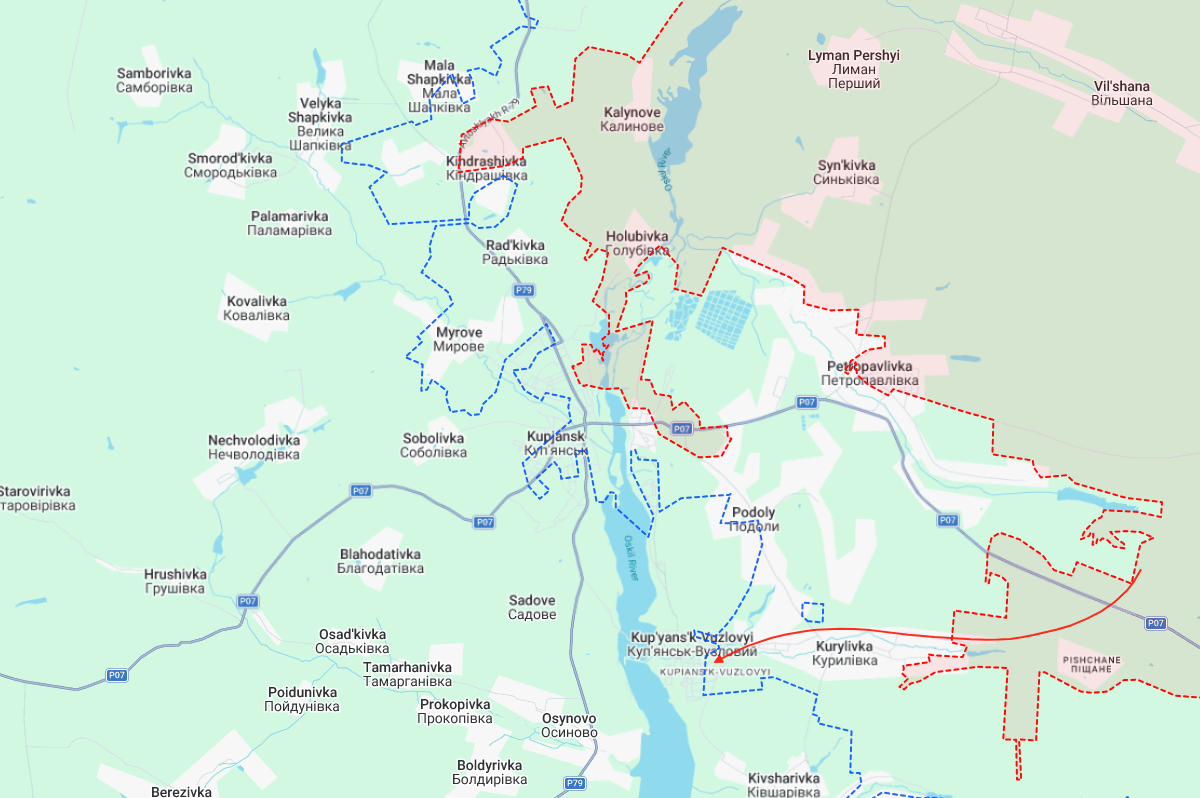
The exact place where the positions held by the starving soldiers were lost was not known, but the Russians were pushing significantly in this area through the village of Kurylivka towards the settlement of Kupiansk-Vuzlovyi (they announced its capture last autumn). If they were to seize it, there would in effect be three bridgeheads on the eastern bank of the Oskil instead of two.
From the Black Bird Group map you can get a clear idea of the difficult conditions in which Ukrainians are fighting here. The attacking Russians are on three sides and behind them is the Oskil river. You will find Kupiansk in the centre of the map. The Ukrainians recently liberated almost all of it, but the situation to the east of the town is deteriorating.
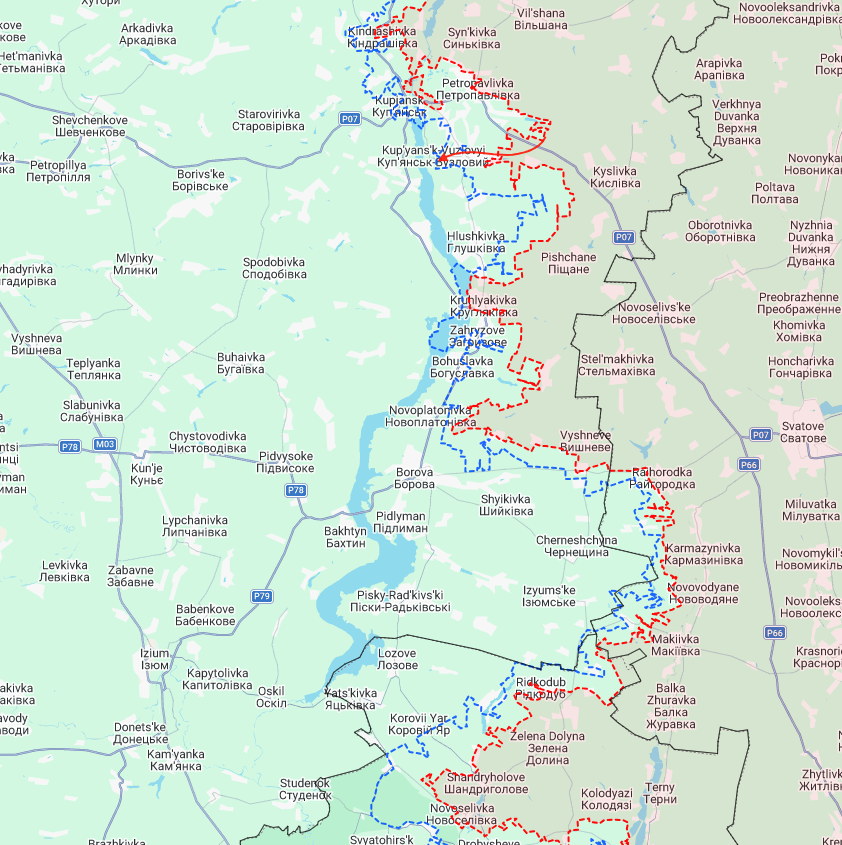
A broader view of the Oskil and its surroundings. This time, Kupiansk is right at the top in the centre. A good point of reference is the map stretching from Kupiansk south‑east towards the town of Svatove. At the beginning of last year, most of this area was under Ukrainian control. The autumn 2022 counteroffensive stopped precisely at Svatove. You will find it in the centre on the right.
The problems are not limited to the 14th Brigade, the corps commander who lost Siversk also stepped down. “I was not an ideal commander. Such people do not exist in war. I made mistakes. I kept silent when I should have spoken. But one thing I know for sure: I never stood behind you – I stood beside you,” brigadier general Serhiy Sirchenko wrote in his farewell statement.
He was being held responsible for the loss of Siversk, which his corps was supposed to defend. Even before him, the commanders of the 54th Mechanised Brigade and the 10th Mountain Assault Brigade had lost their posts for the same reason.
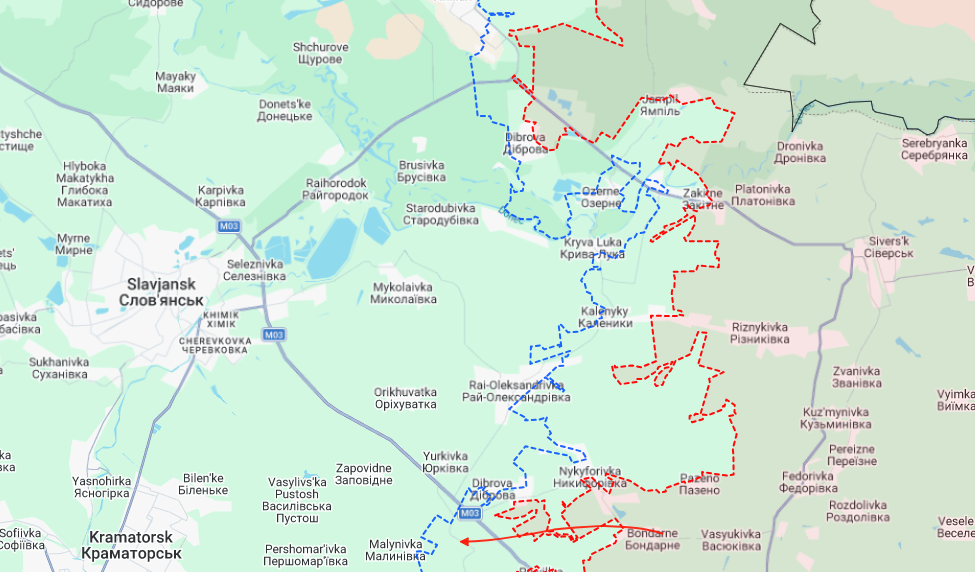
After the loss of Siversk, the command removed Sirchenko’s responsibility for this specific sector and created the Soledar tactical group. It was precisely after the fall of Siversk that the Russian advance towards Sloviansk from this axis accelerated. A battle for the village of Rai-Oleksandrivka is now looming.
The 54th Brigade got a new commander at the end of last year, the 30‑year‑old Vadym Cherniy. He has now given an interview to the Ukrainian website Vchasno, in which he described the state of the unit when he took over. He said it had almost completely focused on building its drone component, and did so so thoroughly that the infantry did not know how it was supposed to fight.
“A similar situation existed in every military unit on the Siversk axis. The brigades relaxed because the sector was stable and the enemy was being destroyed by drones. But someone forgot that it was not drones that would win the war, but the infantry. They built a large number of fortifications – first, second and third lines. But they did not take into account that someone had to defend them,” Cherniy said.
The infantry of the 54th Brigade, at the time he arrived, had everything it needed, but “did not know how to use weapons for its own defence. It did not know how to build a position properly. The infantry did not know how to fight. It did not know how to destroy the enemy. Combat training was not carried out; it existed only on paper.”
The loss of Siversk was also commented on by the well‑known Ukrainian Telegram channel Officer, which said it was a classic story of misleading reports being sent up the chain of command. However, it saw the problem in the lack of oversight, as a result of which higher headquarters did not have accurate information about the situation on the battlefield.
Drones attacked the Russian fleet in Crimea – ships that were hit turned into “destroyed” vessels on the internet without evidence. Ukrainian drones were continuing their offensive against the Russian army on the occupied peninsula. Over the weekend they struck various targets in several locations, which testified both to their growing effectiveness and to problems in Russian air defences.
The Ukrainian Centre for Strategic Communications and Information Security, an official institution tasked with combating Russian disinformation, was one of many that published photographs from the attacks along with a brief comment. In its official statement it said that SBU drones had struck the following targets in the port of Sevastopol and at Belbek airbase:
the large landing ships Yamal and Filchenkov, the reconnaissance ship Ivan Khurs, the Lukomka training centre of the Russian Black Sea Fleet, the command of radio‑technical reconnaissance of the air‑defence forces and the MR‑10M1 Mys‑M1 radar, a MiG‑31 aircraft and the technical and operational section of Belbek airbase.
Overnight, the Security Service of Ukraine (SBU) struck the Russian fleet and aviation in Crimea: three ships and a MiG-31 were hit.
Special forces of the “Alfa” unit carried out an operation at the bases of the Russian Black Sea Fleet in temporarily occupied Sevastopol and at… pic.twitter.com/Eg3TIWH2lV
— SPRAVDI — Stratcom Centre (@StratcomCentre) April 26, 2026
There was no doubt this was a success and a demonstration of the drones’ capabilities. However, the extent of the damage was still completely unknown. For example, the MiG‑31 was very likely a non‑operational aircraft. It was a rare and expensive type, and there was only a small chance that the Russians would risk losing it at an airbase that had repeatedly been the target of Ukrainian air raids. If it later turned out that it was an operational aircraft, that would be excellent news.
All the ships that were hit were, in turn, too large for a single drone to be able to inflict serious damage on them, let alone completely destroy or sink them. And even if that did happen in this case by chance, there was no evidence. Nevertheless, as almost always in such cases, supposedly reliable claims circulated on the internet that every single target had been “destroyed”, accompanied by similar infographics:
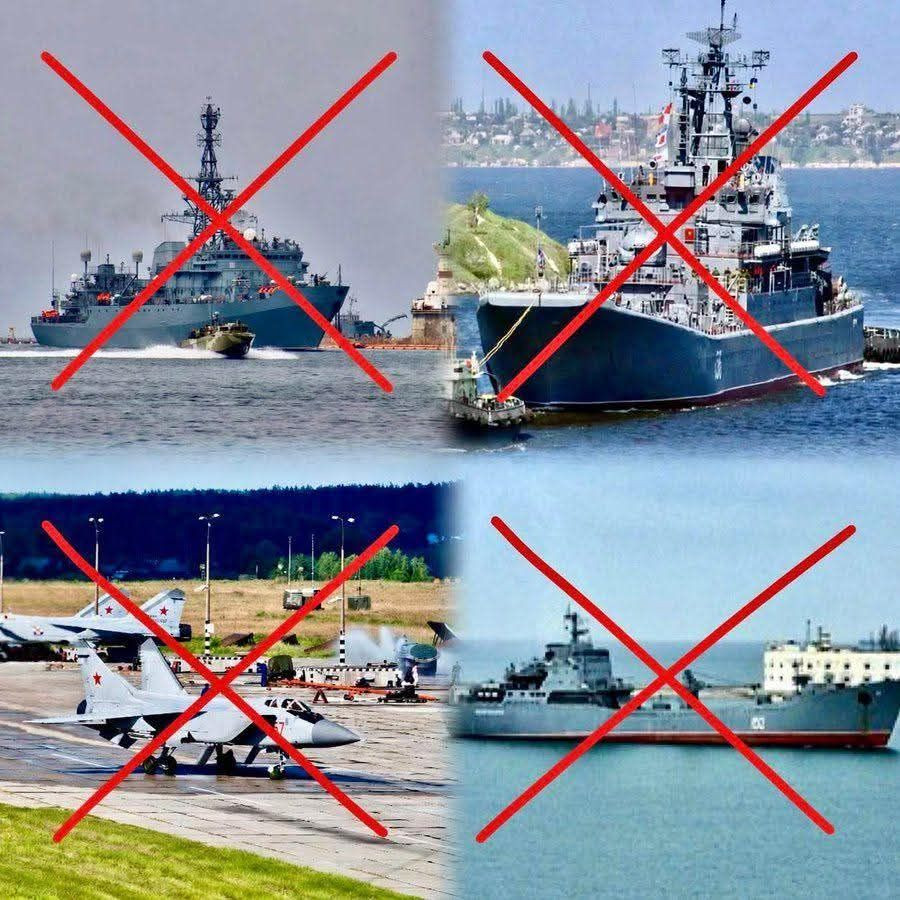
Ukraine was fighting heroically and achieving admirable results, but there was no need to exaggerate.
More than half of the storage tanks in Tuapse have been destroyed. Throughout the previous week, videos of a massive fire were coming from the Russian city of Tuapse. It started after repeated attacks by Ukrainian drones and the firefighting lasted several days. By the weekend no smoke was rising from the ruins and satellite images revealed the consequences.
The Ukrainian project Oko Hora classified 24 storage tanks (52 percent) as destroyed, 4 (9 percent) as damaged, and 18 (39 percent) as unscathed. In total, 61 percent of the capacity was unusable.
🤯 Results of the UAV attack on the Tuapse tank farm in Krasnodar Krai:
🔴 Destroyed – 24 tanks, or 52%;
🟠 Damaged – 4 tanks, or 9%;
🟢 Undamaged – 18 tanks, or 39%;
In total, 61% of the storage tanks will not be operational in the near future in one way or another. https://t.co/xHx203upmU pic.twitter.com/ZV1texj4jv
— Oko Gora (@oko_gora_tg) April 26, 2026
The refinery itself, located next to the hit storage tanks, was undamaged:
To underline that attacks on infrastructure were taking place in both directions, Russian videos recorded a strike on fuel tanks in the Ukrainian city of Dnipro. At least two of them were in flames after being hit.
Videos of the day
The An‑28 is a light transport aircraft that no one ever expected would be used to chase anything. A few months ago, however, a video appeared showing Ukrainians successfully using this type to shoot down drones with a heavy machine gun firing through an open fuselage door. The latest innovation is much more sophisticated. Up to 10 interceptor drones can hang under the wings of the An‑28, controlled by an operator directly from the aircraft.
👀
Запуски дронів-перехоплювачів P1-SUN з борту літака Ан-28
Джерело відео: aero.tim IG pic.twitter.com/J85a6dGaYH
— MilitaryAviationInUa (@MilAviaUA) April 23, 2026
The following video is another refutation of the myth that Russians do not care about their wounded. That is not true. At the same time, it is also a brutal illustration of the brutality of war. A Ukrainian reconnaissance drone tracked a group of Russian soldiers as they evacuated a wounded comrade. After a while, a drone flew into their shelter. The consequences were devastating.
A Ukrainian patrol drone spotted a group of Russian soldiers sheltering inside a building along with an ammunition stockpile. pic.twitter.com/DLR2KZqWJd
— распад и неуважение (@VictorKvert2008) April 26, 2026
What are the losses
By Monday morning, Russia had demonstrably lost 24,487 pieces of heavy equipment (on Tuesday (21 April) it was 24,471). Of these, 19,123 (19,108) pieces were destroyed by the Ukrainians, 976 (976) were damaged, 1,206 (1,206) were abandoned by their crews and 3,182 (3,181) were captured by the Ukrainian army. This included 4,389 (4,385) tanks, of which 3,292 (3,288) were destroyed in combat. Ukraine had lost 11,050 (11,977) pieces of equipment, of which 9,272 (9,224) were destroyed, 673 (669) damaged, 671 (670) abandoned and 1,414 (1,414) captured. This included 1,419 (1,416) tanks, of which 1,084 (1,081) were destroyed in combat.
Note: Neither side regularly reports its dead or destroyed equipment. Ukraine publishes daily figures for Russian casualties and destroyed equipment, which cannot be independently verified. In this overview we use data from the Oryx project, which since the beginning of the war has compiled a list of equipment losses documented exclusively by photographs.