
The latest World Press Freedom Index highlights Serbia and Turkey as countries where journalists are particularly at risk of physical attack, or subject to political pressure.
 Milica Stojanovic



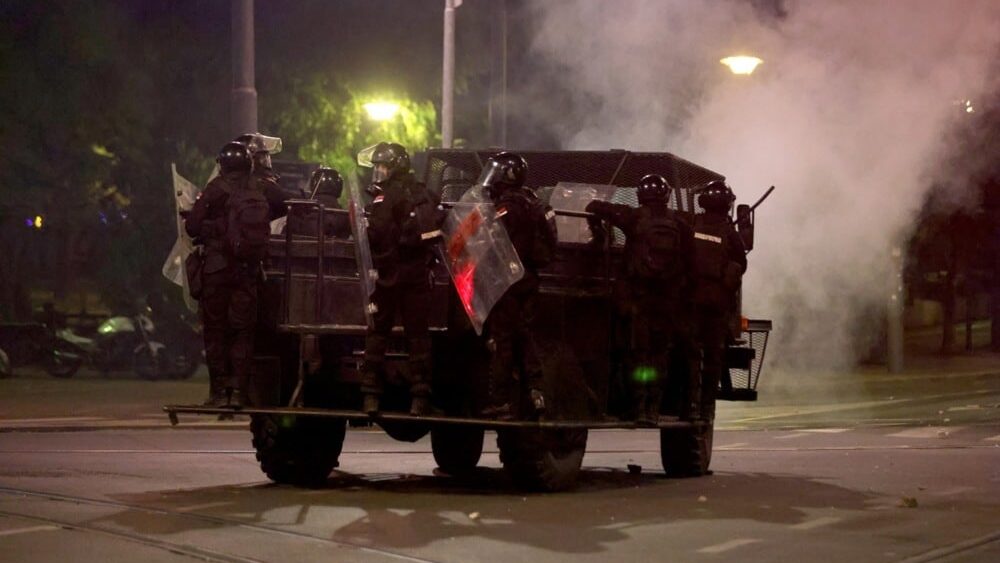
Riot police take up position during an anti-government protest in Belgrade, Serbia, August 2025. Photo: EPA/ANDREJ CUKIC.
Serbia saw the biggest decrease in media freedom in the Balkans last year, according to the global media watchdog Reporters Without Borders’ latest World Press Freedom Index, published on Thursday.
The worst-ranked Balkan country remains Turkey, according to Reporters Without Borders; in both countries, the safety of media workers is the biggest problem.
Serbia this year was ranked in 104th place out of 180 countries surveyed – its worst position since 2002, when it was measured for the first time. “Despite a solid legal framework, journalists [in Serbia] are subject to political pressure and crimes committed against them go unpunished,” the report said.
The report noticed the toll journalists and media workers in Serbia paid for covering the 2025 protests. “Journalists covering the 2025 anti-government protests suffered a record number of physical attacks, at least 100, many of which were committed by police officers,” the report said. “Disturbing cases of illegal hacking of journalists’ mobile phones by the intelligence service and the police have also come to light,” it added.
Serbia ranked worst among former Yugoslav countries, but several others also showed declines, including Albania (ranked at 83). However, Croatia (53) and Kosovo (84), ranked higher than last year.
Turkey was ranked in 163rd place out of 180 countries, its second-worst ranking since 2002. RSF noted that “discriminatory practices towards journalists and media outlets critical of authorities, such as stripping them of press passes, are commonplace.
“The accusation of spreading disinformation has become a means to relentlessly persecute journalists in court, and the proposed amendment on ‘agents of influence’ risks becoming a new legislative tool to crack down on journalism,” Reporters Without Borders said.
It added that the “lawsuits for ‘insult’ are sometimes brought against journalists who question religious, judicial or government figures. “References to domestic violence or other forms of abuse, especially when made by women journalists, can result in social media hate campaigns,” the report noted.
Safety of journalists is a grave problem in Turkey, the report also noted. “Reporters covering anti-government protests are targeted by law enforcement officers. Journalists who dare to cover attacks on secularism, the impact of religious groups (Tarikat) or regional jihadist organisations are increasingly exposed to threats,” it said.
When it comes to other Balkan countries, Bulgaria (71) ranked slightly worse than in 2025. Romania (49) and Greece (86) improved their rankings.
According to Reporters Without Borders, media liberties have declined internationally, and “over half of the world’s countries now fall into the ‘difficult’ or ‘very serious’ categories for press freedom.
“In 25 years, the average score of all 180 countries and territories surveyed in the Index has never been so low,” the organisation said.