
Nato chief Mark Rutte spent two hours in the White House and left without the usual press conference or photo opportunities, calling the talks with US president Donald Trump “very frank”.
 Andrew Rettman



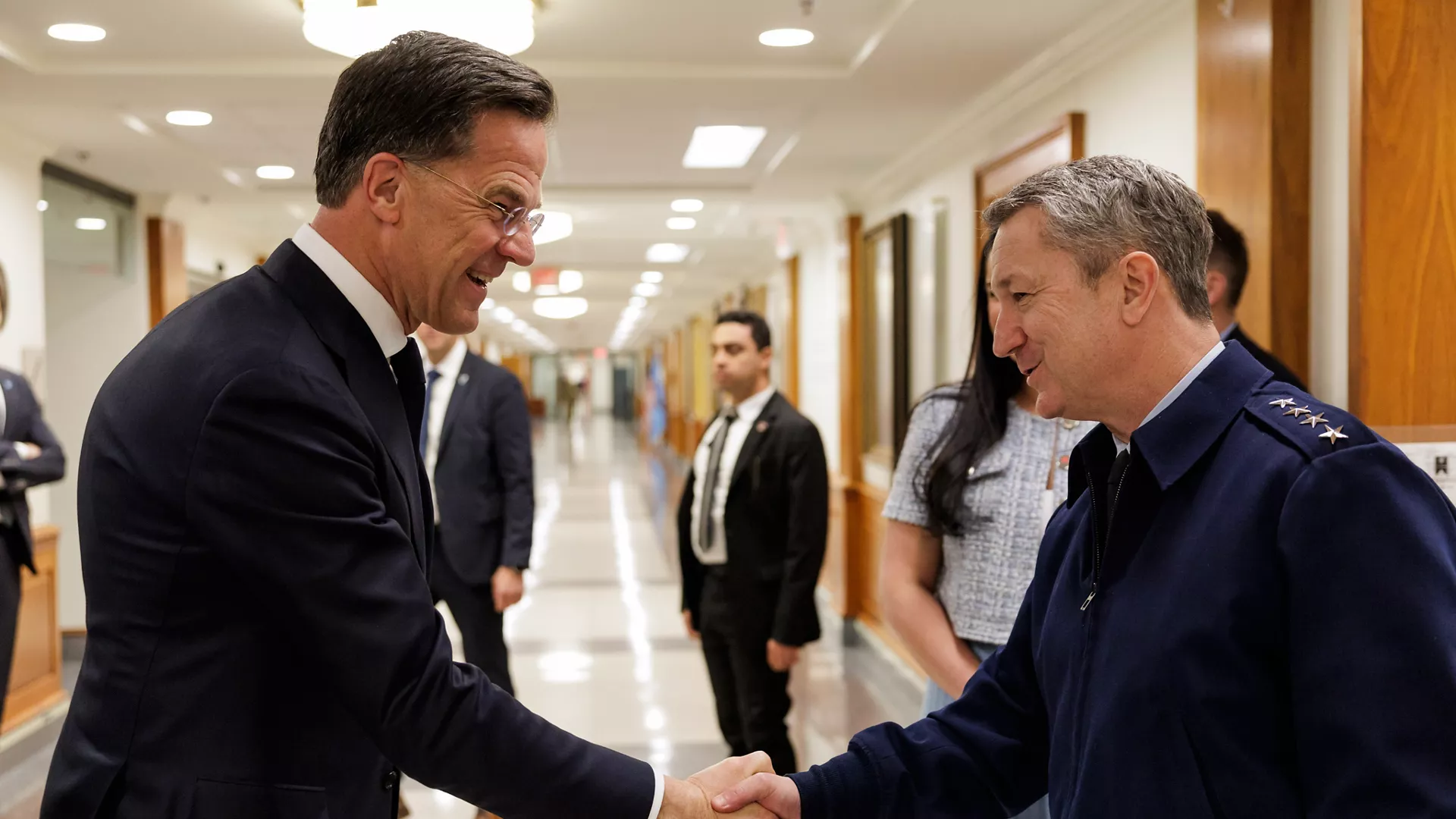
The US president denigrated Western allies and Greenland after meeting Nato chief Mark Rutte on Wednesday (8 April) in Washington, while Israel massacred civilians in Lebanon.
“NATO WASN’T THERE WHEN WE NEEDED THEM, AND THEY WON’T BE THERE IF WE NEED THEM AGAIN,” said Trump on social media after meeting Nato secretary general and former Dutch prime minister Mark Rutte.
“REMEMBER GREENLAND, THAT BIG, POORLY RUN, PIECE OF ICE!!!”, he added.
His comments referred to Nato allies’ refusal to join his war on Iran and to let him annex Greenland from Denmark.
For his part, Rutte spent two hours in the White House and left without the normal press conference or photo opportunities, but later told the CNN broadcaster: “He [Trump] is clearly disappointed with many Nato allies, and I can see his point”.
“This was a very frank, very open discussion, but also a discussion between two good friends,” he said.
“Very frank” is usually diplomatic jargon for an ill-tempered meeting that led to no agreement.
Rutte is to stay in the US until Sunday, where he will attend a meeting of the ‘Bilderberg Club’ at the weekend — an elite and secretive group of politicians, business leaders, and intellectuals, created in 1954 to foster transatlantic dialogue.
Speaking to press earlier on Wednesday, Trump’s spokeswoman Caroline Leavitt also said: “Nato [members] turned their backs on the American people over the course of the last six weeks”.
“It’s something the president has discussed,” she said of his numerous threats to quit the 80-year-old alliance in the past four months.
Fragile ceasefire
The Trump-Rutte meeting came after the US and Iran had agreed on a two-week ceasefire deal that included reopening the Strait of Hormuz to international shipping.
The move paved the way for European allies to start escorting ships through the war zone, in line with Trump’s previous demands and in what might help mend transatlantic relations.
“Our governments will contribute to ensuring freedom of navigation in the Strait of Hormuz,” said 16 countries in a statement on Wednesday, including Denmark, Greece, Finland, France, Germany, Spain, and Sweden.
But the ceasefire deal risked immediately unravelling as Israel launched mass-scale attacks on civilians in Lebanon also on Wednesday, killing 254 people, and prompting Iran to threaten to close the strait again in response.
“We call upon all sides to implement the ceasefire, including in Lebanon,” the statement by the group-of-16 added, taking Iran’s side against Israel and the US, which said the deal did not cover Lebanon.
French president Emmanuel Macron also spoke by phone on Wednesday with Trump, Iranian president Massoud Pezeshkian, and Lebanese president Joseph Aoun.
“I expressed France’s full solidarity in the face of the indiscriminate strikes carried out by Israel in Lebanon today, which resulted in a very high number of civilian casualties. We condemn these strikes in the strongest possible terms,” Macron said.
“They pose a direct threat to the sustainability of the ceasefire that has just been reached,” Macron said.
Spanish prime minister Pedro Sánchez said that Israeli prime minister Benjamin Netanyahu’s “contempt for life and international law is intolerable”.
Meanwhile, Trump’s ‘secretary of war’, Pete Hegseth, mocked Iran, in what also risked destabilising the fragile accord.
“Iran begged for this ceasefire — and we all know it,” he told press in Washington.
Trump also said on social media “the ‘Shootin’ Starts,’ bigger, and better, and stronger than anyone has ever seen” if Iran closed Hormuz again.
“Our great Military is Loading Up and Resting, looking forward, actually, to its next Conquest,” he added, after having earlier threatened to invade Cuba after the Iran war ended.
US ‘interfering’ in Hungary
And on the other side of the Atlantic, US vice-president JD Vance verbally attacked the EU and Western ally Ukraine while in Budapest, in his bid to help far-right Hungarian prime minister Viktor Orbán cling to power in elections on Sunday.
Ukrainian president Volodomyr Zelensky’s behaviour was “completely scandalous,” Vance said at an event with the Mathias Corvinus Collegium pro-Orbán think tank, referring to Zelensky’s joke, one month ago, that he would send soldiers to Hungary to strong-arm Orbán into unblocking EU funds for Kyiv.
He accused the EU of “foreign influence” in the Hungarian election because it had withheld funds from Budapest in the past two years, due to his backsliding on rule-of-law.
He denied that his own visit was outside interference, adding: “This is not American influence. I would never do this”.
But the EU called him out for lying on this point.
“That the US vice president was in Hungary just a few days before the election, this fact alone speaks for itself as to who is interfering,” said German government deputy spokesman Sebastian Hille in Berlin, echoing the EU Commission in Brussels.
The Vance-Orbán speaking points on the EU were repeated by Kremlin spokesman Dmitry Peskov.
Peskov spoke after Hungarian media published a second tranche of transcripts of Hungarian foreign minister Péter Szijjártó’s phone calls with Russian foreign minister Sergei Lavrov, in which Szijjártó pledged to share internal EU documents with the Kremlin.
“OK, Peter, if you can send me the document, I would appreciate this,” said Lavrov in one exchange in 2024.
“I immediately do it. I send it to my embassy in Moscow, and my ambassador will forward it to your chief of staff, and then it’s at your disposal,” Szijjártó said.
Polish prime minister Donald Tusk called Wednesday’s new revelation “truly shocking”.
But Szijjártó said: “Foreign intelligence interference in Hungary’s parliamentary election continues in an unusually aggressive and open manner”.