
Estonia is one of Nato’s smallest members, but its experience of Russian occupation has contributed to high spending on defence and preparedness for attack.
 Ondřej Kundra



Why Estonia is massively investing in defence and prioritising freedom over the welfare state.
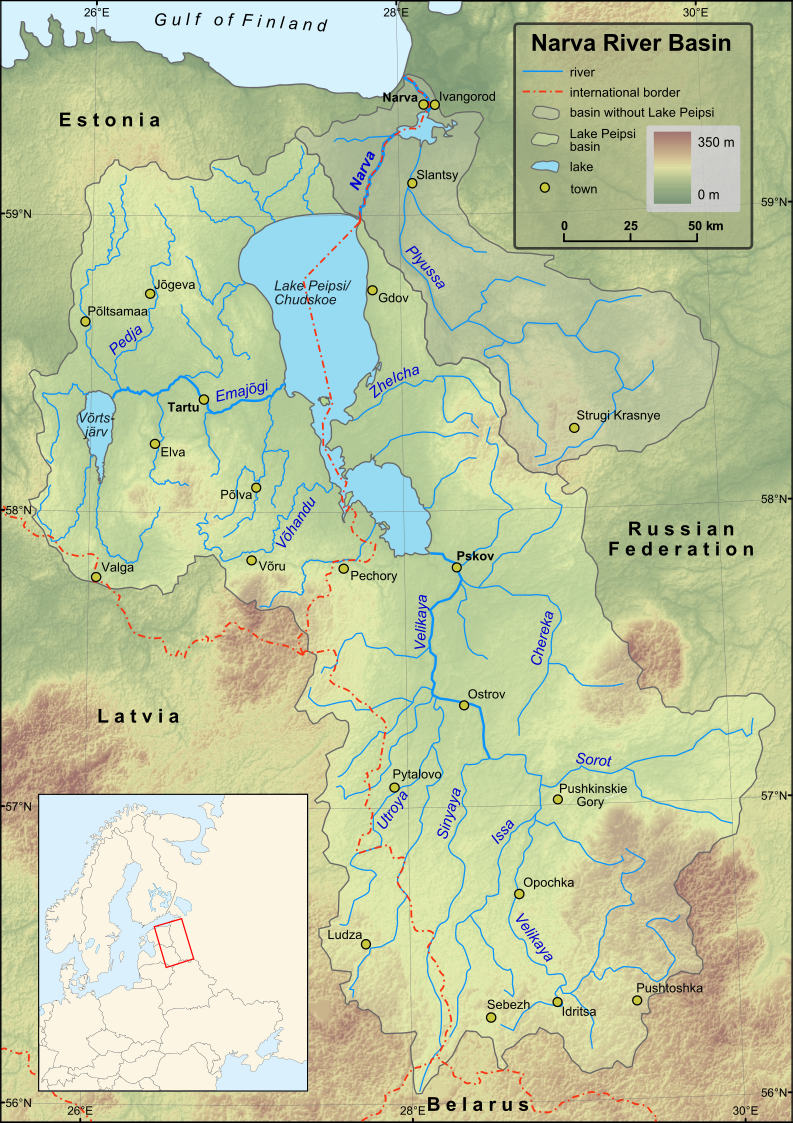
The place in Europe where, with a single brief turn of the head, one can most clearly see the symbols of our age’s beauty and madness side by side lies by the gigantic Lake Peipus in Estonia. And perhaps it is this that has pushed Estonians to the top in defence spending: they do not want to lose anything of the former and want to avoid the latter as much as possible.
It is terrifying
“I am sorry, but I will only be able to talk to you a little later. This is a historic moment, I have to be there,” Reili Tooming, deputy mayor of the small town of Mustvee, told me, without taking her eyes off the gleaming white boat that a crane was lowering onto the surface of Lake Peipus.
“The last time we had such a boat here was in the 1970s; it took trippers even to the other side of the border, to Russia. Then it had to stop because of its age and for a long time there was nothing here, until now, when a local entrepreneur had a new one built, and we are looking forward to it bringing more tourists here in the summer.”
It is not that there are too few of them in Mustvee. From spring to the end of summer cyclists and motorcyclists and lovers of summer swim in the dark waters of the lake, which also gave its name to Mustvee itself. Still, the boat, as Reili Tooming hopes, could encourage some of them to stay overnight, which would bring Mustvee higher revenues from tourism. Unlike its predecessor, however, this steamer will have a different timetable, and Russia will no longer be on it.
After Russia’s aggression against Ukraine, Estonians reduced any contact with their eastern neighbours to a minimum and, given the frequent threats, a potential invasion by Moscow is a much-discussed scenario here.
“I do not think the war will reach us, but nothing can be underestimated. So the new school we are building will include a shelter,” Reili Tooming said.
 (Source: Wikimedia)
Some security measures around the lake are already in place. “They arrived a few days ago, they are here because of the drones,” the politician said when asked what two infantry fighting vehicles with their cannons aimed over the lake were doing in the surrounding woods. Despite the camouflage, they are clearly visible; the area next to them is cordoned off.
The soldiers arrived here after Estonian airspace had been repeatedly violated by drones from the other side of the border. One hit a factory chimney several dozen kilometres from Mustvee, another crashed in an uninhabited area. These were Ukrainian unmanned aircraft heading for Ust-Luga and Primorsk, Russian ports on the Baltic where the Russians load oil onto tankers of their shadow fleet and ship it to India or China so that, with the proceeds, they can continue financing the war.
The closest route to them is via Belarus and along Estonia; the Russians try to disable the drones with jamming, and so they sometimes stray onto Alliance territory and endanger local residents.
“It is terrifying that this year we will have soldiers by our lake alongside tourists. On the other hand, if needed, they will protect us from the drones,” deputy mayor Tooming said.
“We cannot give interviews about our mission,” one of the soldiers who was patrolling around the fighting vehicles with a submachine gun in his hand told me a little later.
Behind his back a transformer station was humming to keep the unit permanently supplied with electricity, and a fire was burning in an outdoor firepit so that the patrols would have somewhere to warm up during their rounds. Several similar groups are currently deployed across Estonia.
A million rockets a year
Estonia, with its 1.3 million inhabitants, is one of the smallest Nato member states, yet in defence spending it is outpacing most of the Alliance. “This year we will get above five percent of GDP. Back in 2012 we reached two percent, even before Nato started talking about it. There has always been political consensus on this between the coalition and the opposition. When Russia attacked Ukraine in 2022, we increased spending to three percent, but as we concluded that this was not sufficient given the security situation, we raised the number further,” deputy defence minister Kadri Peeters said.
According to the deputy minister, it was not easy for the government to decide to increase military spending. “Politically you gain more when you invest in social areas and all those things that make life better. Our approach to the public is honest. We speak openly about the fact that a further Russian invasion is possible. And we have agreed that freedom, at this moment, is better than the welfare state.”
The Estonian government is taking several steps to strengthen defence. On the outskirts of the border town of Narva, at the very eastern edge of the country, I walk with the regional head of police and the border guard – the “eastern prefect” – Tarvo Kruup along a three-metre-high razor-wire fence, in front of which stands a tall watchtower with numerous cameras. “Nothing escapes us thanks to them,” Kruup said, waving at one of the cameras to his colleagues who were watching him from one of the command centres located in the middle of town.
In the uninhabited sections of the border the military plans in time to deploy anti-personnel mines as well. The government has already announced that it has purchased HIMARS rocket launchers from the Americans and is acquiring additional long-range rocket systems with the aim – if necessary – of delivering precise strikes deep into Russian territory and destroying their weapons depots, command posts and military bases. Published defence documents state that, in the event of an attack, the armed forces would seek actively to transfer the war onto the aggressor’s territory, in order to cause as few civilian casualties as possible and as many losses as possible to the enemy.
“We are reassessing some arms deals; our priorities are drones, systems against them and air defence,” chair of the Estonian parliament’s security committee Grigore-Kalev Stoicescu said.
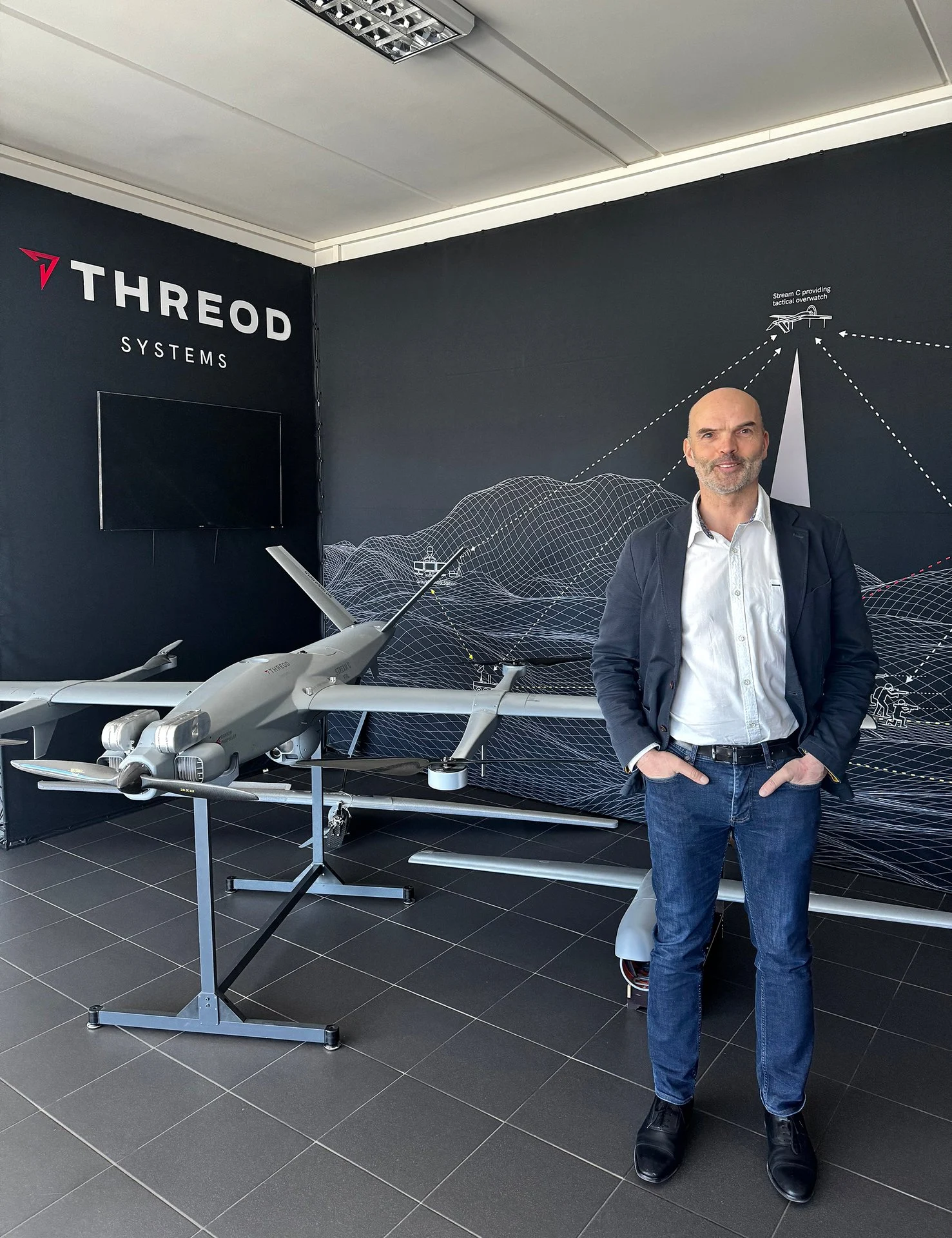 Ranno Pajuri, sales director of one of the main private manufacturers of reconnaissance drones and disposable drone-launch systems, at the headquarters of Threod Systems (Source: Ondřej Kundra)
The private sector plays a key role in this. “We want to produce millions of rockets a year,” said Kusti Salm, a long-serving government official who, within the company Frankenburg Technologies, launched the development of a small, AI-guided Mark 1 rocket designed to shoot down drones. Its advantage, defence experts agreed, is its low cost and high effectiveness in hitting targets, which could give Estonia and other Alliance countries a technological edge on the battlefield. Other companies are producing reconnaissance drones.
“Our customers include, for example, the Estonian police authority and the border guard. And of course various foreign partners,” said Ranno Pajuri, sales director of one of the main private manufacturers of reconnaissance drones and disposable drone-launch systems, Threod Systems. Since the beginning of 2022, its number of employees had increased 2.7 times and by the end of 2025 had reached almost 200, while revenues over the same period had grown nearly sevenfold.
What to do with one’s life next
An ever greater share of responsibility for defence, however, has to be borne by citizens themselves. Given Estonia’s location, Russia could cut it – and the entire Baltic region – off from the rest of the Alliance by blockading the Suwałki corridor: a 100 km strip of land between Lithuania and Poland, bordered on one side by the Russian exclave of Kaliningrad, Moscow’s only ice-free port on the Baltic Sea, and on the other by Putin’s satellite Belarus. Another Russian blockade could then come directly from the sea.
Like Mustvee, the Estonian government is building a network of shelters across the country to protect its citizens; people have an app on their phones that shows them the nearest shelter to their home and also warns them of incoming drones. State-distributed supplies should last for a month in a crisis, and for an additional week – until, under Alliance plans, Nato reinforcements fought their way into Estonia – people would, have to be able to provide food, water and medicines themselves.