
With more than 50 percent of votes counted on Sunday, Tisza’s Magyar had already secured 136 out of 199 seats, in a clear constitutional majority.
 Veronika Munk



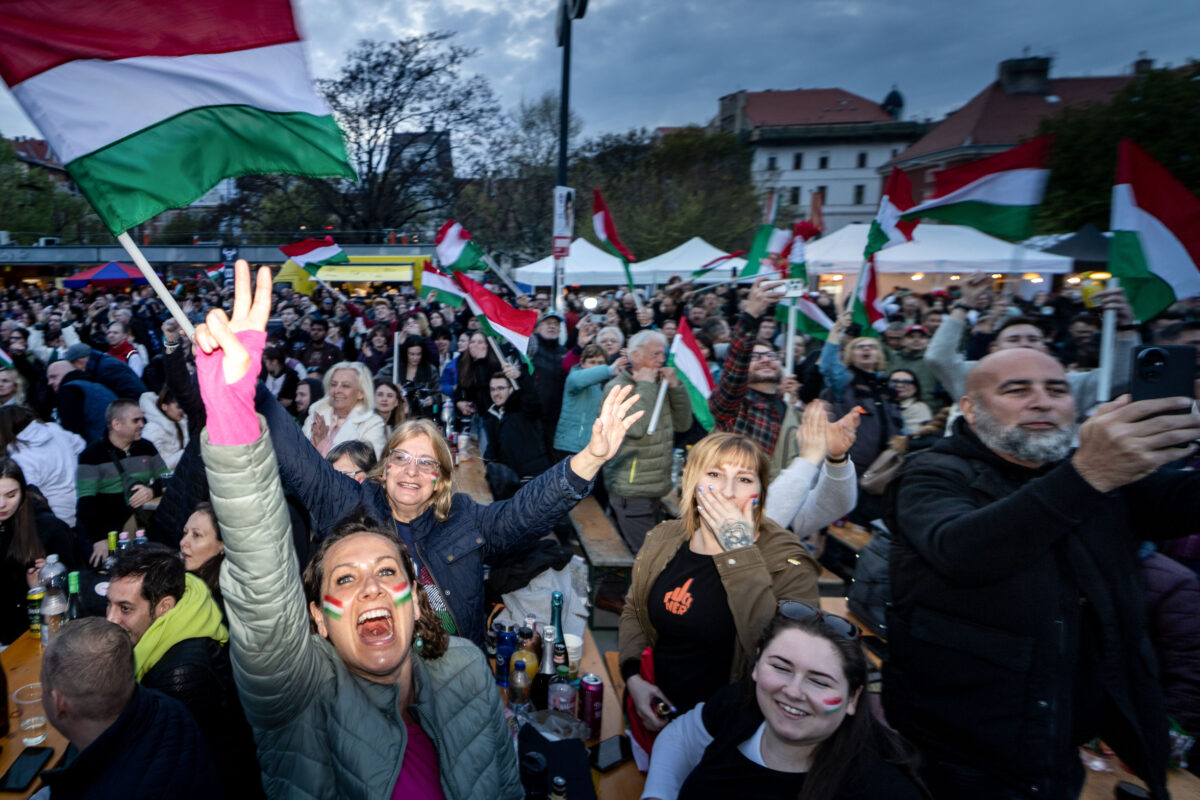
The centre-right opposition Tisza Party of Péter Magyar won the parliamentary election in Hungary with a two-thirds majority, while prime minister Viktor Orbán’s Fidesz suffered a devastating defeat.
With more than 90 percent of votes counted, Tisza had already secured 138 out of 199 seats in parliament, which meant a clear constitutional majority.
In addition to its victory on the national party list, Tisza has also captured most single-member constituencies, while Fidesz has won fewer than 15 individual seats.
After 9PM, Orbán phoned Magyar to congratulate him on his victory; Magyar published this on his Facebook page.
In his short speech, Orbán also said he had congratulated the winner.
“From the opposition we will also serve our homeland and the Hungarian nation,” he added.
“The burden of governing no longer weighs on our shoulders, so now our task is to strengthen our communities,” said the outgoing prime minister.
“Two and a half million voters trusted us; let us send them the message from here that we will never let them down,” he added, saying that they would never give up.
“These days ahead of us will still be about healing the wounds, but then the work will begin,” Orbán said.
Record turnout
From the early morning hours it was clear that mobilisation had reached an unprecedented level during the campaign.
The early turnout figures were already strikingly high: In the first hour of voting, nearly twice as many people cast their ballots as four years earlier.
By the afternoon, the absolute record had been broken: by 5PM, more people had voted than in any previous election since the change of regime.
In the first hours, Fidesz politicians were still saying that the high turnout could favour the governing party. Minister Gergely Gulyás also said this in an interview with Napunk.
Already at that point, however, it was evident that voters were most active in larger municipalities, which seemed more favourable to Tisza.
At Tisza’s public election-night event on Budapest’s Batthyány Square, enthusiastic picnickers waited for the results throughout the afternoon and later.
Magyar first appeared in front of the cameras at 7.30PM, saying they were optimistic about the results. He also added that “signs of madness” were showing among Fidesz supporters, who were “hallucinating” about a possible occupation of public buildings.
Fidesz held its election-night gathering at the Bálna centre in Budapest, where politicians were strictly separated from journalists and were even more reserved in providing information than four years earlier.
What did the polls show?
In recent months, opinion polls by independent agencies had indicated a stable lead for Tisza.
The projection by Medián, published four days before the election, showed a secure two-thirds majority for Tisza, with 138–143 seats. Fidesz was projected to win between 49 and 55 seats. According to this, the far-right Mi Hazánk would have obtained five or six MPs.
The 21 Research Centre [21 Kutatóközpont], which is also among the most reliable pollsters, in a survey published on 1 April showed 56 percent for Tisza, 37 percent for Fidesz, and 5 percent for Mi Hazánk.
Polls published after the closing of the ballot boxes also indicated a clear Tisza victory: Medián put Tisza ahead by 56:38, while the 21 Research Centre showed 55:38.
By contrast, the government-affiliated Nézőpont Institute, in a survey published on 3 April, still showed Fidesz in the lead.
According to them, Orbán’s party would have won 109 seats, Tisza 80, and Mi Hazánk 8.
How did Magyar win by such a margin?
Experts see the reasons for Magyar’s victory in the fact that he stepped onto the stage precisely when the public mood coincided with a strong leadership image.
According to political analyst Botond Feledy, by 2024 the social climate in Hungary was already ripe for grassroots protests.
“There had been leakers and various protest cases before, but there was no face who could have become a leader. The anti-government mood eventually condensed into support for a protest movement that we today call Tisza,” Feledy said.
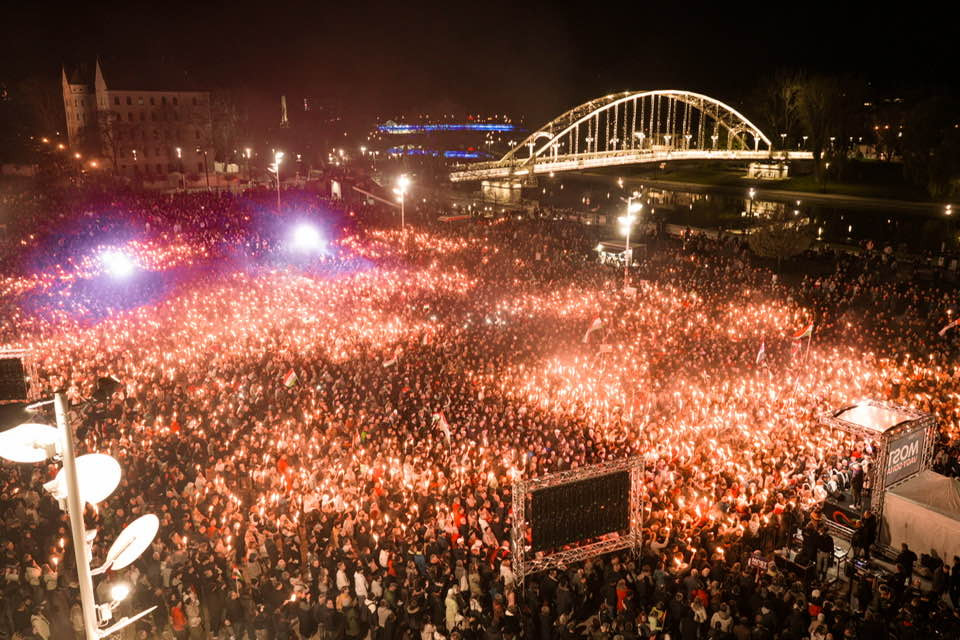 Magyar’s campaign rally in Győr three days before the election. Photo – Péter Magyar/FB
Magyar’s victory was greatly helped by his tour across the country, which he effectively conducted for two years, with shorter and longer breaks.
“Over the past two years, and especially since 15 March, Péter Magyar has been running a countryside-focused campaign, spending little time in Budapest,” political scientist Nóra Schultz told Napunk.
Tisza also held its closing campaign rally outside Budapest, in Debrecen, which for a long time had been considered a Fidesz stronghold.
“Tisza’s communication and the final speeches by Péter Magyar and the candidates were about the future, about restoring, reclaiming and operating the Hungarian state,” is how Schultz assessed the final days of Tisza’s campaign for Napunk.
Russian interference and spy affairs
The suspicion of Russian interference emerged early in the campaign.
“The Russian foreign intelligence service, the SVR, already indicated openly last year that it was supporting Viktor Orbán. Putin was also backing him, and clearly discernible interests were emerging from other directions as well,” said Feledy.
“The usual Russian networks were also active on the internet: actors that had previously been identified, for example in Moldova, and that this time were working to discredit pro-Tisza influencers. NewsGuard identified TikTok accounts created in January that achieved more than 10m views in total,” he added
At his campaign rallies, Magyar regularly spoke about Russian interference and about Orbán, who, in 1989, became famous for sending Russian troops home from Hungary, but “37 years later called the Russians back”.
At the same time, the role of the Hungarian intelligence services also came into focus.
Investigative portal Direkt36 revealed that mysterious groups had tried to crash Tisza’s IT system.
Police captain Bence Szabó, who leaked the story, and Tisza’s IT specialist Dániel Hrabóczki – who became known under the alias Gundalf – turned into opposition heroes of the campaign.
In the last weeks of the campaign, several phone calls between Hungarian foreign minister Péter Szijjártó and his Russian counterpart Sergei Lavrov were also leaked.
These revealed that Szijjártó regularly phoned Lavrov about EU negotiations and even sent him EU documents.
The transcript of another phone call also came to light, in which Orbán spoke with Russian president Vladimir Putin and assured him that Hungary was at his disposal in every respect.
The war-scare did not work
Fidesz built its campaign on fear of war. Orbán’s main message was that if the opposition won – whom he alternately equated with Ukrainian president Volodymyr Zelensky and with “Brussels” – “they will take the Hungarians’ money to Ukraine”.
Orbán’s other main theme was to emphasise the government’s welfare measures: the minimum wage was raised by 11 percent; personal income tax was abolished for mothers under 40 who have given birth to at least two children; and young people were offered housing loans with a 3-percent discount.
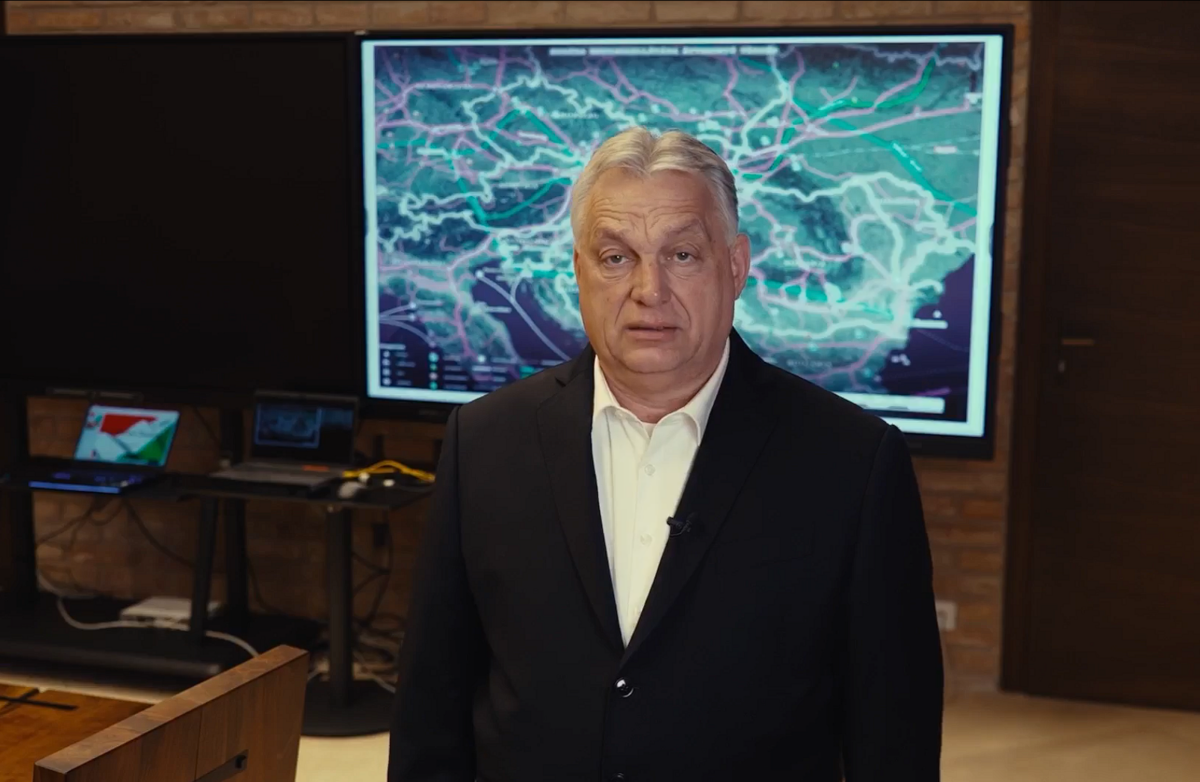 Orbán speaks about the incident in Serbia after the Easter Sunday meeting of the Defence Council. Photo – screengrab, O.V.’s Facebook page
According to Schultz, the politics expert, the Fidesz campaign ultimately descended into incoherence.
“Although it was a rational political decision to place him at the centre of the Fidesz campaign – as he is still the most popular politician within the Fidesz camp – he started his nationwide tour too late. In the end, these rallies were highly counterproductive. Moreover, in the last weeks the Fidesz campaign degenerated into communication chaos. There was a bomb threat in Serbia on Easter Sunday, they referred to welfare measures, then they returned to the threat of war. Fidesz’s communication was characterised by inconsistency, which was surprising because they are usually more professional than this,” Schultz said.
In the political scientist’s view, the visit of US vice-president J.D. Vance to Budapest in the last week of the campaign was also a misstep.
“It was an irrational move,” she said.