
Viktor Orbán’s far-right Patriots for Europe (PfE) bloc in the European Parliament opposed measures aimed at tackling rule-of-law breaches in the EU’s forthcoming long-term budget.
 Nikolaj Nielsen



Viktor Orbán’s far-right Patriots for Europe (PfE) bloc in the European Parliament opposed measures aimed at tackling rule-of-law breaches in the EU’s forthcoming long-term budget.
“We cannot agree to the conditionality mechanism which is used for political purposes,” said Tomasz Buczek, a Polish PfE, speaking on behalf of the group on Wednesday (15 April).
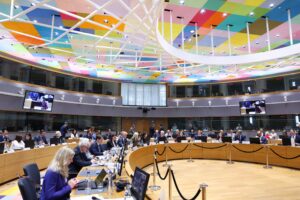
Buczek’s comments preceded a key committee vote on the EU’s next seven-year budget, also on Wednesday, which incorporates safeguards against rule-of-law violations in member states.
Despite Orbán’s landslide defeat that ended his 16-year grip on Hungary, his allies in the European Parliament appeared to show no signs of retreat. Orbán himself remains prime minister of Hungary until the new government takes over in May.
Launched by the EU in January 2021, the conditionality mechanism ties fund payouts to member states’ adherence to rule-of-law standards.
It was first activated in 2022 against Hungary, resulting in €6.3bn withheld over flaws in public procurement and the absence of an anti-corruption strategy.

The amount has since risen to around €18bn under Orbán’s long-time government, once branded totally corrupt by Transparency International.
Despite PfE efforts, the budget proposal set forward by the leading MEPs on the file was adopted by 26 in favour, nine against and with five abstentions.
PfE members Tomasz Buczek, Angéline Furet, Séverine Werbrouck, and Auke Zijlstra all voted against, while Jana Nagyová and Annamária Vicsek abstained.
It means the committee voted in favour of increasing the European Commission’s overall budget proposal for various programmes to €197.30bn.
This represents a 10-percent increase or the equivalent of 1.27 percent of EU GNI.
Crucially, it also excludes any debt repayments for the post-pandemic NextGenerationEU recovery fund.
“The repayment of NextGenerationEU debt should be made above and beyond the ceilings and should be funded through own resources,” said Siegfried Mureșan, a centre-right Romanian and one of the two lead MEPs on the budget file.
Such own resources could potentially include taxes on online-gambling, crypto-asset capital gains and US big tech operators in Europe.
The committee has also opposed giving EU states flexibility over some €200bn in the budget, as initially proposed by the commission.
“We as a parliament should have a say on everything related to the budget,” countered Mureșan.
The committee vote could become the official European Parliament position to enter talks with EU states if it is adopted in the plenary before the end of the month.
Some big ticket figures revealed on Wednesday include €139.31bn for farmers, €78.87bn for structural and cohesion funds, €124.19bn for the European Social Fund, and €3.82bn for asylum and migration, among others.