

The continent of Europe is warming up two times faster than other regions in the world, with the biggest changes seen in colder regions, according to the 2025 European State of the Climate report.
 Petra Pavlovičová



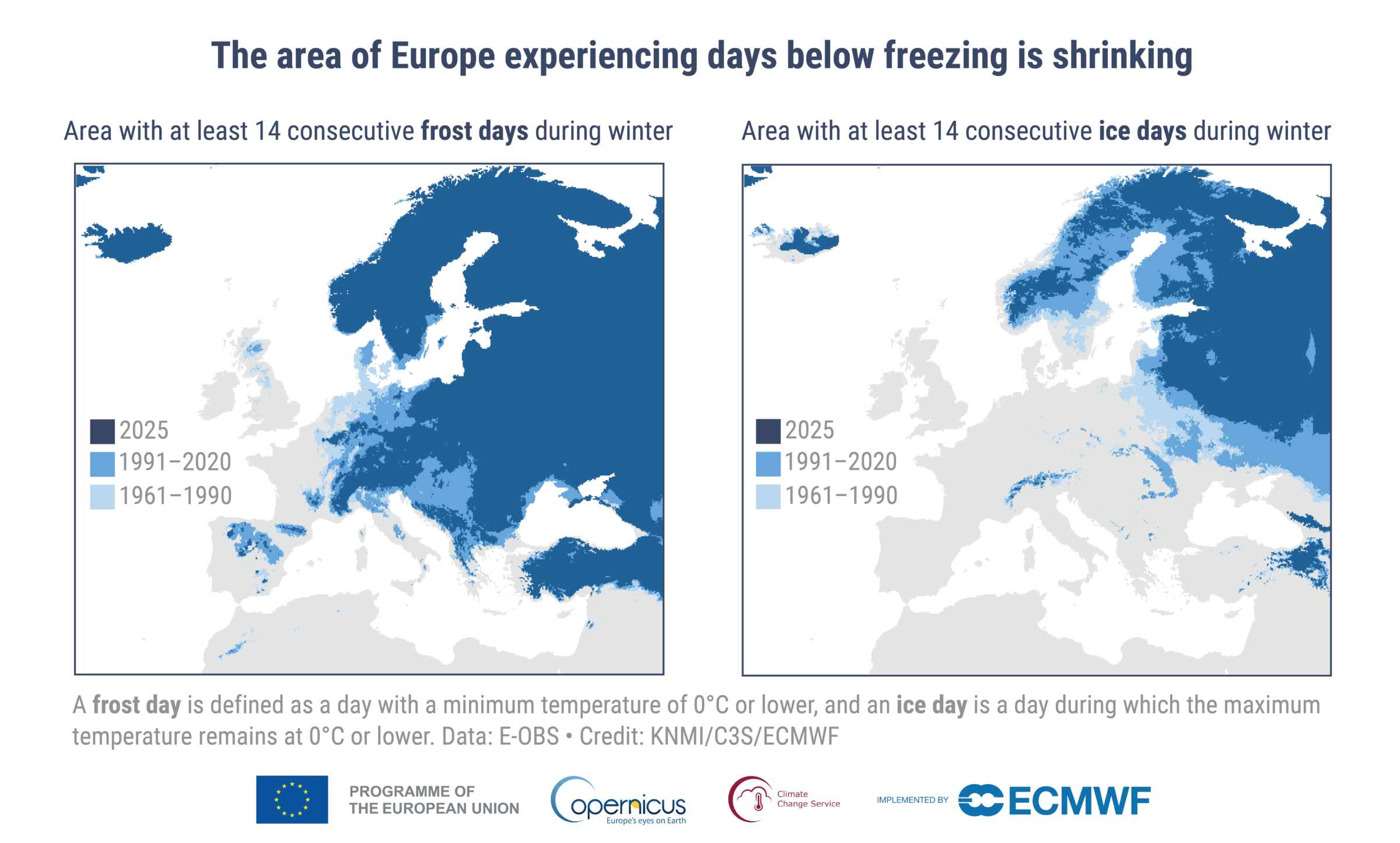
Biodiversity hurt, long and abnormal heatwaves, sea level rises or ice melting are the main takeaways from the 2025 report on the European State of the Climate (ESOTC) presented on Wednesday (29 April).
The situation is dire for Europe. The continent is warming up two times faster than other regions in the world, with the biggest changes seen in colder regions.
In the last 30 years, in Europe, the average temperature has risen by 0.56˚C per decade which is twice as much as the world’s average (+ 0.27˚C).
“Our joint effort to produce the ESOTC reflects how climate change is impacting biodiversity and the bold initiatives taken by European policy makers to protect and restore it,” said Celeste Saulo, secretary-general of the World Meteorological Organization.
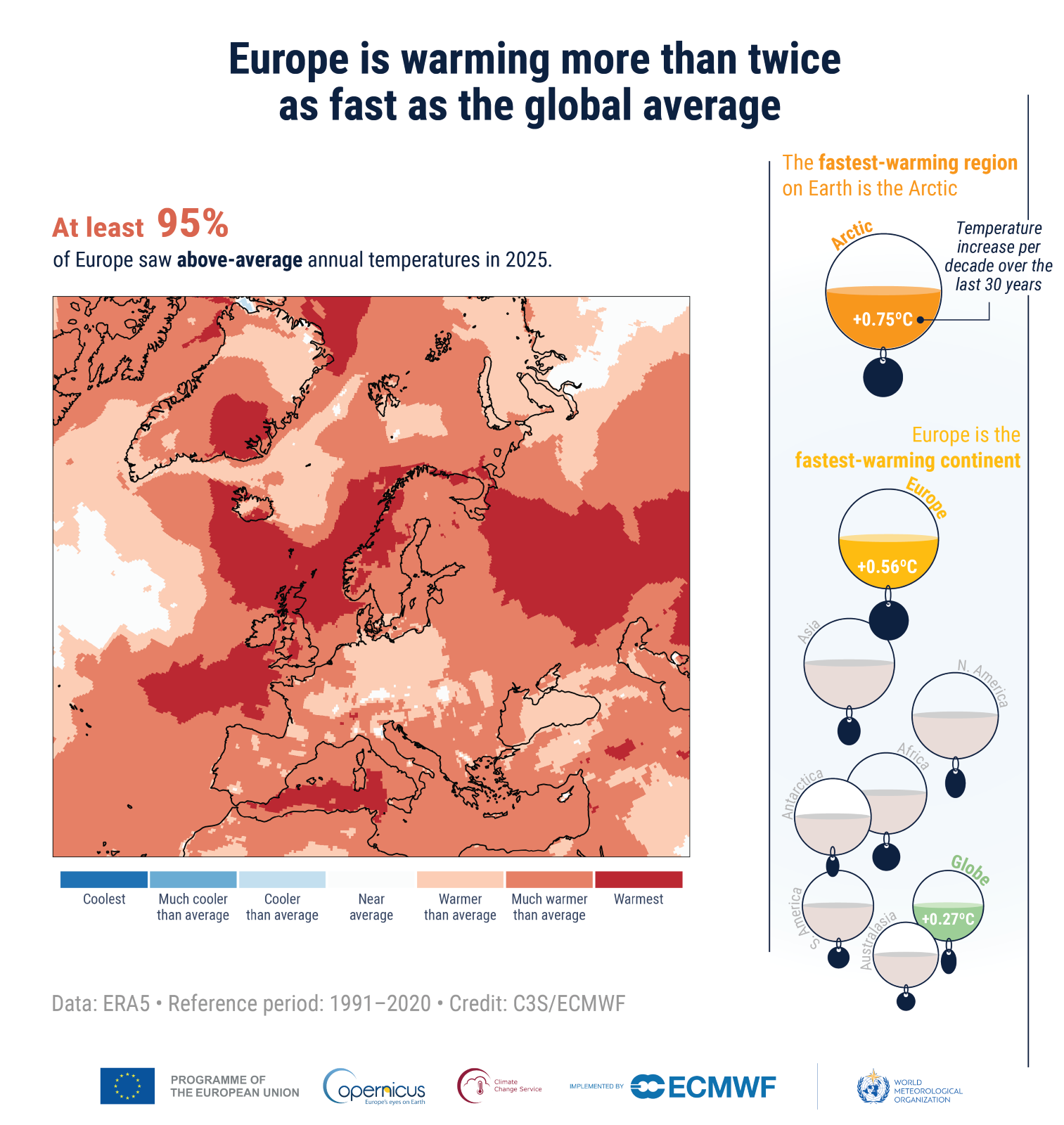 (Left) Anomalies and extremes in annual surface air temperature in 2025. The extreme categories (‘coolest’ and ‘warmest’) are based on rankings for 1979–2025. The other categories describe how the temperatures compare to their distribution during the 1991–2020 reference period. ‘Much cooler/warmer than average’ – cooler/warmer than 90% of temperatures; ‘cooler/warmer than average’ – than 66% of temperatures; ‘near average’ – within the middle 33%. (Right) Visual representation of anomalies in average temperature over the globe, for each continent based on the IPCC regions, and the Arctic. Linear trends are indicated for the last thirty years (1996–2025) for the globe, Europe and the Arctic. Data: ERA5. Source: C3S/ECMWF
The report shows Europe’s coldest regions, such as the Arctic and the Alps, are the most affected as the snow and ice melt heavily. These layers, once melted, change their role and cannot reflect the sunlight back into space as they did before.
Indeed last year, temperatures within the Arctic Circle peaked at 34.9°C during a a three-week heatwave disrupting massively the system.
“When temperatures reach nearly 35 degrees inside the Arctic circle, it feels like we are standing at the edge of catastrophe. All the emergency warning lights are flashing red. Either governments take swift and effective action to cut carbon pollution right now, or they can continue irresponsibly rolling back protections, placing countless people’s health, homes, jobs and livelihoods at risk. Climate breakdown is the greatest threat to Europe’s safety and prosperity,” said John Hyland, spokesperson for Greenpeace EU.
“In 2025, sub‑Arctic Norway, Sweden and Finland recorded their worst heatwave on record with 21 straight days and temperatures exceeding 30°C within the Arctic Circle itself,” said Florian Pappenberger, director-general of the ECMWF.
Above-average temperature and below-average precipitation led to a significant loss of snow and ice cover. In March 2025, the snow-covered area in Europe was about 1.32 million square kilometres (31 percent) below average – equivalent to the combined area of France, Italy, Germany, Switzerland, and Austria.
Water system under pressure
Around 70 percent of rivers across Europe experienced below-average flows and 53 percent of the continent was affected by drought conditions. These changes underline patterns that reflect a combination of factors that are altering including circulation and rainfall variability, alongside longer-term climate trends.