

Map: Russia is expanding a buffer zone in the Sumy region, while building fast jet-drones, as Ukrainian drones strike 1,300 km deep in Russian interior.
 Roman Pataj



Every day, the Ukraine Battlefield update newsletter offers a clear look at how the war is unfolding on the ground, highlighting key developments along the frontline and the shifting dynamics of the conflict. This offers readers regular and detailed information to better understand the implications of the war for the country and the whole continent.
The war is changing at enormous speed, Russians need jet-powered drones, and even those are now being shot down. Russia is expanding the buffer zone in the Sumy region. The situation in Kostyantynivka is gradually deteriorating, Russia is massing infantry around it for a main assault. The advance in Zaporizhzhia has been halted, the Ukrainian army is trying to clear Stepnohirsk. “Debris” from drones set a factory on fire 1,300 km from the front line Unexpected consequences of the war for the business of Moscow flying clubs. Maps of the day – Sumy region, Stepnohirsk, Kostyantynivka Videos of the day – a Russian drone flies through a car window and fails to explode; air raid on the airport in Donetsk; compilation of strikes on the Donetsk motorway
The war is changing at enormous speed, Russians need jet-powered drones, and even those are now being shot down. Losses of Russian Geran drones (improved copies of Iranian Shaheds) are so large, and Ukrainian defences against them so effective, that Russia is seriously debating their future. According to available statistics, as many as 5,833 Russian drones were neutralised out of a total of 6,462 launched at Ukraine in March. That is an almost 90-percent success rate for air defences.
Of course, this statistic includes not only Gerans, but all types of drones, including decoys intended to fool radars.
Shahed type OWA-UAS stats Mar2026 [per UA Air Force Reports]
Total: 6462 (New Record)
Claimed Intercepted: 5833
Hits: 530 (629 Not Intercepted)
Interception Rate: ~90%
Median Attack: 149 drones
Average Decoy Rate: ~39% pic.twitter.com/2hYOtIEJPV
— Shahed Tracker (@ShahedTracker) April 3, 2026
In Russia, some now argue that, as a result of these massive losses, the effectiveness of drone use has deteriorated to such an extent that the cost/benefit ratio is approaching that of expensive Iskander ballistic missiles. Yet the drones were supposed to be a cheap alternative to precisely these weapons, which cost the equivalent of more than €1m apiece.
The answer is the deployment of jet-powered drones, but Russian commentators are sceptical here as well. So far, it appears that Ukrainian interceptor drones can deal with most of them. This week footage emerged showing Ukrainian drones successfully pursuing and hitting Russian Geran-3 jet-powered drones. This indicated that the interceptors were capable of flying significantly faster than the jet-powered drone and catching up with it.
A Russian military channel with an audience of 600,000 wrote about the footage published by the Ukrainian army: “Jet-powered Geran-3s are no longer invulnerable to Ukrainian interceptor drones. In the released footage there are two cases of jet-powered Gerans being caught up by interceptor drones from the rear hemisphere. This indicates that the interceptors are capable of flying significantly faster than the jet-powered drone and catching up with it.”
The larger Rybar Telegram channel backed this up: “When we wrote that Ukrainian units had learned to fight Geran-2s and Geran-3s, we were referring precisely to the significant expansion of the range of interceptor drones that the Armed Forces of Ukraine are using more and more often.”
The author wrote that this did not mean the weapon had become completely unusable, because Ukraine was not capable of covering its entire territory with effective air defences. He also suggested using them in greater numbers at the front and in its immediate vicinity.
A possible solution for Russia could be the mass use of an even more advanced jet-powered drone that already resembles a cruise missile. It is called Geran-5 and, at the beginning of April, it hit a fuel storage facility in the Sumy region:
❗️The threat of stronger attacks: Russia is now striking with the Geran-5 guided jet drone. It is closer in design even to a mini-cruise missile.
⚠️ The footage from Russian channels shows a strike on the energy infrastructure of the Sumy region with this same jet drone. pic.twitter.com/2br2D9r9ii
— MAKS 25 🇺🇦👀 (@Maks_NAFO_FELLA) April 9, 2026
When that happened, Serhii Sternenko, adviser to the Ukrainian defence minister and an expert on drone warfare, wrote: “Some time ago I wrote that the future of deep-strike attacks is speed. At the moment, jet-powered drones of the Geran-3 type have a speed of 280 to 330 km per hour and Geran-4 of 400 to 550 km per hour. Once we are shooting down 90 percent of the regular ‘Shaheds’ with interceptors, the enemy will immediately start deploying jet-powered attack drones against our rear. We must be ready for this. After a meeting (with manufacturers of interceptor drones) I have a good feeling. They are potentially ready for any challenge from the enemy.”
The aforementioned Rybar acknowledged this as well: “The next stage of development is the Geran-5, which Ukrainian drones are not yet able to catch up with, but sooner or later the enemy will learn to fight them too, which will in turn speed up the emergence of a new model.”
Moreover, the Geran-5 and any even more powerful drone will be much more expensive and demanding to produce than the first versions, whose effectiveness has dropped so sharply.
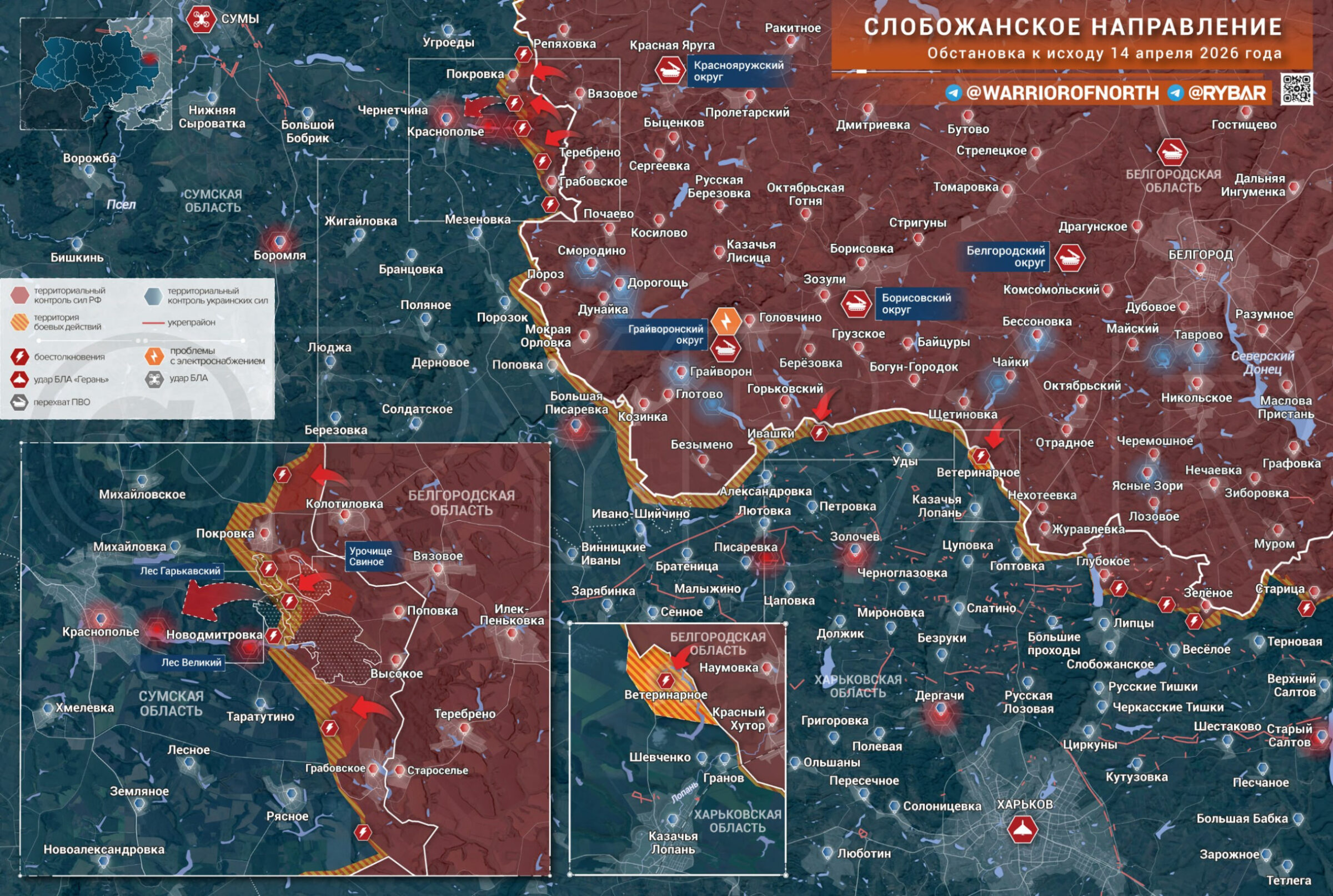
Russia is expanding the buffer zone in the Sumy region. It is emerging in the eastern part of the region and, according to DeepStateUA, it already covers an area of 150 square km.
“Russia embarked on this after ‘probing’ our border in order to find out to what extent it could control the terrain and to identify weak spots in the defences. To some extent, the starting point of their advance was the village of Hrabovske, and today it continues with pressure in the Myropillia area,” the Ukrainian analysts wrote.
“The army is aware of the enemy’s plans, is monitoring developments and trying to prevent the expansion of territory controlled by the enemy, but the most important question is who should have seen this earlier and who should have prevented this embryo”, they added.
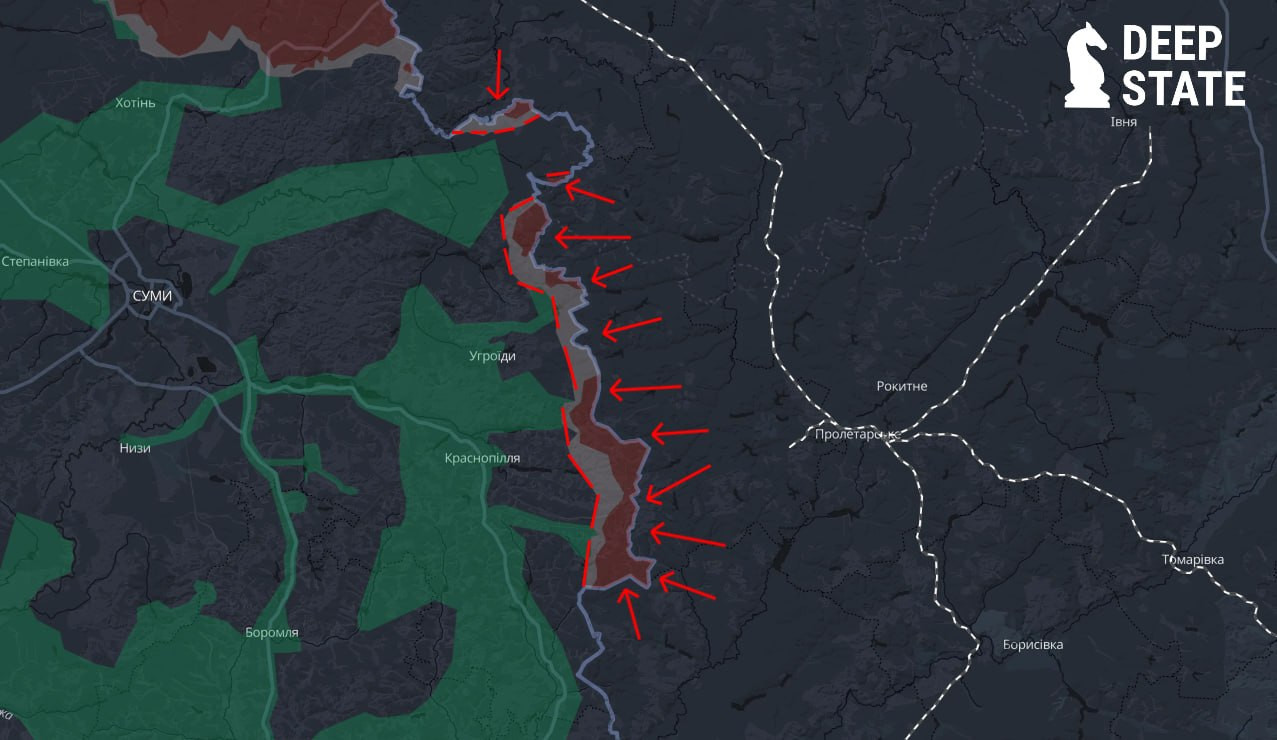
For comparison, here is a Russian map of the same area:
The situation in Kostyantynivka is gradually deteriorating, Russia is massing infantry around it for a main assault. The battle for the town has lasted so long, and the Russian advance is so slow, that it may seem to lead nowhere. The Russian army is, however, capturing Kostyantynivka systematically.
If it succeeds, only ruins will remain, with a new obstacle in front of it in the form of Druzhkivka. But taking Kostyantynivka is a necessary condition for seizing Kramatorsk, Sloviansk and the entire Donetsk region, so Russia will continue to advance in this way.
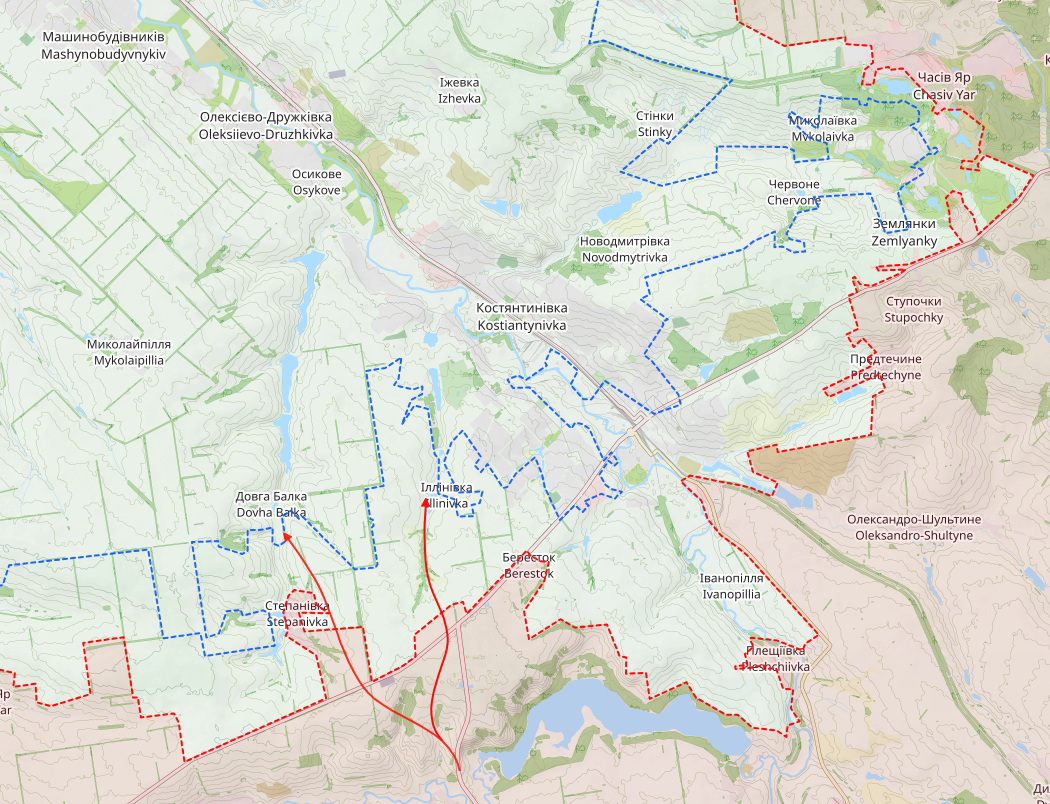
The situation in the town and its surroundings is being closely monitored by the OSINT account Playfra. From its persistent tracking of Russian actions and maps, it follows that Russia will most likely try to bypass Kostyantynivka from the west, where it is massing forces in the village of Berestok, while at the same time trying to break directly into the town from the east.
The relatively best situation is in the southeast, where Russia has been unable to advance from the Kleban-Byk reservoir.
In the Kostyantynivka direction, things are steadily worsening.
Over the past days, Russian forces made a number of deep advances and infiltrations.
East of the city, attacks were carried out through the forest and dachas, and it is possible that some isolated infantrymen… pic.twitter.com/7TZlQuL7jW
— Playfra (@Playfra0) April 13, 2026
Alongside the ground fighting, the town is a target for the Russian air force. The same source geolocated and marked on a map the places where Russian bombs landed on this map:
30-day view of Russian airstrikes and shelling on Kostyantynivka, with every blue dot representing one such strike.
The city is being flattened just like Toretsk as we speak, which, together with massive logistical pressure, will serve Russia as a method of harsh suppression of… https://t.co/EaiYaB5eI7 pic.twitter.com/WiJifPIHU0
— Playfra (@Playfra0) April 13, 2026
For comparison, here again is a map from the Black Bird Group. The Finns likewise see the main axes of attack running west of Kostyantynivka through Illinivka and Dovha Balka further to the west.
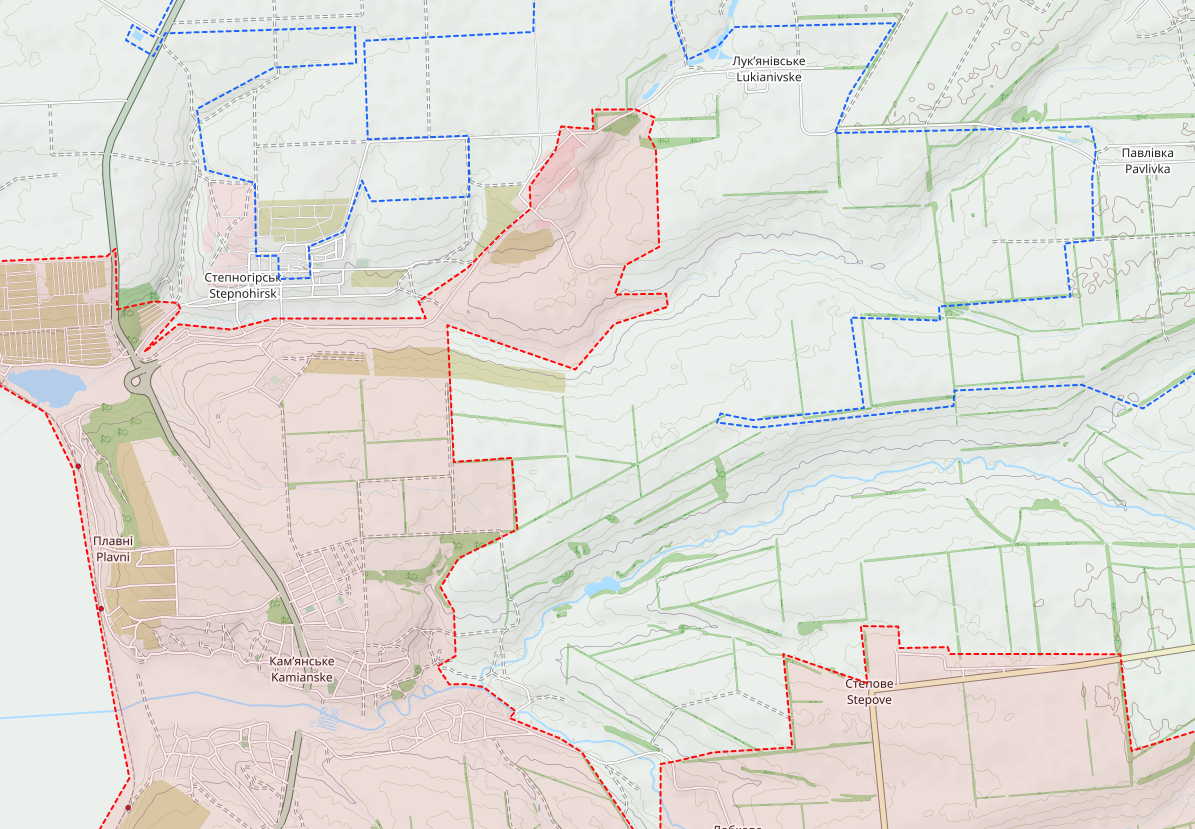
The advance in Zaporizhzhia has been halted, the Ukrainian army is trying to clear Stepnohirsk. “On the western flank of the Zaporizhzhia axis, Ukrainian formations continue counterattacks along the Stepnohirsk–Pavlivka line and are pushing the front towards Kamjanske,” the Russian Rybar channel wrote on Wednesday morning.
According to Rybar, the battlefield, which lies on the eastern bank of the former Kakhovka reservoir, looks like this:
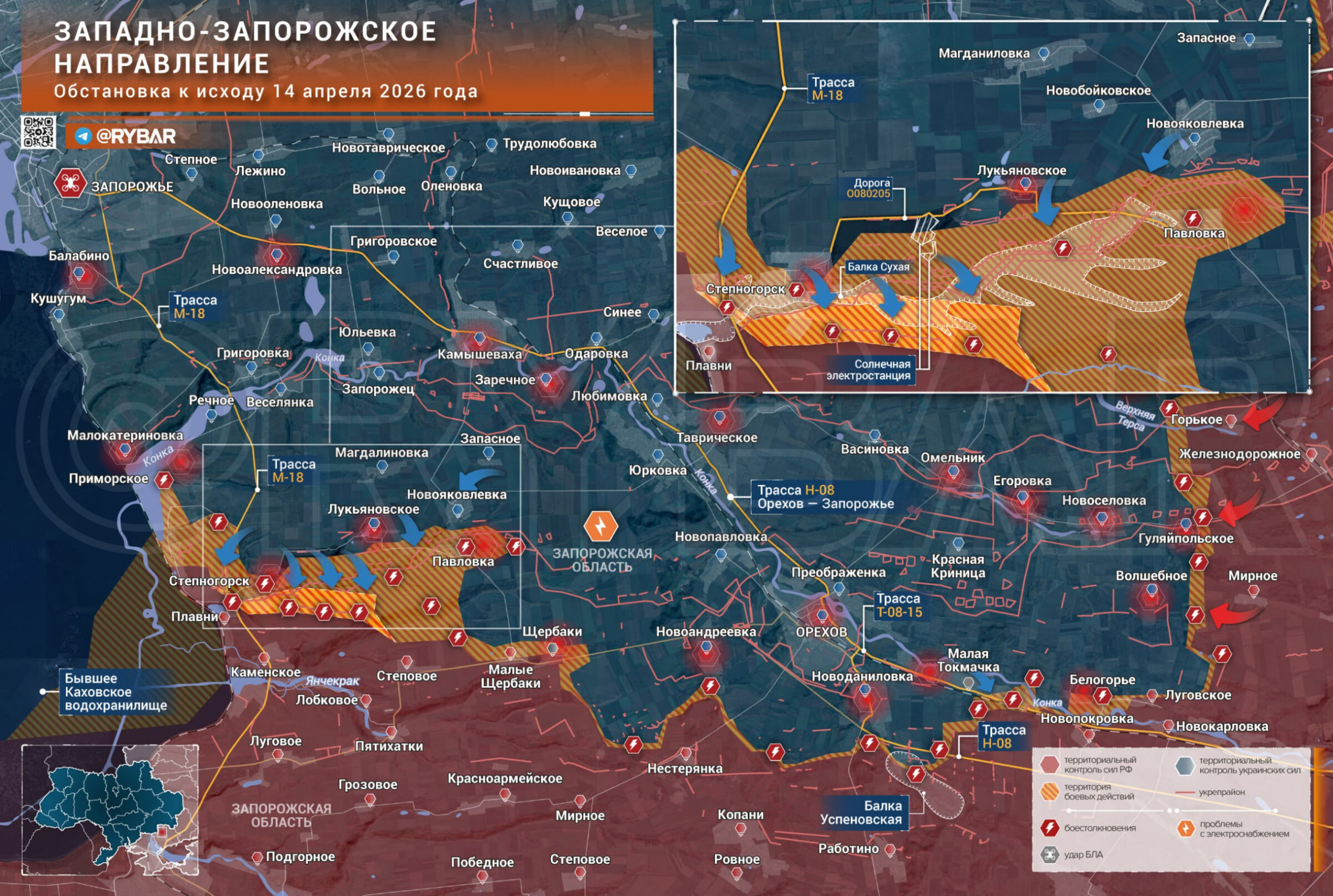
As we have already written, this map is largely outdated, because it marks the area around the village of Pavlivka as a site of fighting, even though, according to non-Russian sources, this village has long been free of any Russian presence.
However, when it comes to the fighting in Stepnohirsk, Rybar’s description is confirmed by Ukrainian commentator Oleh Petrenko: “On the Zaporizhzhia axis, the special unit ‘Artan’ of the HUR (Main Intelligence Directorate of the Ukrainian Ministry of Defence), in coordination with other HUR units and the Defence Forces, is conducting a large-scale operation to liberate and clear Stepnohirsk. Moreover, reports are already coming in of infantry battles on the section between Stepnohirsk and Kamjanske.”

Kamjanske is the village from which Russia’s advance on this sector began last year. Although it is less closely watched than the battles for Kostyantynivka, Pokrovsk, or the upcoming battle for Sloviansk, it is an exceptionally important location.
From Kamjanske to the southern edge of the regional centre Zaporizhzhia it is roughly 28 km in a straight line, from Stepnohirsk just under 23 km, and from Prymorsk about 16 km. Every single kilometre between Russian units and the city of 0.75 million inhabitants determines whether it comes within range of Russian artillery, and to what extent Russia will be able to terrorise it with drones.
This is how the Finnish OSINT Black Bird Group sees the situation around Stepnohirsk:
“Debris” from drones set a factory on fire 1,300 km from the front line. Drones attacked in Russia’s Bashkiria region, more than 1,300 km from the front. “Bashkiria has become the target of a terrorist attack by unmanned aerial vehicles. Several drones were shot down over the industrial zone of the city of Sterlitamak. The wreckage fell on one of the local factories. All emergency services are working on site and extinguishing the resulting fire. We are clarifying the details,” said Radiy Khabirov, head of the Bashkiria republic.
This was the official confirmation of a Ukrainian drone strike on a target deep inside Russia, under the Urals.
In the traditional vocabulary of Russian president Vladimir Putin’s regime, attacks on Ukrainian power plants are the “denazification” and “demilitarisation” of Ukraine, but raids on Russian industry are “terrorist acts”.
The official Russian line is that it shoots down all the enemy drones, but falling debris always manages to set something on fire, in its handling of the growing effectiveness of raids in Russia’s deep interior.
Sterlitamak lies more than 1,300 km from the nearest Ukrainian positions and has become an increasingly frequent target of attacks. The first strikes took place in October last year, and since then the city has been a regular target. Among other things, a local ammunition-production facility has already been hit.
This time, the likely target was the Sintez-Kauchuk chemical plant. It is Russia’s largest producer of aviation fuels, fuel additives and other chemical products. It is highly likely that the aim was its fuel-production operations and thereby, indirectly, the Russian air force, which depends on them. Footage from the city on Wednesday morning showed a large cloud of smoke; the “debris” was clearly aimed with precision.
Ukrainian drones attacked the AO “Sintez-Kauchuk” plant in Sterlitamak this morning, with explosions and fire reported in the industrial zone. 1300km from the frontline.
The facility is one of Russia’s key synthetic rubber producers, including specialized polymers used in… https://t.co/NiRW0GOf5V pic.twitter.com/N1j7LVAK2x
— Special Kherson Cat 🐈🇺🇦 (@bayraktar_1love) April 15, 2026
Local residents managed to film the arrival of one of the attacking drones:
Unexpected consequences of the war for the business of Moscow flying clubs. This is more of a curiosity than frontline news, but it illustrates the broad and often surprising impact of combat operations on everyday life – increasingly so in Russia.
The large Telegram outlet Baza, owned by media magnate Aram Gabrelyanov, reported that raids by Ukrainian drones were destroying the business of flying clubs around the Russian capital which offer commercial parachute jumps.
“In this year, about 40 to 50 percent of take-offs in the region have been cancelled,” Vadim Niyazov, coach of the Russian national parachuting team, told Baza. “And it is precisely in the Moscow region that as many as 70 percent of all jumps in the country take place,” the website wrote.
Since the beginning of this year, the profits of these businesses have fallen by 50 percent. Because of the constant attacks, Russia suspends all air traffic during them in order to avoid shooting down its own sports aircraft. One of the flying clubs therefore barely flew at all during the previous two weeks. Sometimes the ban is announced just before take-off. The clubs thus incur costs for instructors’ salaries and maintenance, but cannot provide the service already paid for.
According to Niyazov, “a large part of flying clubs is already operating on the verge of zero profit, and if the number of working days continues to fall, it will be loss-making for them to maintain equipment and personnel. In future, there is a risk of a complete halt to activity in this sector. That applies even if no other sources of funding are found to keep the aircraft operational.”
In other words, the problem is not only the raids, but also the inability to keep sports aircraft in operation – probably also as a result of sanctions in the case of Western models.
Videos of the day
The Ukrainian army once again bombed the airport in Donetsk, which Russia uses as a base from which its drones take off. The Ukrainians used a combination of GBU-39 precision-guided bombs and SCALP-EG cruise missiles, the French equivalent of the British Storm Shadow missile.
⚡️ SCALP cruise missiles struck a Russian UAV storage site near Donetsk airport overnight on April 14.
The strike was carried out by the Ukrainian Air Force using SCALP missiles and GBU-39 guided bombs. pic.twitter.com/Gr5N6RX4BM
— Special Kherson Cat 🐈🇺🇦 (@bayraktar_1love) April 14, 2026
A Russian drone flew straight through the open window of a car carrying Ukrainian soldiers. Fortunately, the charge failed and the entire crew escaped unharmed.
A compilation of drone attacks on Russia’s main supply route in Donbas near the city of Donetsk. Some of the footage is already known, some is new. Thanks to new drones, the fight against logistics is shifting to distances of 50 km and more.
What are the losses By Monday morning, Russia had verifiably lost 24,440 pieces of heavy equipment (on Monday (30 March) it was 24,383). Of these, 19,079 (19,028) pieces were destroyed by Ukrainians, 975 (971) were damaged, 1,205 (1,204) were abandoned by their crews, and 3,181 (3,180) were captured by the Ukrainian army. This includes 4,381 (4,371) tanks, of which 3,284 (3,276) were destroyed in combat. Ukraine had lost 11,923 (11,697) pieces of equipment, of which 9,175 (9,027) were destroyed, 668 (656) damaged, 666 (661) abandoned and 1,414 (1,404) captured. This includes 1,412 (1,401) tanks, of which 1,078 (1,071) were destroyed in combat.
Note: Neither side regularly reports its dead or its destroyed equipment. Ukraine publishes daily figures on Russian casualties and destroyed equipment, but these cannot be independently verified. In this overview we use data from the Oryx project which, since the start of the war, has been compiling a list of equipment losses documented exclusively by photographic evidence.