
Ongoing combat in Mali has seen Islamists and Tuareg rebels launch a joint offensive against the ruling junta and its supporting Russian forces.
 Petra Procházková



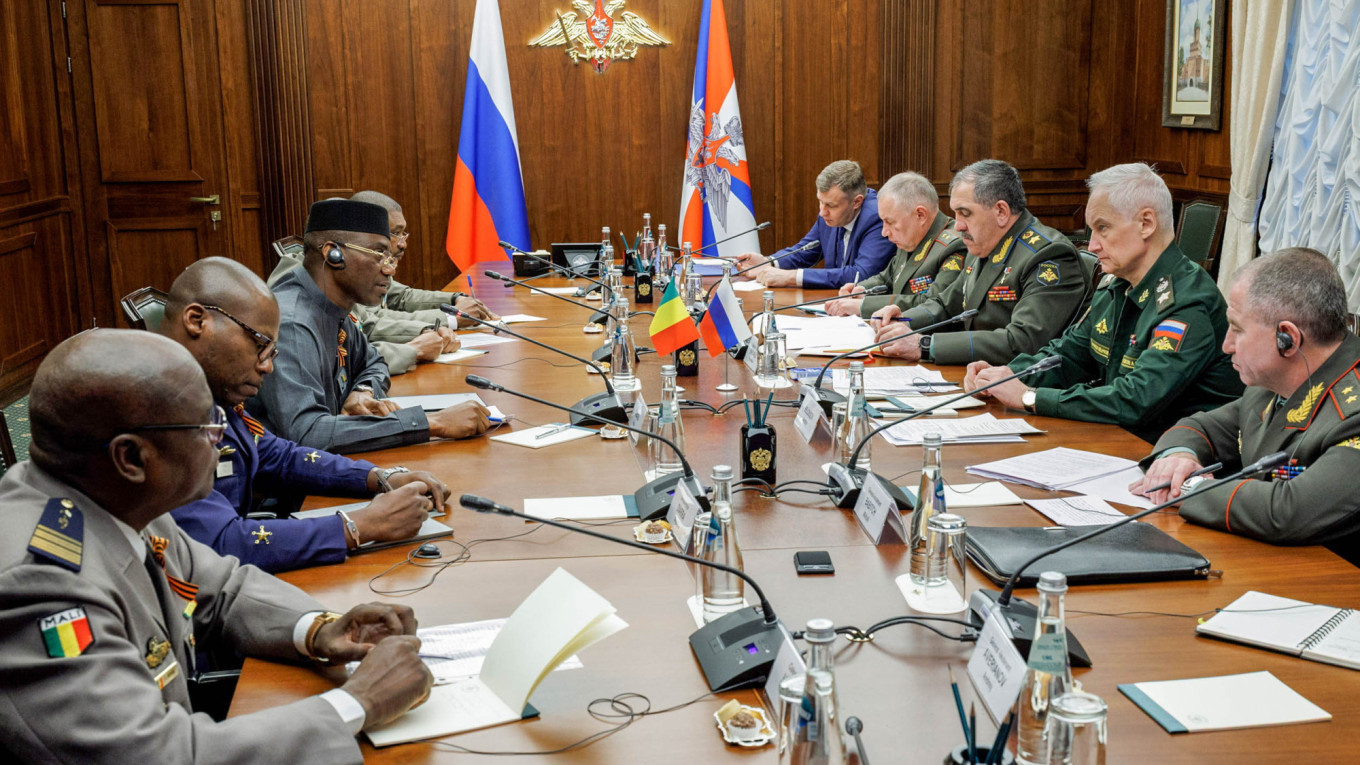
Islamists and Tuaregs have launched an attack on the ruling junta in Mali, which is backed by Russian troops. In the African country, which is twice the size of France and where Moscow has been trying to build one of its main strongholds on the continent, Russia is losing ground and people.
Just before six o’clock in the morning local time, two powerful explosions rang out near the Kati military base, located north of Mali’s capital Bamako. This was followed by prolonged gunfire. Since Saturday, when Islamist fighters from JNIM [Jama’at Nusrat al-Islam wal-Muslimin] and Tuaregs launched an attack on the ruling military junta and the Russian African Corps tasked with protecting it, the fighting has not stopped.
Al Jazeera, citing eyewitnesses, described how the army immediately headed to the scene to block the roads. Apparently it was already too late. Among the targets of the attack was Mali’s defence minister Sadio Camara, who was killed when his residence in Kati was attacked. He had played a key role in negotiating the alliance and military support with Russia.
The residence of Mali’s leader Assimi Goita is also in Kati. At the critical moment, however, he apparently was not there. Local residents told the AFP agency that they barricaded themselves in their houses. Russian mercenaries, who have one of their main headquarters there, were unable to prevent the attack.
Heroic surrender of positions
The Russians most likely lost other facilities and territories they had been tasked with protecting as well. Some of them were reportedly handed over without resistance.
Mali’s foreign ministry and sources close to the Russian defence ministry stated that behind the attacks by Islamists linked to al-Qaeda stood “Western and Ukrainian forces”. In the past, Russians has accused Kyiv of supplying drones to the insurgents, which are also being used now to attack the Russian African Corps.
According to some media, Goita was evacuated to one of the military bases controlled by government troops and the Russians.
Russian propagandists wrote about a “heroic Russian struggle for the freedom of the African continent” and compared the fighting for some positions to the “defence of the Brest Fortress” at the start of the Great Patriotic War (from the Soviet Union’s entry into the Second World War on the side of the Allies in 1941 until 1945), but reporters on the ground described a rather different reality.
Al Jazeera’s Africa correspondent Nicolas Haque pointed out that recently some Russian mercenaries have been withdrawn from Mali to Russia and sent to the Russian-Ukrainian front. According to Haque, it appears that the Russians are leaving some locations without a fight.
https://datawrapper.dwcdn.net/8bHcA/2
Moscow lost an important base
The wave of violence is spreading not only to the areas around the capital but also to the less populated north of one of Africa’s poorest countries. These are the largest attacks in the last fourteen years.
The Malian army confirmed this in a statement, saying it had killed hundreds of attackers; however, the fighting is still ongoing, the situation is chaotic, and the gunmen belong to several armed formations.
Responsibility for the killing of the defence minister was claimed by the group Džamá’at Nasr al-Islám val-muslimín. Tuareg rebels, for their part, are operating in other towns such as Sevare, Kidal and Gao. According to Al Jazeera, there is panic within the Malian army.
Photos and videos have appeared on social media showing Russian heavy military equipment leaving its positions without a fight, to the cheers of the rebels.
In Moscow, developments concerning its key African allies are being followed with great concern. Yesterday Russian forces in Mali lost a combat helicopter with its entire crew. Russian sources admitted that the cause was an external hit from anti-aircraft missile system fire.
In addition, the Russians likely lost the town of Kidal, which they had controlled until the weekend. JNIM and Tuareg insurgents reported that they had captured it.
The command of the Russian African Corps has already cautiously confirmed this report: “Our soldiers left the town,” Russian commanders wrote on social media this morning, adding that they had been attacked by at least 12,000 rebels. “First and foremost, the wounded and heavy equipment were evacuated,” the statement said. “The situation remains difficult, our soldiers continue to carry out combat tasks.”
Russian mercenaries in Africa claimed that the attackers from among the Islamists and Tuaregs were shooting civilians, while Russian military medics were treating wounded local residents in their field hospitals.
Videos circulating on social media show armed men entering the grounds of a youth camp in Kidal and the residence of the Kidal governor.
Another Russian base is located near the airport in the capital Bamako. It, too, was one of the first targets of the Islamists.
Gold in exchange for protection
Moscow considers Mali one of its strongholds that should enable it to consolidate its position on the African continent. Although it is a poor country, it is of interest to Russia because of its gold mining, its size and the possibility of exerting influence across the wider Sahel region. It is precisely in gold mining that Russians, in return for their military support, are involved and in some places effectively exercise control.
However, last autumn the Russians failed to prevent repeated Islamist attacks on fuel tankers supplying Bamako. Routes from neighbouring Senegal and Ivory Coast, from where fuel flows into the landlocked country, were blocked by Islamists. Life in the Malian capital was effectively paralysed as a result of a catastrophic shortage of fuel.
Despite the Russian military presence, the security situation in the country is deteriorating, and in some parts of Mali neither the junta’s units nor the Russians have any control.
According to German security analyst Ulf Laessing, who specialises in the Sahel region, Mali is such a vast territory that it cannot be fully controlled. “Most people live in the south, the north consists of desert and mountains, and even the French were unable to control it, let alone the Russians,” he noted. “A military solution no longer exists. Armed groups in the countryside are firmly entrenched.”
Fighting over the important transport hub, the town of Sevare. Source: Afrikanskij korpus, Telegram
Goita came to power as a result of a military coup in 2021 and promised to provide security for the country’s inhabitants.
The political and security crisis in Mali has in effect lasted since May 2012, when the democratically elected president Amadou Toumani Touré was overthrown in a military coup. With France’s help, democratic elections were held in the country in 2013, which were won by Ibrahim Boubacar Keita. Neither he nor Touré managed to resolve the uprising of separatist Tuaregs who inhabit northern Mali.
In August 2020, Keita was overthrown by a military junta led by Goita. The following year he invited Russian mercenaries to assist, while expelling French troops from Mali.
Until 2022, the European Union’s EUTM military mission also operated in the country.
After private Wagner mercenaries, the Russian state took over in Mali
Support for the Malian junta was provided for almost three and a half years, until last June, by the private Russian Wagner Group – a mercenary army originally led by Yevgeny Prigozhin. However, after his mutiny against the Russian defence ministry in Russia, he died and his army was gradually dissolved.
The Russian defence ministry then created, as a replacement, the Russian African Corps, a set of paramilitary units backed by the Kremlin and commanded by officers from the general staff and the intelligence services. The units are overseen by Yunus-Bek Yevkurov, former president of Russia’s Ingushetia and now a deputy defence minister of the Russian Federation. He coordinates the presence of Russian mercenaries not only in Mali, but also in Burkina Faso and Niger. In addition to training local soldiers, they are in charge of special operations using air power, which in Mali has so far suffered more losses than successes.
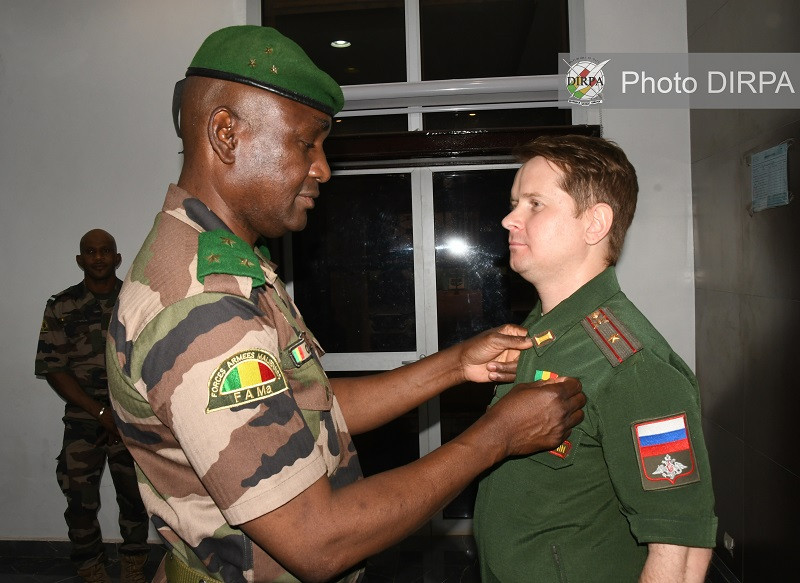 Chief of the General Staff of the Malian Armed Forces Major General Oumar Diarra decorates the deputy head of the Russian military mission in Mali, Anton Shcherbinin, with the National Order of Merit with the bee emblem. Source: Malian army
In brief
Islamists and separatists have launched a large-scale attack in Mali against the ruling junta and the Russian African Corps.
The Russians have lost an important town and a helicopter; the rebels have also suffered losses.
Russia is trying to build a new sphere of interest in Africa, but lacks sufficient resources to do so, not least because of Ukraine.
Islamists and separatists have launched a large-scale attack in Mali against the ruling junta and the Russian African Corps.
The Russians have lost an important town and a helicopter; the rebels have also suffered losses. Russia is trying to build a new sphere of interest in Africa, but lacks sufficient resources to do so, not least because of Ukraine.