

Russian war commentators have become increasingly gloomy about the Ukraine war, as Moscow also worries about its 9 May parade.
 Roman Pataj



Every day, the Ukraine Battlefield update newsletter offers a clear look at how the war is unfolding on the ground, highlighting key developments along the frontline and the shifting dynamics of the conflict.
Ukraine ignores Putin’s ceasefire, hundreds of drones targeted Russia. Such a gloomy mood among Russian supporters of the war has not been seen at least since autumn 2022. A drone disabled air traffic over the whole of southern Russia for several days. No reports of Russian advances came from the front. Maps of the day – Moscow’s air defence. Videos of the day – a guided bomb hit the target but did not explode; Azov returned to Mariupol; captured Russian Hyacinth howitzer in action.
Ukraine ignores Putin’s ceasefire, hundreds of drones targeted Russia. Russia announced a unilateral ceasefire for 8 and 9 May for a single reason. It wanted peace and quiet to hold the celebrations in Moscow. Ukraine was well aware of this and therefore, in addition to proposing a long-term ceasefire, added the condition that if the Russians respected the ceasefires it proposed for 6 and 7 May, it would adapt and let Russians march on Red Square.
However, as we wrote in previous days, the Russians refused and ignored the Ukrainian ceasefire. The reaction was exactly as Ukrainian president Volodymyr Zelensky had indicated – a mirror one. Ukrainian drones attacked Russia throughout the night and achieved successes.
Naturally, Russian president Vladimir Putin’s regime pretended this was an outrageous refusal to observe a truce, and some Z‑channels wrote in the same vein. The overall picture, however, was much more varied and potentially dangerous for Russia. The mood there was changing significantly and, as we will show, this was already being described on the Russian internet openly and in very radical terms.
“The Armed Forces of Ukraine violated the ceasefire regime 1,365 times, — the Ministry of Defence of Russia,” quoted on Friday before noon the currently most influential pro-Putin and pro-war blogger, Yuriy Podolyaka, citing official statistics. What followed was, by his standards, unusually sober: “I do not understand the point of such counting. We simply need to admit that no ceasefire regime exists. All the more so because the other side did not recognise it for even a minute and therefore did not intend to observe it. Which it proves in practice. Just as we did not recognise their ‘regime’ in previous days.”
Ukrainian security analyst Bohdan Myroshnykov also reminded readers that the Russians had not respected the Ukrainian counter‑proposal and were now facing the consequences. “Until the last moment I was not sure we would go for it. Given how busy the US is in the Middle East, we apparently feel much more confident than before,” he wrote.
And Andriy Kovalenko, a respected Ukrainian analyst, also pointed to Russia’s weakened position. In his view, Russia had long tried to monopolise the credit for the outcome of the Second World War, while ignoring the heroism and sacrifices of other nations. “Now Russia is not able to ensure even a parade, because Russians are not victors,” he added.
They really do not look like victors. Ukraine’s decision not to bow to unilateral Russian conditions on such a significant date for Russians was a sign of Ukraine’s growing self‑confidence and Russia’s weakening. That night, refineries in Perm and Yaroslavl and the already mentioned Rostov‑on‑Don were among the targets. The Russians also reported destroying dozens of drones near Moscow.
During the night, UAVs and missiles attacked 5 facilities on Russian territory:
🟢 Yaroslavl Oil Refinery in Yaroslavl Oblast, 700 km from the GGU (2–3 videos);
🟢 “Radar” Scientific & Technical Center, involved in radar/EW systems development, in Rostov — reportedly attacked… pic.twitter.com/BQyglxnjmB
— Oko Gora (@oko_gora_tg) May 8, 2026
The most exotic targets this time were Grozny and its surroundings. One video, for example, showed a drone hitting an ‘FSB’ intelligence service building in the village of Znamenskoye, north‑west of Grozny.
Moment of a Lyutyi kamikaze drone strike on an FSB building in the village of Znamenskoye, Ichkeria, Russia, this morning. pic.twitter.com/Fa7wcGiZwi
— Special Kherson Cat 🐈🇺🇦 (@bayraktar_1love) May 8, 2026
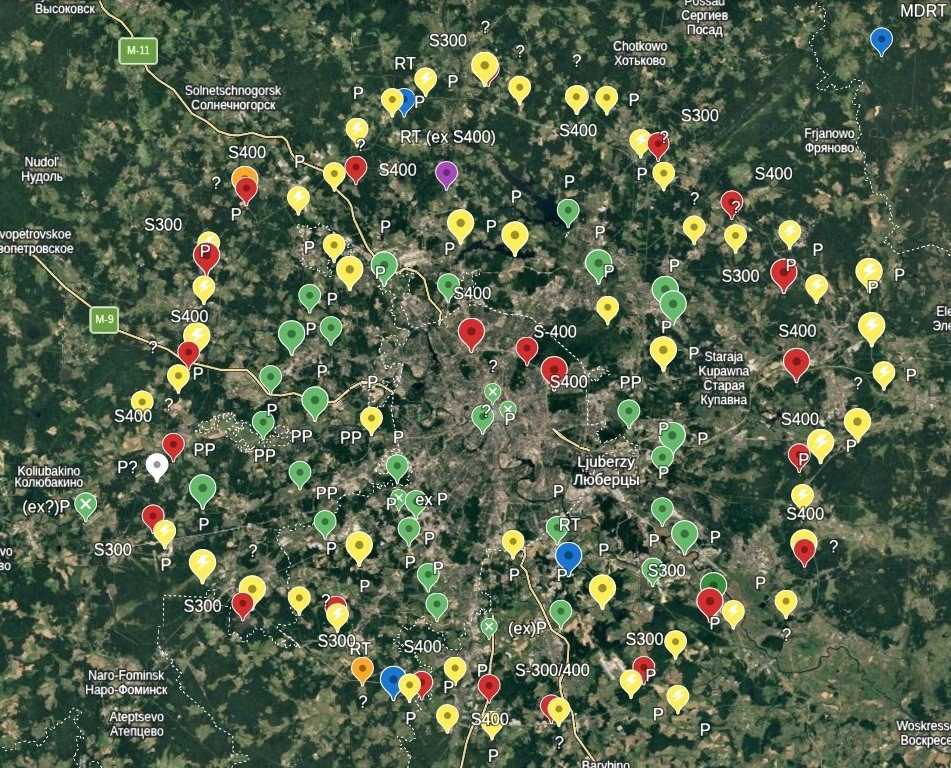
The key question now is what the Ukrainian army will do on 9 May. Whether it will attack the parade directly, or use the weakening of Russian defences in other places and strike somewhere completely different. The second option is more likely, but an attempt at a direct strike on Moscow at the time of the celebrations cannot be ruled out either. If Ukrainians tried it, this is what the map of the deployment of air defence components directly in Moscow and its immediate surroundings looks like. It was published by the Russian channel Fighterbomber, with the note that it is certainly not complete, because it does not include mobile teams and other components.
Such a gloomy atmosphere among Russian supporters of the war has not been seen at least since autumn 2022. “Thanks to their superiority in drones they have the initiative and use it to attack our military and industrial facilities deep in the rear. One time a factory, then a refinery, then warships,” wrote Archangel Spetsnaza, a Russian Telegram account with over a million followers, about this “ceasefire without peace”.
Russian commentators are currently using much harsher words, but this quote is remarkable in that it acknowledges that Ukrainians currently have the initiative in the war. While as recently as half a year ago war supporters in Russia were full of self‑confidence, in recent weeks they have become increasingly sceptical and even frustrated. This is a combination of military failures and the overall situation in society.
“We know several admins of big Z‑patriotic channels … All of them consistently report a sharp change in the mood of their readers. In which direction, that does not need to be explained,” the large Telegram channel MIG Rosii stated on 1 May. It is read by more than 500,000 Russians.
The author claimed that the mood began to change at the end of last year, and in response to doubts about whether this was a Ukrainian PSYOPS, he relayed his colleagues’ reactions: “They answer that these are people who have been writing to them for years, and they would have noticed a surge of bots or even live Ukrainian propagandists.”
The influential war correspondent and propagandist Roman Saponkov, who often appears as an external contributor to Russian state media, first referred to another account, whose author wrote: “In this state of collective psychosis, society will only last about a month and a half to two months more. Then irreversible changes will occur and by September everything will be completely screwed if we continue in the current way … My audience is slowly going crazy … There is a strong demand for radicalism. For someone to explain who is the biggest idiot and who needs to be slapped.” This was a reaction to MIG Rosii’s post.
“Unfortunately, Alexander was right about everything,” wrote Saponkov himself in his reply to his colleague.
From this and other texts it follows that internet blocking is a huge problem for Russians. Saponkov also saw growing radicalism among his readers, fuelled by the actions of the state leadership. In his view, the situation was so serious that “it will be enough to strike a match”.
The author said that when he drew attention to this trend in public moods, he was advised to bring more positive news: “That is not how it works. If you are sawing a person’s leg off with a rusty saw without anaesthesia and at the same time telling them fairy tales, they will still scream in pain. Tension is not caused by opinion‑formers or bloggers; it is caused by those who still live in the USSR and think their task is not to explain anything to people or make sure they have been properly understood.”
A drone disabled air traffic over the whole of southern Russia for several days. A key part of air traffic control is located in Rostov‑on‑Don. It was this facility that a Ukrainian drone successfully attacked.
“It is the main regional centre of the Unified Air Traffic Management System, which controls flights over an area of 729,000 square kms,” the Russian Telegram channel Rybar reported about the incident. According to Rybar, the control centre in Rostov‑on‑Don manages aircraft across the entire south of Russia, the North Caucasus and the areas of the Black, Azov and Caspian Seas. From there, Russians have an overview of 104 air routes, including air corridors between Europe and Asia.
As a result of the attack, the Russians had to suspend operations at 13 airports (including Sochi, Krasnodar, Volgograd, Vladikavkaz and Grozny).
Rybar claimed that the restrictions would last until 23:59 on Monday (11 May) and had already affected 14,000 passengers and perhaps up to 180 flights.
The Russians explained that the control centre in Rostov‑on‑Don could not be replaced because only there were data from all radars in the entire area collected, and other control centres were technically unable to manage traffic at low and medium flight levels.
“A full‑fledged and immediately ready backup does not exist – building one would cost billions of roubles,” Rybar stated.
Two Majors, another influential Russian account, also warned of serious consequences: “This is a very disturbing signal; in this way they can try to shut down all our air traffic.”
Like Rybar, this source explained the importance of the Rostov control centre, which is far greater than that of individual elements of the system.
“If they start destroying control centres, the operation of air traffic control may collapse. And that would mean that it would be necessary to put all traffic on the ground,” Two Majors said.
No reports of Russian advances came from the front. “The Russians have intensified attacks on Konstacha (a nickname for Kostyantynivka). They are also pushing beyond Pokrovsk,” wrote the Ukrainian military account Bakhmut Demon.
Another Ukrainian account – Officer – described the situation differently: “In the Dobropillia sector (the same section of the front that Bakhmut Demon called ‘beyond Pokrovsk’), the Russians are losing most of their infantry even before it reaches its positions. Offensive activity has dropped sharply, but troop movements continue and so do the losses.”
These two quotes are included to illustrate the fact that ground fighting has not stopped, but in the previous 24 hours no confirmed information arrived that it had led to Russian gains of more than a few dozen metres.
Videos of the day
A Ukrainian aircraft carried out a dangerous mission, managing to evade air defences as well as Russian fighter jets, and in the end the bomb it dropped hit the target precisely. But it did not explode. The video was published by the Ukrainian aviation Telegram channel Sunflower. According to the author, drones later triggered the explosion of the unexploded bomb.
Azov is returning to Mariupol, is the first sentence of this post published by the 1st Azov Corps. It is a different formation from the one that defended Mariupol at the start of the invasion, but they share the same name. Again, it appears to be a standard montage of drone attacks on trucks, but they are taking place 160 km from the corps’ positions.
Azov returns to Mariupol. For now, through reconnaissance-strike systems.
Pilots of First Corps Azov of the National Guard of Ukraine patrol roads up to 160 km deep behind the line of contact.
In the cameras of reconnaissance-strike drones: Mariupol and enemy military targets.… pic.twitter.com/9QcTBiZr6I
— First Corps Azov of the National Guard of Ukraine (@azov_media) May 8, 2026
The 24th Mechanised Brigade is successfully defending Chasiv Yar and its surroundings. On Thursday it published a video showing its artillerymen using a captured Russian Hyacinth howitzer.
Часів Яр. Працює «Кракен»! Так артилеристи 24-ки називають трофейну гармату “Гіацит-С”.
Наші воїни захопили її раніше на одному з напрямків. Тепер ця установка працює проти своїх колишніх господарів. Нищимо ворога його ж зброєю!
Бій за Часів Яр триває!#war #ukraine #україна pic.twitter.com/AvIbtsJPn0
— 24 ОМБр імені короля Данила (@24th_brigade) May 7, 2026
What the losses are
On Monday, some categories of equipment were removed from the list, so the total figures fell significantly. No update on Friday.
Russia had demonstrably lost 23,650 pieces of heavy equipment by Tuesday morning (24,487 on Monday (27 April)). Of this, 18,618 (19,123) pieces were destroyed by Ukrainians, 976 (976) were damaged, 1,206 (1,206) were abandoned by their crews and 3,182 (3,182) were captured by the Ukrainian army. This includes 4,394 (4,385) tanks, of which 3,292 (3,296) were destroyed in combat.
Ukraine lost 11,219 (12,050) pieces of equipment, of which 8,708 (9,272) were destroyed, 661 (673) damaged, 666 (671) abandoned and 1,184 (1,414) captured. This includes 1,420 (1,419) tanks, of which 1,085 (1,084) were destroyed in combat.
Note: Neither side regularly reports on its dead or on destroyed equipment. Ukraine publishes daily figures for Russian losses and destroyed equipment, which cannot be independently verified. In this overview we use data from the Oryx project which, since the start of the war, has compiled a list exclusively of visually documented equipment losses.