Putin announced a unilateral ceasefire for his WW2 parade on Saturday, but bombarded Ukraine on Wednesday, putting the Moscow event in Kyiv’s crosshairs.
 Roman Pataj



Every day, the Ukraine Battlefield update newsletter offers a clear look at how the war is unfolding on the ground, highlighting key developments along the frontline and the shifting dynamics of the conflict.
People keep dying, Russians recognise only their own ceasefire. Russian air raids temporarily knocked out Ukraine’s gas industry. Russia and Ukraine are attacking each other’s ports, Ukrainians focused on ships protecting the Crimean Bridge. Ukrainians tried to slow the Russians in Kostiantynivka with a counter-attack, Russians are pushing west of the town. Chart of the day – impact of the war in Iran on the evolution of Russia’s oil revenues. Maps of the day – Kostiantynivka. Videos of the day – major Russian attack in Sumy region; the story of occupied Pisky and Debaltseve through drone strikes; MiG-29 destroys a base of drone operators.
People keep dying, Russians recognise only their own ceasefire. Russia first announced a unilateral ceasefire for 8 and 9 May. On its part this was not an act of humanitarianism, but merely an attempt to ensure an undisturbed course of the annual propagandistic military parade. Ukraine responded by announcing that it was declaring a unilateral ceasefire for (6 and 7 May) and would then act according to whether the Russians respected the Ukrainian proposal.
During Wednesday, however, both sides exchanged accusations of violating the “Ukrainian” ceasefire. The Russians confirmed that the Ukrainian army killed five people in an attack on Dzhankoi in Crimea. Yet the Russians carried out ballistic missile strikes in Dnipro, drones hit a kindergarten building in Sumy, and they also bombed Odesa.
“Russia is not respecting the ceasefire. We need to hit Moscow, to hell with it,” the Ukrainian military channel Bakhmut Demon wrote in the morning. It was most likely referring to the planned military parade marking the anniversary of the end of the Second World War in Europe.
It is precisely the fate of the parade that is at stake, and this is by far the most interesting aspect of the entire ceasefire. Despite Russian threats that, if Ukrainian drones disrupted it, Russian missiles would fall on Kyiv, at this moment the holding of the parade appeared to be in jeopardy.
Russian views on the ceasefire also evolved over the course of the day. For example, the highly influential propagandist Yuriy Podolyaka immediately claimed that Ukraine was not observing the ceasefire, “and therefore today (already since the morning), as before, our drones and air force continued to strike the enemy. They focused on industrial plants, railway infrastructure, fuel depots (filling stations near the front).” In other words, the largest Russian Z‑channel, already at six in the morning (when it published this status), had semi‑officially announced that the Russian army was continuing to fight.
The channel Military Informer, shortly after midnight, still showed signs of optimism: “The enemy claims that at the moment nothing is flying at it on a massive scale. After midnight there were isolated impacts and launches of drones, but not in the numbers usual. If this trend continues, it will mean that Russia, in the interest of a peaceful course of the parade in Moscow on 9 May, has de facto agreed to the terms of the ceasefire proposed by Zelensky, but decided not to announce it publicly.”
The same Russian source, however, had changed its tone by nine in the morning. “It looks like the ceasefire announced by Zelensky has not worked out too well after all,” it wrote. It admitted the bombing of Kharkiv, Zaporizhzhia, and Kryvyi Rih.
It added, however, that the intensity of the attacks was lower than usual, “especially on the Ukrainian side, so everything will depend on the ‘official assessment’ of these attacks.”
Later in the day, Russian sources were already publishing footage of attacks on various cities as usual. A large fire broke out, for example, in Druzhkivka near Kostiantynivka.
The 7th Army Corps, which is fighting near Pokrovsk, published statistics on Wednesday at noon, according to which, after the ceasefire began, the Russians dropped six precision‑guided bombs on its positions, carried out 28 artillery barrages and three assaults, wounding four soldiers.
“Russia has clearly chosen to reject the ceasefire and the saving of lives,” Volodymyr Zelensky declared around noon. In his statement he published the number of recorded Russian attacks, but was cautious when it came to whether Ukraine would accept the ceasefire announced by Russia.
He recalled that Ukraine had previously signalled a mirror response, which literally should have meant rejecting the ceasefire demanded by Russia. However, the conclusion of Zelensky’s statement was not entirely clear: “We can confirm that the Russian side has violated the ceasefire. On the basis of the evening reports from our army and intelligence, we will decide on our next steps.”
The well‑known Russian commentator and radical supporter of the war Fighterbomber, with half a million readers, again wrote about the use of nuclear weapons, but part of his post, in which he explained the situation of both sides, was rational: “As for both ceasefires. Both, because in response to our proposed, unagreed ceasefire, the Ukrainians replied with their own unagreed ceasefire. This means that it is not worthwhile for either us or them to observe a ceasefire declared by the opponent, because it would immediately be reduced to the argument ‘Aha, you got scared!’. At the same time, we (Russians), in connection with the decision to hold a military parade, find ourselves in a much more vulnerable, uncomfortable and tactically‑strategically disadvantageous position compared with the Ukrainians, who, in the worst case, risk the loss of several houses in the centre of Kyiv.”
Russian air raids temporarily knocked out Ukraine’s gas industry. Attacks on Russian refineries are attracting much more attention, but Russia is responding in a similar way. On Tuesday (5 May), the Ukrainian company Naftogaz had to admit, after a massive strike on its facilities, that it had suffered serious damage as a result. Under normal circumstances, Ukraine is self‑sufficient in gas supply, but to cover the outages it had to start importing gas from abroad.
On this occasion, the chair of Naftogaz’s management board, Serhiy Koretskyy, said that since the beginning of the year the Russians had already struck the company’s facilities 107 times, with the latest wave of air raids lasting five days.
During the attack from 4 to 5 May, three Naftogaz employees and two rescuers were killed. Thirty seven people were injured, and gas extraction facilities in Kharkiv and Poltava regions were “significantly damaged”. One of the employees killed was Oleksandr Kozyn, whom the Ukrainian president had awarded the Order of Merit, 3rd class, for heroism in dealing with the aftermath of previous air raids. He had a young son. Yuriy Musiyenko and Mykhailo Dub were also killed alongside Kozyn.
Russia and Ukraine attacked each other’s ports, Ukrainians focused on ships defending the Crimean Bridge. On Tuesday, both armies attacked each other’s ports. The Russians struck the port of Odesa, where their Geran‑2 drones, according to Russian sources, targeted patrol boats. In two cases these were boats donated by the United States even before the start of the invasion, as well as boats of Ukrainian manufacture.
The Russian channel Military Informer pointed out that during a similar Ukrainian air raid on Sevastopol, drones targeted three patrol boats and a Be‑12 maritime patrol aircraft. “It is highly likely that the enemy is trying to deliberately destroy the means used to counter its kamikaze boats, in order to increase the effectiveness of their deployment or carry out some large‑scale operation involving naval drones,” the author wrote. All the boats attacked, as well as the aircraft, were, according to him, involved in the defence of the Kerch Strait, and thus also of the bridge over it.
🎯 Ukrainian unit “Prymary” carried out strikes on Russian targets in Crimea:
⁰— 3 Project 05060 landing assault boats⁰— Support vessel⁰— Hangar for landing boats storage⁰— Be-12 “Chaika” amphibious ASW aircraft pic.twitter.com/usa42LRxzl
— Special Kherson Cat 🐈🇺🇦 (@bayraktar_1love) May 5, 2026
Ukrainians tried to slow the Russians in Kostiantynivka with a counter‑attack, Russians are pushing west of the town. “Heavy fighting is underway in Kostiantynivka. The enemy is attempting counter‑attacks, intense meeting engagements are taking place. Ukrainian armed forces are also attacking in the area of Chasiv Yar,” the Russian channel Two Majors wrote on Wednesday morning in its regular daily situation report.
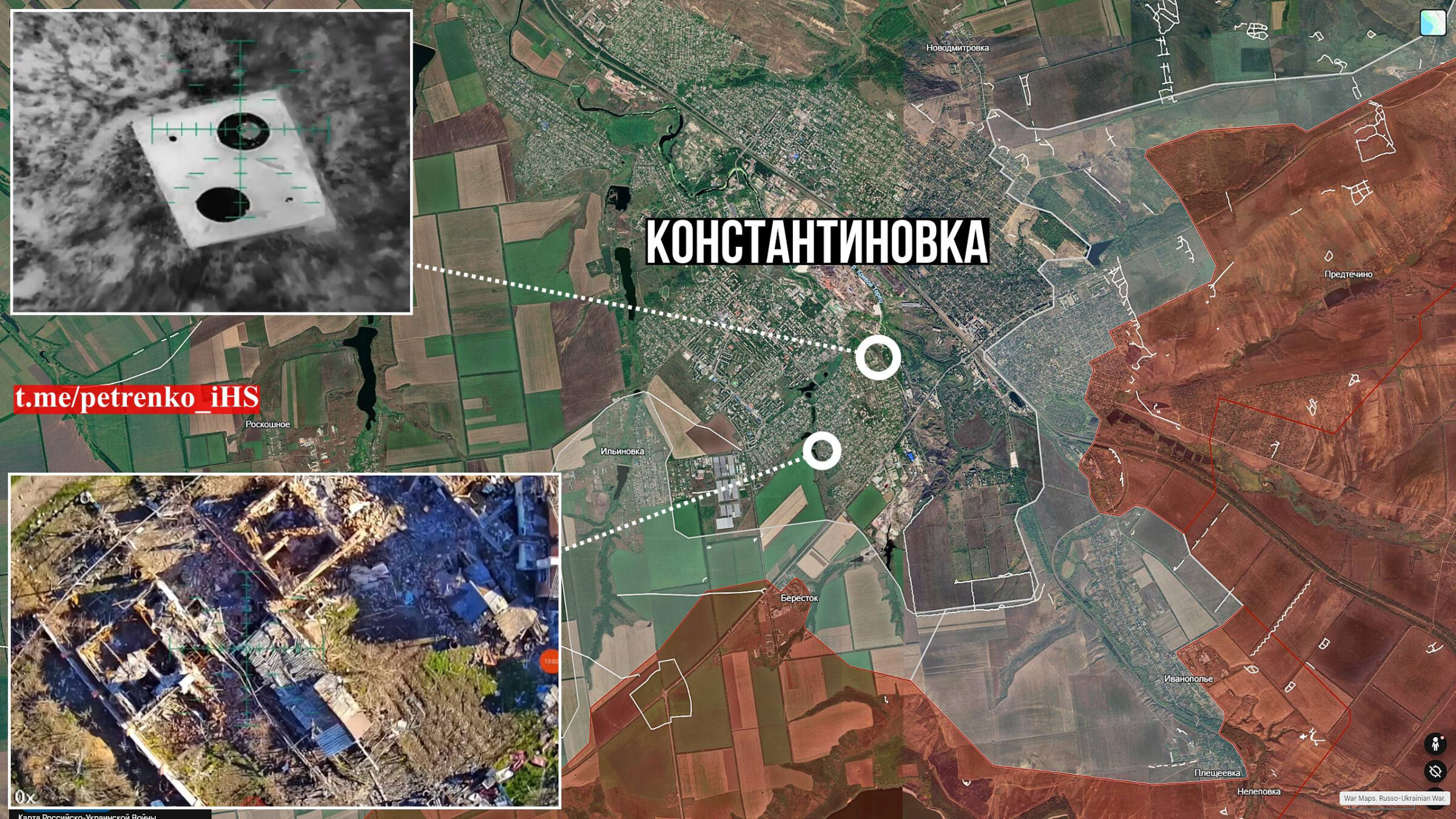
The Ukrainian analyst Petrenko also reported on the counter‑attack. “An attempt by Russian groups to gain a foothold in the districts south of the railway station was repelled during a counter‑attack and subsequent clearing operation by the Armed Forces of Ukraine,” he wrote.
You can easily find the railway line on his map. In its centre there is a distinct circle; to the right of it is a prominent bridge crossing the railway, and right next to this point there is a grey area forming a marked salient whose tip is right‑angled. Directly above it is Kostiantynivka’s railway station.
At the same time, however, Petrenko noted that the situation on the flanks had worsened, specifically in the villages of Dovha Balka and Stepanivka to the west of the town. The Russians deployed fresh forces there and managed to gain new positions.
The two circles indicate places where the presence of Russian soldiers was recorded. This does not mean that they have captured that part of the town.
For comparison, here is a map by the Russian Rybar, one day older. It marks a much larger part of the town as a grey area. This illustrates the different approaches to map‑making. Russians commonly draw these zones on the basis of a single video with their soldiers, who may have long since been killed or be hiding somewhere in a cellar. Ukrainian sources, in this case Petrenko, regard such places as areas under the control of the Ukrainian army.
On Rybar’s map you can find Dovha Balka and Stepanivka in the lower centre. As early as Monday, Russian sources claimed that the Russian army had captured the former and that fighting was already taking place to its north. Ukrainian sources have confirmed nothing of the sort.
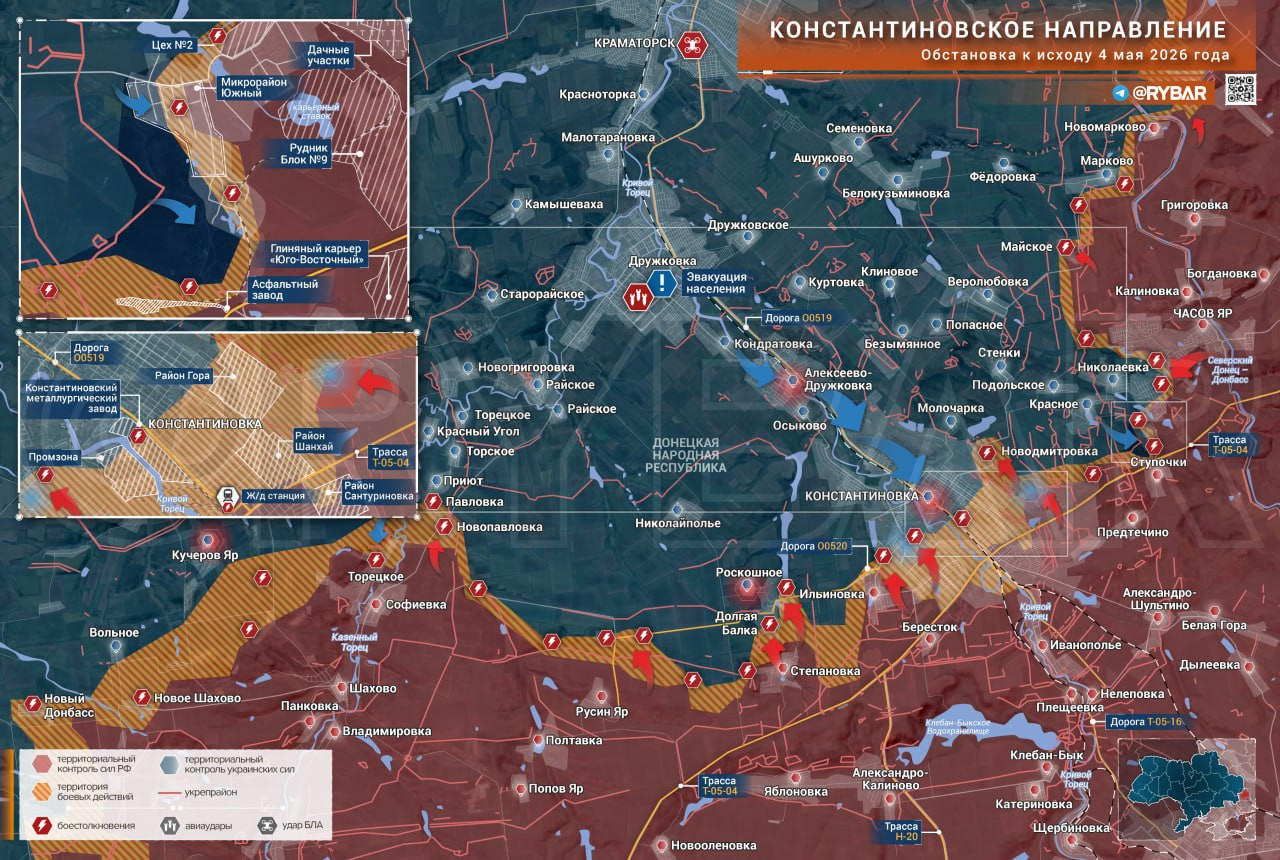
Chart of the day – evolution of Russia’s oil revenues. German economist and expert on the Russian economy Janis Kluge argued that the positive impact of the war in Iran on Russia’s ability to continue the war was so far smaller than generally assumed.
He calculated that the March increase in oil prices was only enough to reach the planned level, and in April revenues from sales were 33 percent higher than planned, but this still accounted for only eight percent of budget income. Higher profits are prevented by high transport costs and a strong rouble. Kluge wrote that the expected exchange rate to the US dollar was to be 92.2 roubles to one dollar, but it is currently approaching 75 roubles to the dollar.
The effect of the Iran war on Russia’s budget is smaller than many expect. Because of the strong ruble and high transportation costs, March oil prices just closed the gap to budget plans, and April lifted revenues 33% above plan. But those 33% are just 8% of total fed. revenues. pic.twitter.com/ymDNLnA5u2
— Janis Kluge (@jakluge) May 4, 2026
Videos of the day
The Russians are continuing to exert pressure in Sumy region. Footage from there shows their attempt at an attack using a larger number of quad bikes and motorbikes. At least the vehicles were stopped by Ukrainian drones. Warning: the video also shows people under fire.
Атака москаликів на село Рясне Сумської області та ефектна раздача люлей👌😎💯 pic.twitter.com/SI5AhnNqMc
— Сергій Нещадим △ 🇺🇦 (@nevedimka123) May 5, 2026
Similar compilations of strikes on Russian logistics tens of kms deep in the rear are no longer surprising. This particular one is interesting because it gives an excellent idea of how far the Russian army has advanced in Donbas over more than four years of fighting.
The post was published by Serhiy Sternenko, an adviser to Ukraine’s defence minister. Part of the footage, he said, comes from the village of Pisky and part from Debaltseve.
Pisky lies directly on the western edge of Donetsk; the Russians captured it in August 2022, and the nearest place of fighting is now approximately 50 kms away to the north, near Pokrovsk.
Debaltseve was the site of a major battle in 2015, in which the Russian army took part despite denials. Today, the front line is almost exactly 50 kms away in a straight line from this important railway junction, specifically at Chasiv Yar near Kostiantynivka.
Of course, there are places where the Russians have advanced somewhat more, but these are the main axes of their attacks. After four years of gruelling fighting and hundreds of thousands of wounded and dead, they have moved roughly 50 to 60 kms westward.
Біля с. Піски та м. Дебальцеве (близько 60 км від ЛБЗ) оператори Ivan Franko Group набили ворожі вантажівки, автівки та інший транспорт.
Русоріз стає усе глибше і глибше. Наші звичайні FPV вже літають інколи і на понад 80 км. Це не межа.
Ми постійно шукаємо і тестуємо нові… https://t.co/cGBZ3LErX3 pic.twitter.com/AAIKW9d4z4
— Serhii Sternenko (@sternenko) May 5, 2026
On the Ukrainian side, only the air force can achieve this – the building housing the base of Russian drone operators was destroyed by a single bomb dropped from a MiG‑29 aircraft.
What are the losses
On Tuesday, some types of equipment were removed from the list, so the overall figures dropped significantly.
Russia had demonstrably lost 23,650 pieces of heavy equipment by Monday morning (24,487 on Monday (27 April)). Of these, 18,618 (19,123) pieces were destroyed by Ukrainians, 976 (976) were damaged, 1,206 (1,206) were abandoned by their crews, and 3,182 (3,182) were captured by the Ukrainian army. This includes 4,394 (4,385) tanks, of which 3,292 (3,296) were destroyed in combat.
Ukraine lost 11,219 (12,050) pieces of equipment, of which 8,708 (9,272) were destroyed, 661 (673) damaged, 666 (671) abandoned and 1,184 (1,414) captured. This includes 1,420 (1,419) tanks, of which 1,085 (1,084) were destroyed in combat.
Note: Neither side regularly reports its dead or its destroyed equipment. Ukraine publishes daily figures for Russian casualties and destroyed equipment, which cannot be independently verified. In this overview we use data from the Oryx project, which since the start of the war has been compiling a list of equipment losses documented exclusively by photographic evidence.