Azure blue to turquoise colours more pronounced on Sea Waves model, with camouflage also “spoiled” by two-digit numbers on tailfin, a Russian expert said.
 Roman Pataj



Every day, the Ukraine Battlefield update newsletter offers a clear look at how the war is unfolding on the ground, highlighting key developments along the frontline and the shifting dynamics of the conflict.
“Aubergine” is excellent, Sea Waves weaker, and the big numerals should be scrapped. Ukrainians liberated the village of Odradne in the Kharkiv region. How difficult it is to supply the defenders of Kostyantynivka. The most comical figure in the Russian army celebrates his 60th birthday today. Death toll in Kyiv has risen, Ukrainians set the Ryazan refinery on fire. Maps of the day – Sloviansk axis, Odradne, Kostyantynivka Videos of the day – logistics near Kostyantynivka; fire at the Ryazan refinery; Magyar Birds showed new successful strikes on exotic targets; a Russian drone hit a steel plant in Kryvyi Rih; what an anti-aircraft machine-gun operator sees on screen while repelling an air raid; the ‘Victory Day’ celebration ended like a slapstick comedy.
How Russian camouflage works – and what, on the contrary, gives it away. Almost as soon as military aviation emerged, armed forces and manufacturers began developing colour schemes that would conceal aircraft as effectively as possible from the enemy, both on the ground and in the air. The aim was never to make the machines “invisible”, but either to break up their silhouette or make them blend in as much as possible with the environment in which they operated.
A good example is the British air force during the Second World War. Its aircraft started the war with green-brown camouflage on their upper surfaces, which protected them from attacks from above in a period when it was assumed they would be the targets of air raids.
This was the time of the Battle of Britain. When the British moved to the offensive, they changed the camouflage of their aircraft to grey-green, which was a more effective combination of colours for offensive operations.
By the end of the Second World War, the Allies had achieved almost complete air superiority and, in particular, the Americans left their aircraft in bare metal, because they did not feel the need to camouflage them. This approach persisted into the 1950s and part of the 1960s, but since then all armed forces have once again switched to camouflaging their equipment.
A captivating treatise on colours in the Russian air force was published on Friday morning by the Russian aviation account Fighterbomber. Its author belongs among those who, amid the propaganda, also publish useful information.
This is a case worth paying attention to. It does not only describe the reasons why Russian aircraft look the way they do (for each camouflage pattern described you can also see its photograph), but also mentions mistakes in markings that contribute to revealing aircraft during combat, and, in passing, problems with procuring certain paints, which has the same effect.
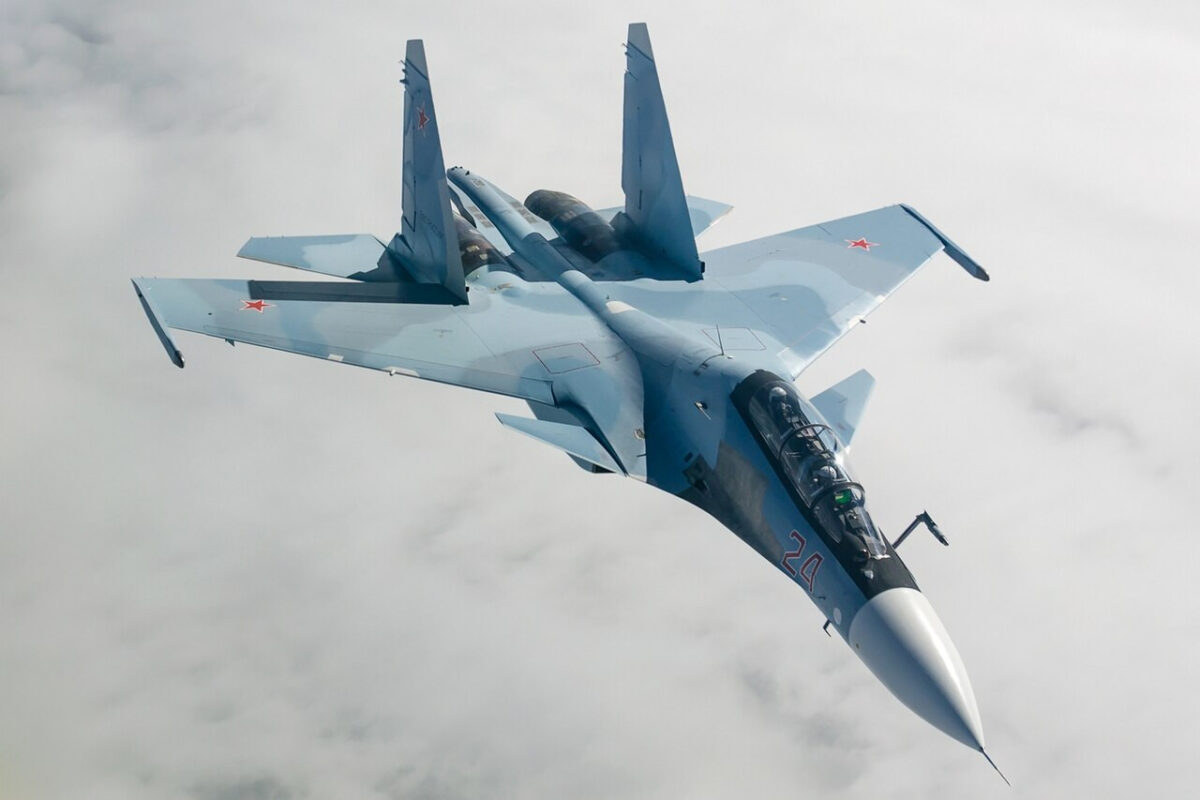
Fighterbomber first turns to the Su-30 and Su-35S fighter types. Their camouflage is generally (though not always) on the lighter side and consists of irregular patches of blue-grey shades.
The author, himself a former combat pilot, praised the colours (“the camouflage of our Su-30 and Su-35 was excellent”), but had reservations about the gloss, “because during manoeuvring the Su-35/30 in sunny weather gives itself away with glints from tens of kms away.”
The first photograph shows a two-seat, multirole Su-30SM fighter aircraft. The shot gives an excellent idea of both its colours and their layout. According to the Oryx website, the Russians have so far lost 21 of them.
The single-seat Su-35 fighter has identical camouflage (eight aircraft lost).
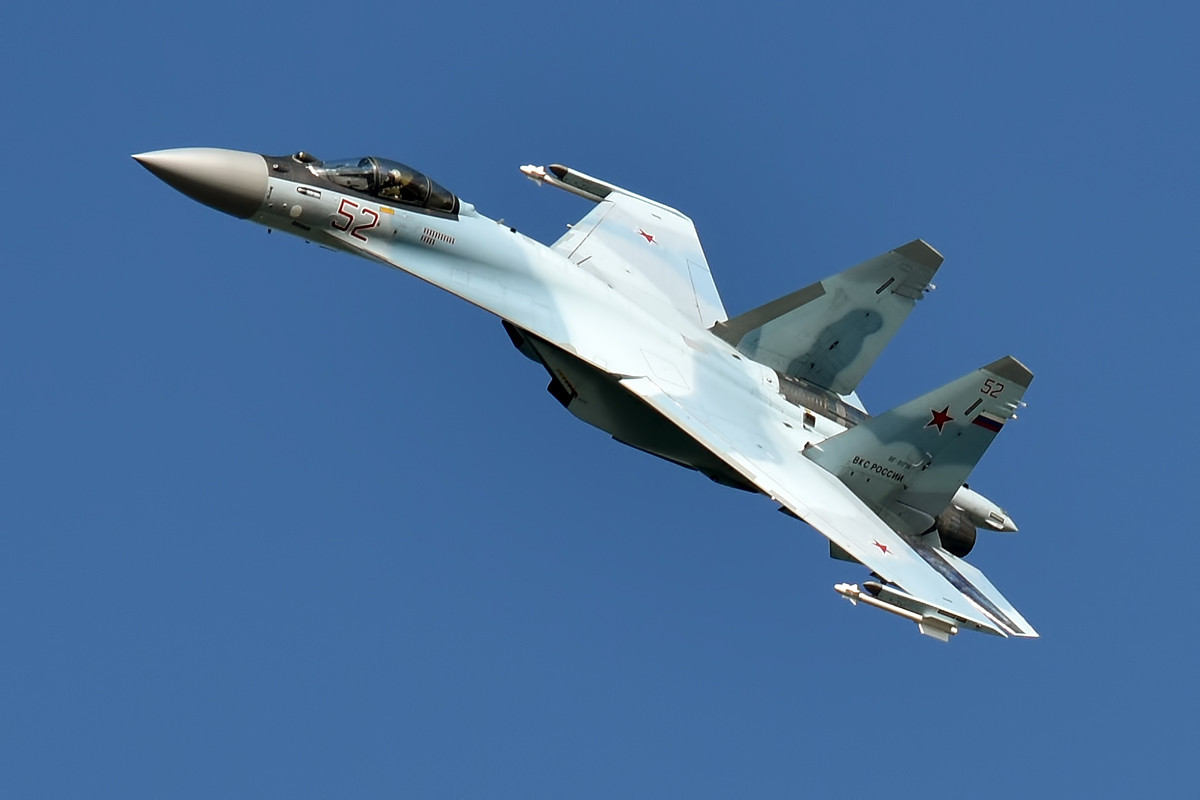 Su-35. Source: Wikipedia
The Su-34 bomber aircraft appears in two variants (43 losses since February 2022). The first is called Aubergine by the Russians, for the typical solid dark-grey paint on the upper surfaces, which changes its properties over time and thus resembles this vegetable.
 Su-34. Source: Russian ministry of defence
The second type of camouflage is called Sea Waves, and the reason is obvious at first glance. The azure blue to turquoise colours are more pronounced than on the fighter types.
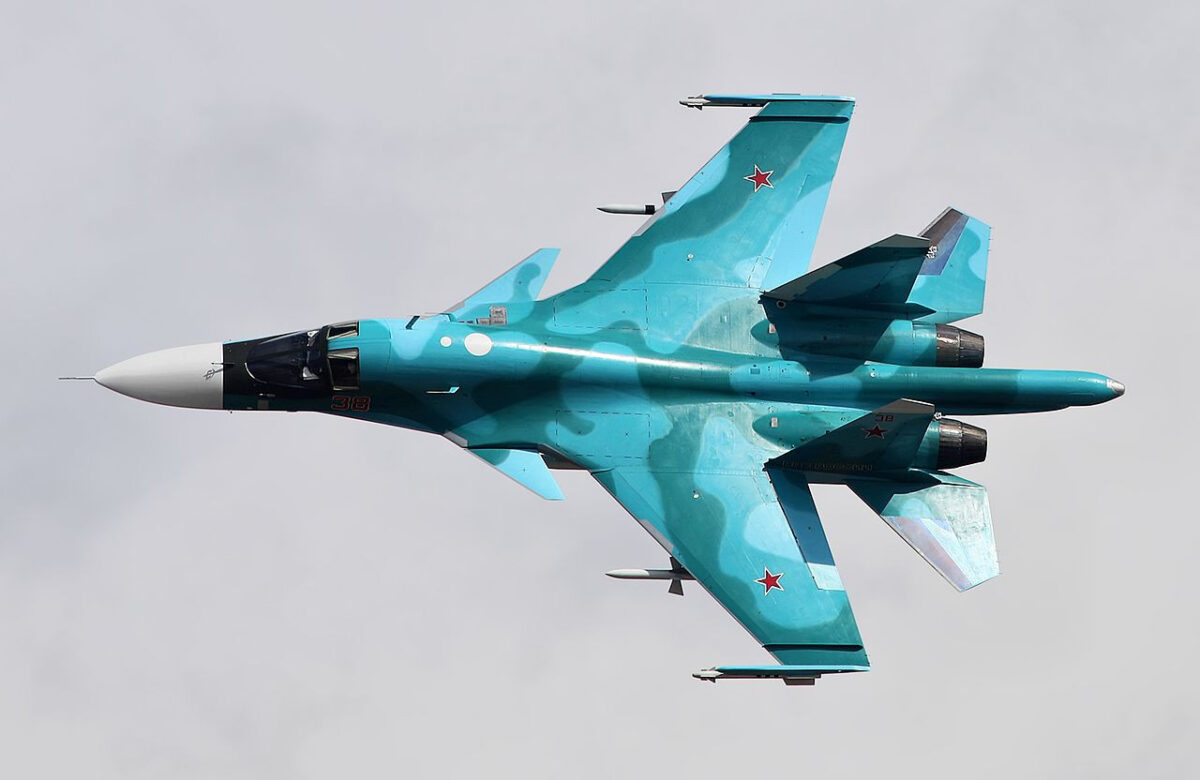 Su-34. Source: Wikipedia
“I personally consider the Aubergine colour scheme to be the more successful one … When it has faded a little in the sun, it provides excellent camouflage for the Su-34 against the background of ground, fields, forests and deserts at its main operational altitudes, from the eyes of enemy fighter pilots. Of course, on the condition that the radome and the tips of the fins are at least grey, and not white,” the Russian author wrote.
He admitted that, in short-range air combat, the second colour scheme had better properties, but the Su-34 was not used for close-range combat, “so Aubergine is more suitable for strike aviation.”
Fighterbomber believed that the Russian industry might have a problem with supplies of a special grey paint used for the radar cover (radome) and the upper part of the vertical tail, “and therefore, sometimes for some reason they use a bright white colour, which gives the aircraft away … This is a great evil.” In close-range combat, any reflection or more conspicuous colour helped reveal the aircraft’s position.
He regarded the large, colourful two-digit numbers identifying a specific aircraft as the same kind of mistake, calling them not only ugly but downright stupid. “I do not understand why we spoil the good and functional camouflage on our aircraft with such trifles,” he said.
For this purpose, blue and red paint with a white outline was used. As an example to follow, he recommended “the Westerners”. Nato air forces had for decades used grey even for national markings and various elements of the livery. That was also how Slovak F-16s looked.
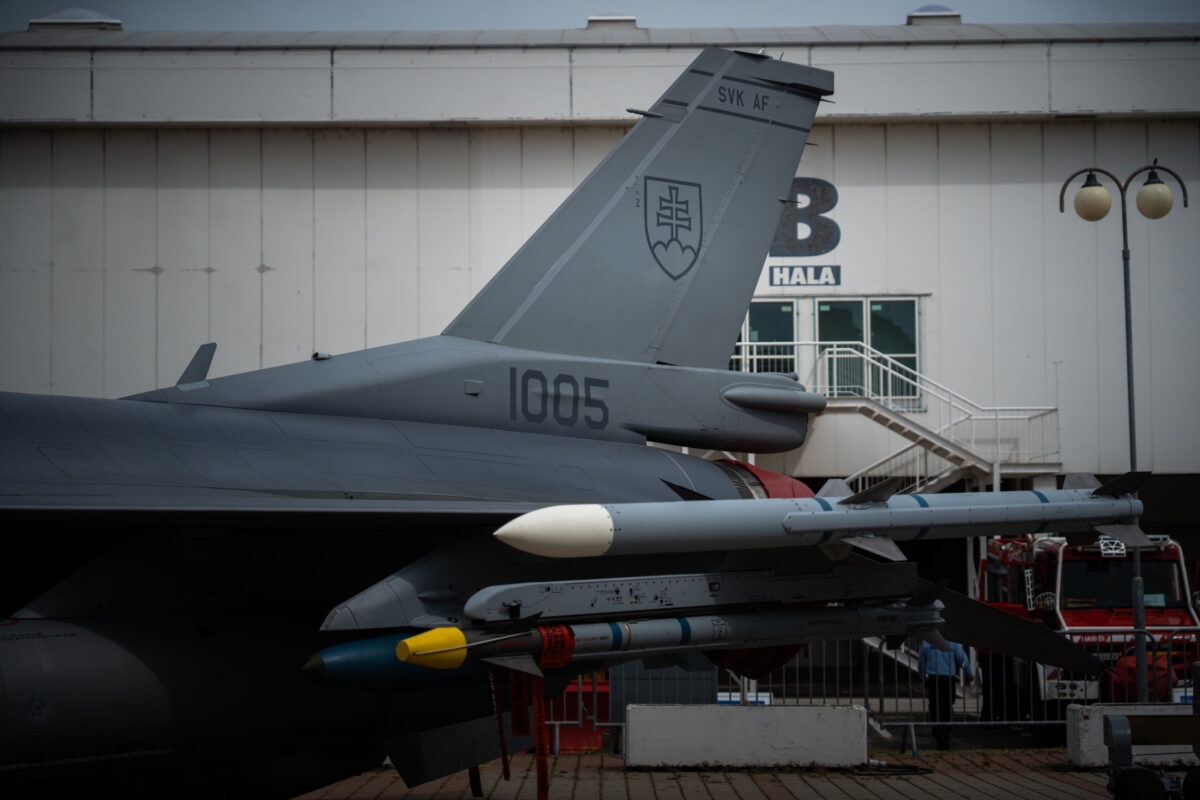 Source: Tomáš Hrivňák, Denník N
“I do not really trust digital camouflage, I have not seen it in the sky and I think it is simply paying tribute to fashion,” he concluded. The Russian air force indeed did not use digital camouflage on its combat aircraft, but it was very widespread in the Ukrainian air force.
It was used on Ukrainian MiG-29s.
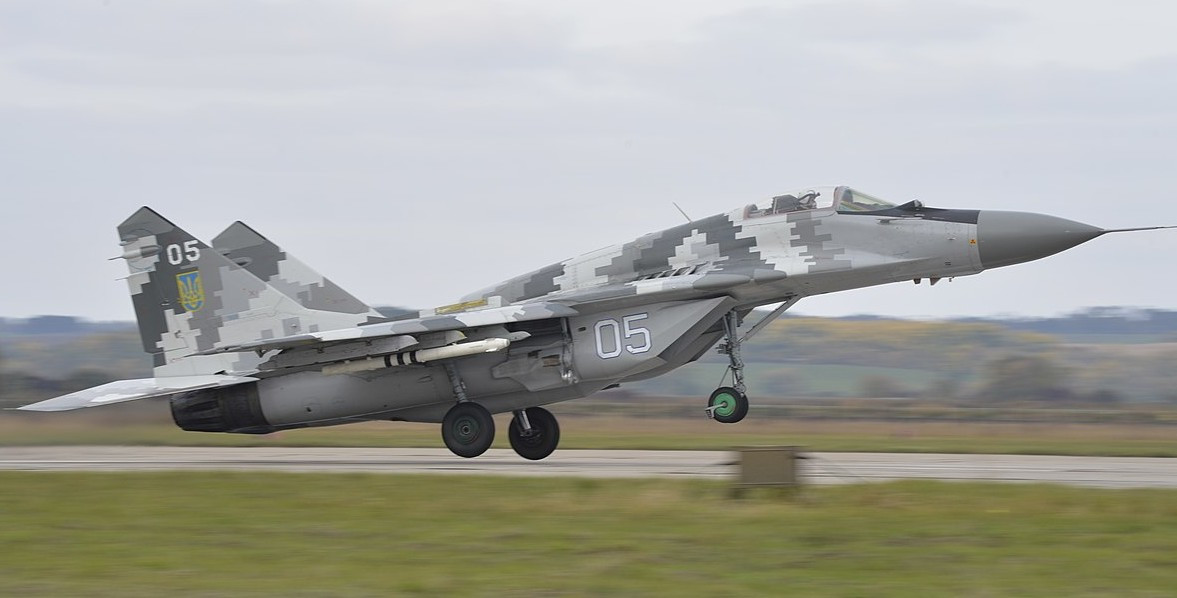 Ukrainian MiG-29. Source: Wikipedia
… as well as on Su-27s.
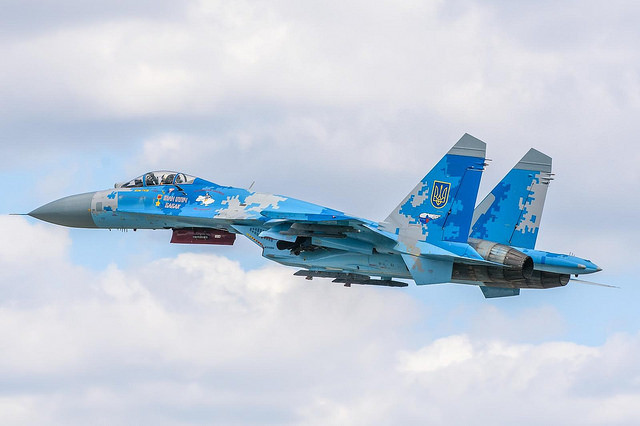 Sukhoi-27 of the Ukrainian air force. Source: Wikipedia
Ukrainians liberated the village of Odradne in the Kharkiv region. The Ukrainian army reported this, stating that in addition to the village itself, they had managed to liberate 22 square kms of territory. The Ukrainians claimed that the Russians suffered heavy losses in the fighting, specifically losing 56 soldiers killed. They also released a video not suitable for publication, which suggested they were telling the truth.
The attack was carried out by the 129th Heavy Mechanised Brigade, and Ukrainian sources wrote about a yet unspecified new tactic that led to the success. They published only a general description of how assault units, drones and artillery cooperated in the operation, gradually overcoming Russian fortified positions thanks to mutual coordination.
Odradne is one of the places in the Kharkiv and Sumy regions where Russian incursions across the state border are used to put pressure on the Ukrainian army and force it to deploy scarce resources that are then missing elsewhere. It lies to the north of Kupiansk. The map is by analysts from DeepStateUA, who have already marked the liberated territory in blue.

How difficult it is to supply the defenders of Kostyantynivka. Ukrainian analyst Petrenko wrote about the outcome of Thursday’s fighting that the grey zone – that is, the area under the control of neither army – had expanded as far as the centre of Novodmytrivka. This is a village on the eastern edge of the town, directly adjacent to Molocharka further to the north.
The Russians pushed as far as there during this week, but according to available reports did not manage to hold it. The expansion of the grey zone into Novodmytrivka nevertheless signalled a gradual Russian advance.
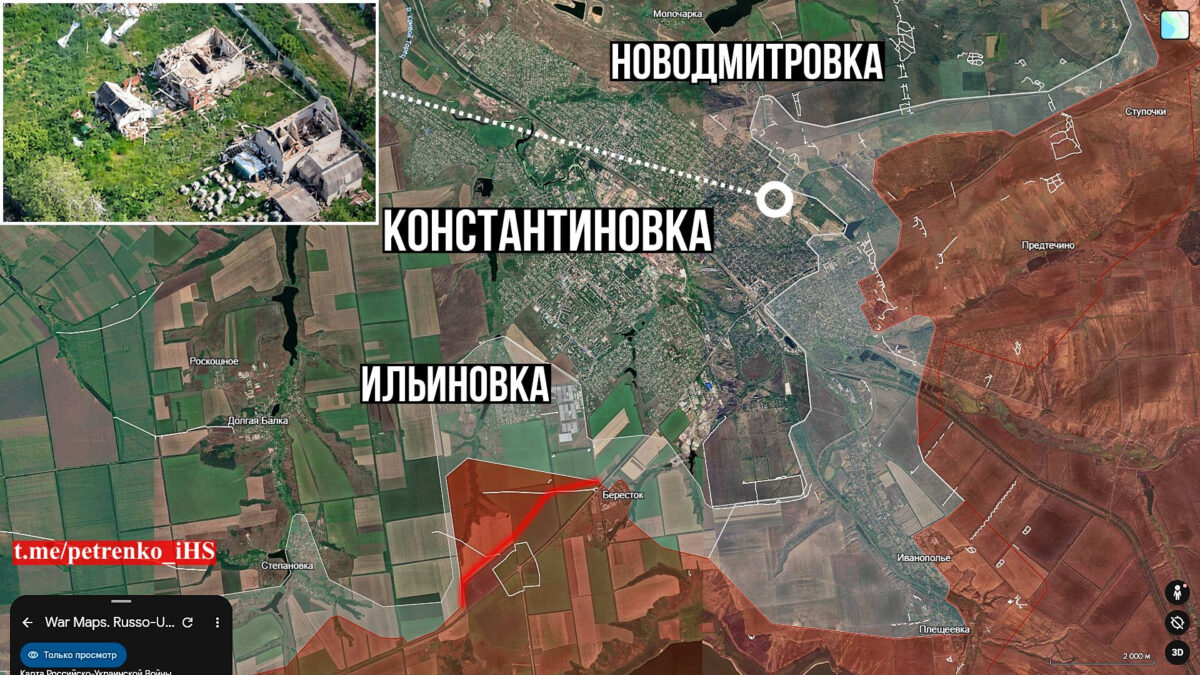
During the week, a video appeared showing dozens of destroyed ground drones trying to deliver much-needed supplies to the defenders of Kostyantynivka. French analyst Clément Molin at the same time published his own map with the geolocation of destroyed Ukrainian army supply vehicles.
It clearly shows that they move along two parallel routes and reach at most the northern half of the town. (You can find a shorter version of the video mentioned below the map.)
The most comical figure in the Russian army celebrates his 60th birthday today. Do you remember Russian army lieutenant general Igor Konashenkov? At the Moscow ministry of defence, he heads the public communications department.
It was he who, in the early stages of the war, appeared in front of the camera every day to report on the huge successes of the Russian army and the massive losses of Ukrainian units, which, according to his statistics, after a few weeks far exceeded the actual strength of the Ukrainian army before the invasion began.
Thanks to Konashenkov, Russians could believe that the Ukrainian army had lost multiples of the actual number of tanks or aircraft in its arsenal. After a while, however, even Russians began to find it suspicious how Ukraine could continue to fight effectively despite this.
It did not take long before the then most visible face of Russian propaganda became the butt of jokes. Konashenkov was often depicted as a clown. Today he no longer reports on successes, but he still heads the relevant department at the ministry of defence.
How deep a mark he left even in Russia is shown by today’s post from Rybar. This account, which was at least at the beginning of the invasion close to the Russian defence ministry, illustrated its birthday greeting to the lieutenant general with an AI-generated image showing Konashenkov standing on a pile of skulls, with the wreckage of two Abrams tanks, one F-16 aircraft and also an AH-64 Apache helicopter behind him – a type the Ukrainian army does not even have in its arsenal.
It was an obvious piece of irony, poking fun at Konashenkov’s penchant for publishing completely unrealistic figures on Ukrainian losses.
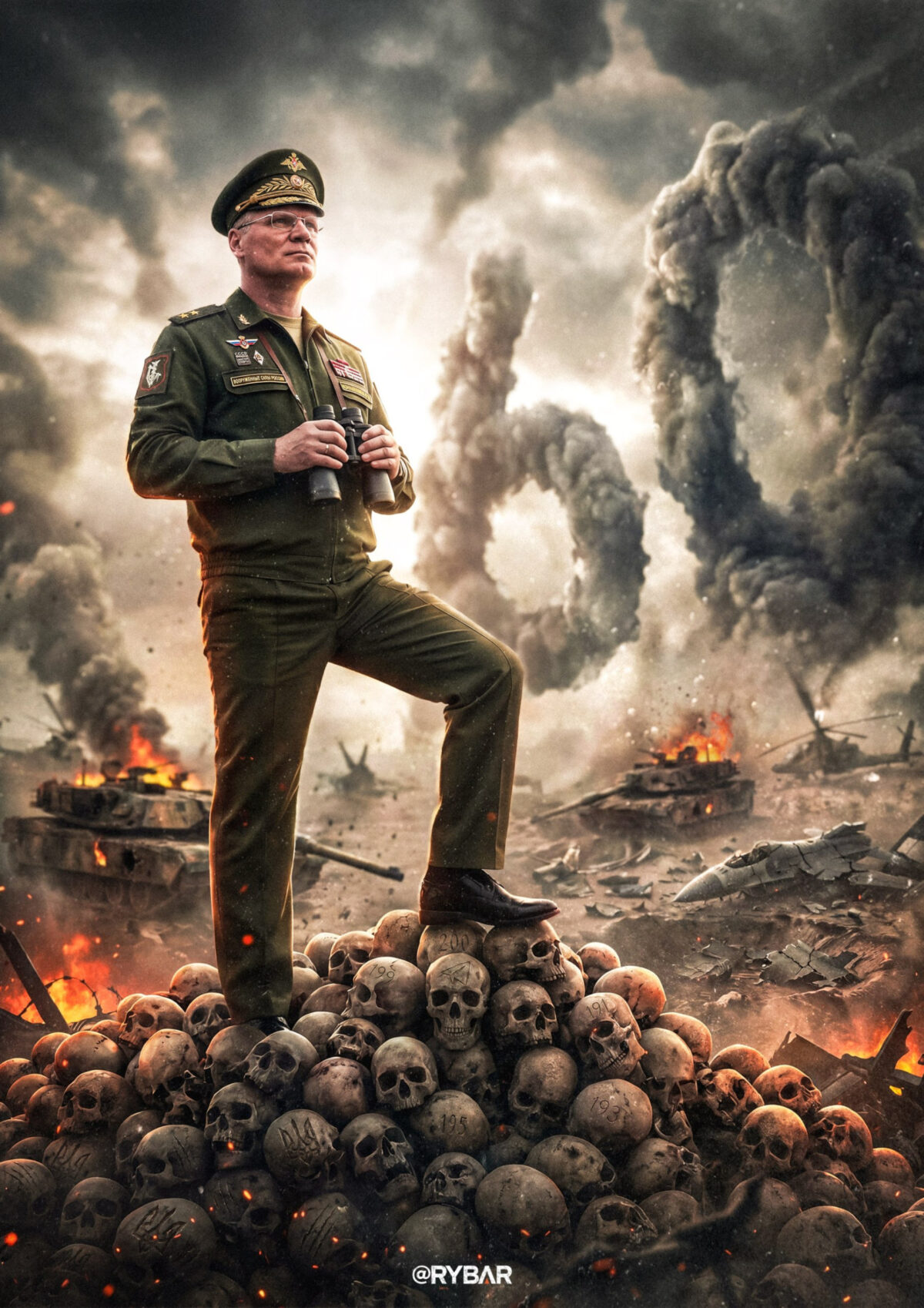
Conan, Maniac, Up to 200 Nationalists Eliminated – according to Rybar, these are Konashenkov’s nicknames among Russians. In his defence, however, Rybar wrote the following: “Regardless of how the public and the media perceive Konashenkov, to a large extent he became a hostage of the information policy of the previous leadership of the Russian ministry of defence. And he repeatedly tried to push for a change to it.”
The final birthday wish said it all: “Happy birthday, Barbarian Conan! Keep eliminating nationalists by the hundreds and win on the fronts of the information war!”.
Death toll in Kyiv has risen, Ukrainians set the Ryazan refinery on fire. As many as 24 residents of Kyiv, including three children, were killed by a Russian air raid from Wednesday to Thursday. This was one of the deadliest single incidents directly in the Ukrainian capital and the consequence of the most massive Russian air raids since the beginning of the war. They came shortly after a three-day truce that Putin had prayed for so that a military parade could take place in Moscow.
Despite the fact that, in the period before the pause in fighting, Ukraine managed to send more drones over Russia than Russia did over Ukraine, its retaliation was not yet as large. It did, however, manage to set a major refinery in Ryazan on fire.
It belongs to the company Rosneft and accounts for 5 percent of Russian production of oil products. It processes 13mn tonnes of crude oil per year. Ryazan lies approximately 160 kms south-east of Moscow.
Additional footage of Russia’s Ryazan oil refinery suffering a catastrophic fire this morning after an overnight Ukrainian drone attack. pic.twitter.com/HX2Z3iDTOw
— OSINTtechnical (@Osinttechnical) May 15, 2026
Videos of the day
Magyar Birds released a compilation of successful attacks on various targets. The very first was a Be-200 amphibious aircraft, which in later shots was completely engulfed in flames.
Next in line was a Ka-27 naval patrol helicopter. The outcome of the strike in this case could not be determined, but note that the helicopter was protected by an anti-drone net. Perhaps the most remarkable is the attack on a supply ship in the port of occupied Berdiansk. This is one of the key locations for supplying the Russian army in Ukraine.
Magyar’s update:
USF destroyed a Be-200 “Altair” amphibious aircraft with a Ka-27 carcass in Yeysk (rf), a Pantsir SAM system and a Tor SAM system, hit an ammo-carrying dry cargo ship, a locomotive, and more.
During the night of May 15, USF Birds delivered 55 fire strikes on 23… pic.twitter.com/eGw4uNvgMJ
— 414 Magyar’s Birds (@414magyarbirds) May 15, 2026
A Russian drone hit a steel plant in Kryvyi Rih.
Russian strikes with Shahed/Geran-type long-range attack drones equipped with real-time guidance system hit the ArcelorMittal steel plant located in the Ukrainian city of Kryvyi Rih.
ArcelorMittal is Ukraine’s largest integrated steel company. pic.twitter.com/E8ND3EWMKg
— Status-6 (War & Military News) (@Archer83Able) May 14, 2026
This is what an anti-aircraft machine-gun operator sees on the screen used to aim at an incoming drone.
🇺🇦 How a gunner of a mobile air defense fire group sees enemy “Shaheds” in a thermal imager, and how shots are fired in advance. pic.twitter.com/wVpvxf5VMA
— MAKS 25 🇺🇦👀 (@Maks_NAFO_FELLA) May 13, 2026
So little decides between life and death.
This is not a parody, but the real Russia. Stalin, Zhigulis, poverty, Russian flags and a “pile-up” like from the Soviet animated series Nu, pogodi!
💩Колонна рос.пропаганданов НЕ смогла даже проехать по Пензенской обл.😂
👇Даже в тылу в РФ всё также печально, как и на фронте‼️ pic.twitter.com/HHU14AX5DB
— Александр Кайдаш (@wizardaleks) May 13, 2026
What are the losses
Russia had demonstrably lost 23,439 pieces of heavy equipment by Monday morning (23,650 on Tuesday (5 May)). Of these, 18,444 (18,618) pieces were destroyed by the Ukrainians, 971 (976) were damaged, 1,197 (1,206) were abandoned by their crews, and 2,827 (3,182) were captured by the Ukrainian army. This includes 4,390 (4,394) tanks, of which 3,293 (3,292) were destroyed in combat.
Ukraine had lost 11,239 (11,219) pieces of equipment, of which 8,737 (8,708) were destroyed, 666 (661) damaged, 665 (666) abandoned and 1,185 (1,184) captured. This includes 1,422 (1,420) tanks, of which 1,087 (1,085) were destroyed in combat.
Note: Neither side regularly reports on its dead or on destroyed equipment. Ukraine publishes daily figures for Russian casualties and destroyed equipment, which cannot be independently verified. In this overview we use data from the Oryx project which, since the start of the war, has compiled a list of equipment losses documented exclusively by photographic evidence.