“That they’d send five Shaheds to my peaceful family home to kill everyone … was something I couldn’t imagine,” said Ukraine’s electronic warfare guru.
 Tomáš Vasilko



Every day, the Ukraine Battlefield update newsletter offers a clear look at how the war is unfolding on the ground, highlighting key developments along the frontline and the shifting dynamics of the conflict. This offers readers regular and detailed information to better understand the implications of the war for the country and the whole continent.
Russians, in a targeted Shahed attack, injured Serhiy Beskrestnov, an adviser to the defence minister and an expert on jamming and drones. They may have used Russian SIM cards in the drones, against which the expert had warned. Russians are advancing along the border in Sumy region, but there is no threat of the city being encircled. Photo of the day: oil storage tanks in Tuapse were still burning on the second day. Videos of the day: a three‑tonne bomb falls on Kostyantynivka, the Lima system disables a Russian Kinzhal, drones attack concealed equipment, evacuation of a soldier filmed by drone.
It is no secret that Russia is trying to kill key figures in the Ukrainian army. For example, last year Ukrainian drone ace Robert Brovdi, alias Magyar, reported an attempt to assassinate him and other commanders of drone units.
In March this year, Ukrainians reported a foiled attempt to assassinate the commander of the 3rd Army Corps, Andriy Biletsky.
On Monday, the Russians likely tried to kill another important person who influences the Ukrainians’ ability to defend themselves.
Serhiy Beskrestnov, also known as ‘Flash’, is one of Ukraine’s leading experts on jamming, drones and electronic warfare. Unlike Magyar, however, he is still a civilian and has not joined the army, even though he has been helping soldiers since the beginning of the full‑scale invasion.
Like Magyar, over four years he became relatively well‑known in Ukraine. On social networks, where he writes about technologies in the drone war, he has hundreds of thousands of followers. Since 2026 he has been an adviser to Ukrainian defence minister Mykhailo Fedorov on technology.
On Monday Flash posted a status saying that the Russians had tried to kill him. From what he wrote it follows that this was no accident, but a targeted assassination attempt that this time the Russians almost pulled off.
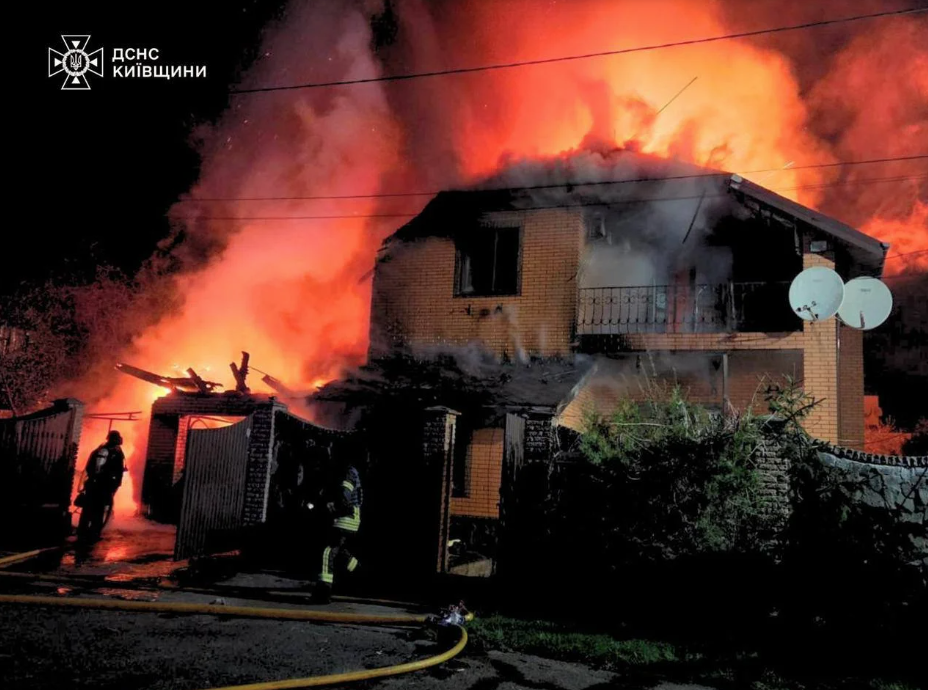
As Beskrestnov wrote, five Shahed drones were sent against his house in the Kyiv suburb of Brovary (on Monday he wrote of four). Ukrainian forces managed to shoot down at least two of them, but at least one hit his house.
“One guided Shahed missile came and hit the wall of my house. I no longer have a house. I was hit a little, but the main thing is that I am miraculously alive,” he wrote on Monday in a status with a photo from hospital. Ukrainian authorities said the drones hit a house and wounded a man born in 1974, which matches the age of 51‑year‑old Beskrestnov.
On Tuesday he posted photos of a completely destroyed building and a burned‑out car. “In one moment I thus lost everything I had built over 20 years. No house, no cars, no belongings. I am lying in a cast and it seems I will remain so for a long time. I should now be devoting myself to my family, but physically I cannot,” he wrote.
Beskrestnov’s house, which was hit by at least one Shahed.
On Monday, he wrote that he had been prepared for something like this and that a similar attack would not stop him. On Tuesday, however, he added that the way it happened had surprised him.
“That the enemy would send five Shaheds at the peaceful home of my family to kill everyone there was something I could not even imagine,” he added.
Before the war, Beskrestnov held important positions at Ukrainian operators Kyivstar and Vodafone Ukraine. Since 2009 he had been doing business in the IT sector.
After the invasion began, he according to RBC joined the defence of Kyiv region, cooperated with several units and organised a reliable military communications network in the north. He continued to cooperate with the army, posting up‑to‑date findings on Russian drones and how to counter them on social networks.
He focuses mainly on electronic warfare against incoming Russian drones, seeking to improve ways for Ukrainians to defend themselves against them and shoot them down.
Defence minister Fedorov said that he was “one of the best practical experts in the field of drones, electronic warfare and analysis of the enemy’s decisions”. The targeted Russian attack on him confirms these words.
Beskrestnov claimed that the Russians controlled the Shaheds remotely from Russia, which to some extent confirms new developments. Just a few days ago, Beskrestnov himself wrote about how they were managing to do this.
He believes that in the Shaheds they use SIM cards of the Russian operator Tele2, thanks to which they connect to the internet and transmit a signal. According to him, 20 percent of Shaheds are controlled in this way.
Ukraine, however, is blocking roaming by this Russian telecoms company on its territory. According to Flash, though, the Russians are using Belarusian roaming – and along the western and southern border, Polish and Romanian roaming signals. Since Kyiv lies relatively close to the Belarusian border, they could have used a Belarusian signal when attacking his house.
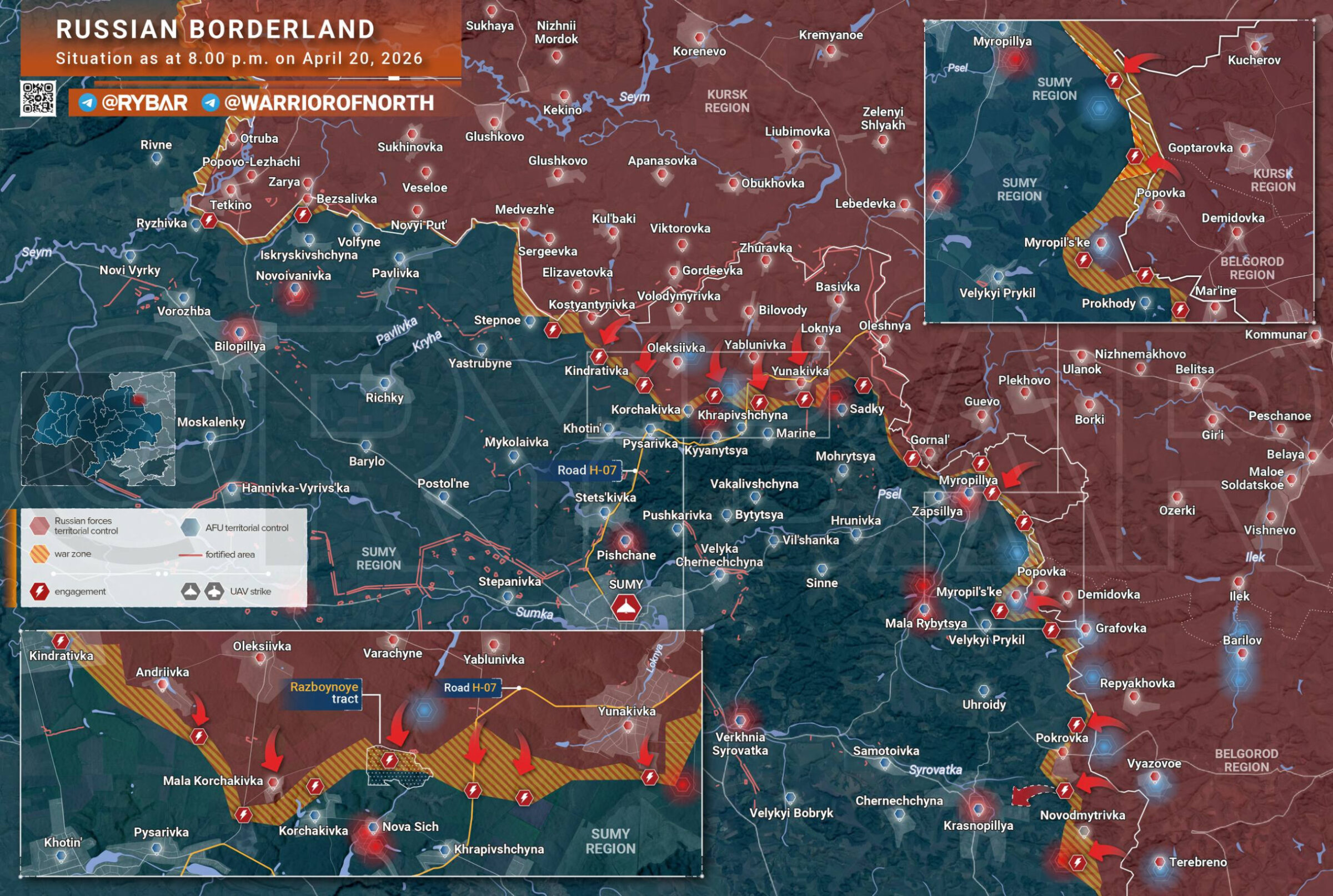
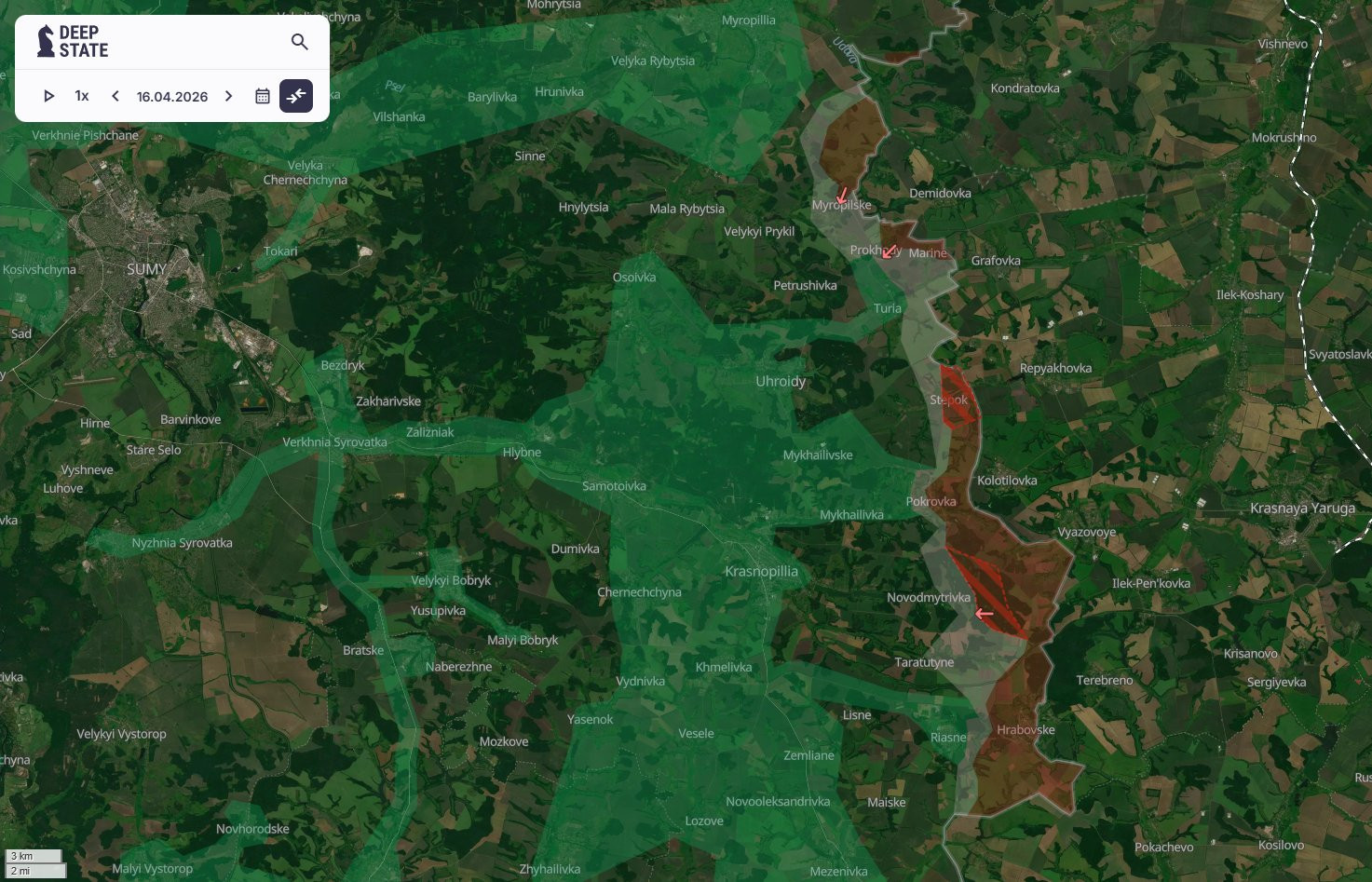
Russians are advancing near the border in Sumy region, but there is no threat of the city being encircled. In recent weeks, Russians have been extending a buffer zone along the border in Sumy region east of the city of Sumy. Over the weekend, the DeepState UA account also redrew the front line in Russia’s favour.
This is how analysts from the Finnish Black Bird Group see the situation.
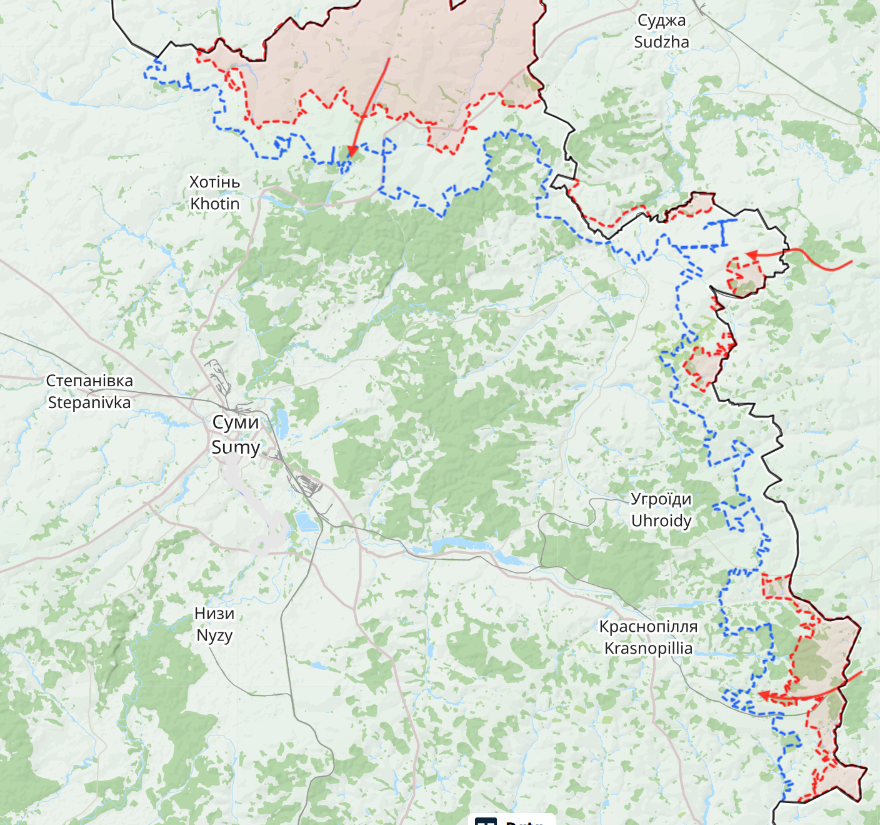
And the map from the Russian channel Rybar:
At present, according to DeepState, Russians hold 93 square kms of territory here and another 233 square kms north of the city. Although Russians have advanced at several points in the east, they are still clinging to the border – at their furthest they are 5 km from it. Apart from the village of Hrabovske in the east, they have not captured any larger settlement. Fighting is ongoing for Myropilske and Prokhody.
After the latest advances, however, reports began to appear that the Russians were trying to encircle or semi‑encircle the city of Sumy.
Ukrainian command, independent experts such as the DeepState UA account, and last but not least Russian channels like Rybar all say that nothing of the sort is happening.
“Russians are far from this city, they have penetrated very little into Ukrainian territory and their presence in the immediate border area is limited, so any reports about a possibility of reaching Sumy from the east do not correspond to reality,” explained Viktor Trehubov, spokesman for the Ukrainian Joint Forces North.
According to him, the Russians are merely trying to widen the border buffer zone. From the east they are 35 km away from the city of Sumy. Of course, it is always dangerous when Russians move closer to a regional centre – at a certain distance this allows them to shell the city with artillery or terrorise the population with FPV drones. But they are far from any encirclement.
Videos have emerged showing attacks by groups of Russian infantry, as well as smaller attacks by armoured vehicles.
These vehicles are, according to geolocation, still on the Russian side of the border.
The situation here is also being monitored by the DeepState UA account, which is in contact with soldiers.
“Soldiers of the 21st Motorised Rifle Brigade and the 71st Armoured Rifle Brigade published footage of repelling enemy attacks in which both light and heavy equipment was used. The attacks were repelled and the situation in the area has not changed dramatically, because its development is not being influenced by a column of equipment, to which Ukrainian pilots respond with fire and destroy on the way, but by constant pressure by infantry in small groups, mainly from the ranks of DRGs [diversionary‑reconnaissance groups]. They are gradually penetrating our territory and operating directly in the border area, where it is difficult to hold the area without sufficient support,” the DeepState UA account wrote.
Russians also unsuccessfully tried to use an empty pipeline here to infiltrate deeper into Ukrainian territory.
According to analyst Kostyantyn Mashovets, the Russian Northern Group of Forces is operating here, trying to create various salients across the border and then link them into a single whole.
In one place they have already managed to do so. “Russians continue to wage fierce fighting here with Ukrainian units defending the state border along the Prokhody–Marine line and in the Myropilske area,” Mashovets wrote.
According to Rybar as well, Ukrainians are still present in the village of Myropilske. He called claims about Russian plans to encircle Sumy propaganda by the Ukrainian army.
He also wrote that this front would remain secondary compared to Kharkiv and Donbas. However, by advancing across the border, Russians are tying down Ukrainian units.
Photo of the day
Throughout Monday, photos and videos were published showing oil storage tanks on fire at a refinery in the Russian city of Tuapse on the Black Sea coast after a Ukrainian strike. The fire was extensive and had not been extinguished even by Tuesday.
The latest video coming from the refinery in Tuapse, Krasnodar region, in Russia shows that basically the entire facility is burning.
I’m saying that this facility is a total loss. pic.twitter.com/irrA0Y21LI
— (((Tendar))) (@Tendar) April 21, 2026
In addition, videos appeared in which local residents complained about the situation in the city. The air is hard to breathe and an oil slick has appeared along the shore.
Ukrainians also struck Tuapse last week; on Sunday, after three and a half days, the fire was extinguished, but on Monday there was another attack.
The exact extent of the damage was not known because of the dense cloud of smoke rising from the site of the strike.
1/2 A new fire at the Tuapse oil refinery storage site after a second Ukrainian strike on the night of April 20 is much closer to the sea than the previous epicenter. Unfortunately, the first impact site is again covered by thick smoke in this @planet image taken today 8:56 UTC. pic.twitter.com/s5FPgtql4B
— Mark Krutov (@kromark) April 20, 2026
Videos of the day
This video shows the impact of a three‑tonne aerial bomb in the city of Kostyantynivka. According to the description, it destroyed an entire apartment block.
With a pre‑war population of 60,000, Kostyantynivka is already starting to resemble other cities captured by the Russian army, even though Russians are still far from taking it.
This is what the “liberation” by the Russian occupiers looks like. A 3-ton Russian aerial bomb struck Kostiantynivka. An entire block of apartment buildings was leveled to the foundation. Footage provided by aerial reconnaissance from the “Phoenix” border guard unit.… pic.twitter.com/6qE3nZWZZf
— WarTranslated (@wartranslated) April 21, 2026
A very interesting video shows the fall of the warhead of a Russian Kinzhal ballistic missile. It was reportedly disabled by the Ukrainian electronic warfare system Lima.
The missile falls vertically to the ground. As stated in the video, thanks to the Lima system Ukrainians have neutralised 26 Kinzhals and 33 cruise missiles.
The moment a Russian aeroballistic “Kinzhal” missile falls after being knocked off course by the Ukrainian “Lima” electronic warfare system. Since the beginning of 2026 alone, Ukrainian electronic warfare has downed 26 “Kinzhals,” deflected 33 cruise missiles, and intercepted… pic.twitter.com/tHvpqCBHb2
— WarTranslated (@wartranslated) April 20, 2026
A compilation of videos shows Ukrainian units destroying Russian equipment hidden in buildings. If such “warehouses” are not properly sealed, a skilful operator can get inside.
Ukrainian forces have destroyed a heavily modified T-55 near Huliaipole after tracking Russian movements, striking the staging area with HIMARS and finishing targets with FPV drones. #Ukraine pic.twitter.com/REOoMyaBmf
— NOELREPORTS 🇪🇺 🇺🇦 (@NOELreports) April 20, 2026
We have already seen several evacuations of wounded soldiers by robots. This video offers a view directly from a ground unmanned drone. It shows the final phase of the evacuation, when comrades from the unit come to pick up the wounded soldier.
What are the losses By Tuesday morning, Russia had demonstrably lost 24,471 pieces of heavy equipment. Of these, 19,108 pieces had been destroyed by Ukrainians, 976 damaged, 1,206 abandoned by their crews and 3,181 captured by the Ukrainian army. This includes 4,385 tanks, of which 3,288 were destroyed in combat. Ukraine had lost 11,977 pieces of equipment, of which 9,224 had been destroyed, 669 damaged, 670 abandoned and 1,414 captured. This includes 1,416 tanks, of which 1,081 were destroyed in combat.
Note: Neither side regularly reports its fatalities or destroyed equipment. Ukraine publishes daily figures for Russian casualties and destroyed equipment. In this overview we use data from the Oryx project, which since the start of the war has been compiling a list of equipment losses documented exclusively by photographic evidence.