
Elastics, a Warsaw-based startup building AI agents for prediction markets, has raised €1.7 million (€2 million) in oversubscribed pre-Seed funding to hire AI and quantitative talent in Poland. The funding round was led by French VC Frst, with participation from angels including Mati Staniszewski (co-founder and CEO of ElevenLabs), Piotr
 Rahul Raj



Elastics, a Warsaw-based startup building AI agents for prediction markets, has raised €1.7 million (€2 million) in oversubscribed pre-Seed funding to hire AI and quantitative talent in Poland.
The funding round was led by French VC Frst, with participation from angels including Mati Staniszewski (co-founder and CEO of ElevenLabs), Piotr Dabkowski co-founder and CTO of ElevenLabs), Philippe Bekhazi (founder and CEO of XBTO), Karl Naim (Chief Commercial Officer of XBTO), Bartek Pucek (Scout at a16z), Marcin Kaźmierczak (co-founder of RedStone), Bartosz Jakubowski (Partner at Alven), Aleksandra Pedraszewska (founding partner at vastpoint ventures), Tytus Cytowski (founder of Cytowski and Partners), Jan Czarnocki (Doctoral Researcher at KU Leuven), Łukasz Żurowski (founder of Silver Summit Development), and Edouard Palardy (contract manager at Web3 Foundation).
Pierre Entremont, co-Founder and Partner at Frst. “Prediction markets are emerging as a new asset class in finance, and we believe the industry is still in its very early innings. Elastics is building the AI layer that this market needs, and we’re excited to back Szymon and Mateusz as they democratise access to quantitative trading tools that were previously out of reach for most participants.”
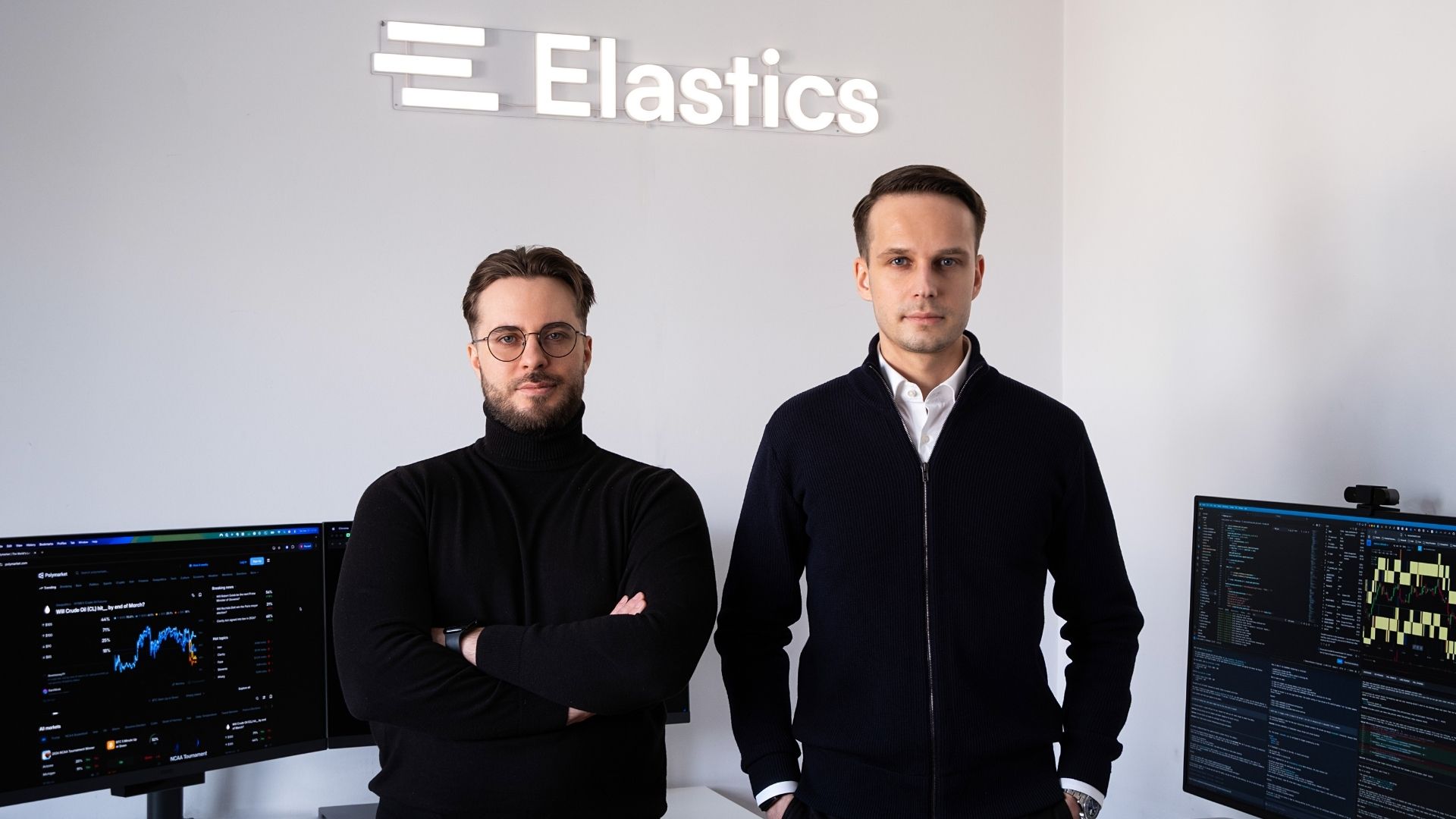
Founded in April 2025 by Szymon Pawica (CEO) and Mateusz Brodowicz (CTO), Elastics is an AI-native operating system for prediction markets and beyond. It is powered by auditable AI agents, and it allows traders to build and automate trading workflows in plain language, from signal generation to live execution.
While at Goldman Sachs, Szymon Pawica observed quantitative funds leveraging a significant advantage: teams of skilled and expensive quants and developers developing models, automating strategies, and processing data at a scale that retail traders can’t match.
After leaving the firm, the NYU Stern graduate started trading on his own. The difference between what he observed at work and what he could access as an individual trader was difficult to overlook.
“The quant edge at hedge funds comes down to people and infrastructure. We think AI can now replicate most of that and make it available to anyone,” said Szymon Pawica, founder and CEO of Elastics.
This conviction motivated Pawica to co-found Elastics with Mateusz Brodowicz, a mathematician from the University of Houston who had previously developed quantitative models for a prediction markets fund.
According to the company, it gives individual traders access to the kind of automated research, execution, and portfolio management tooling that has historically been locked behind the walls of institutional finance.
“The timing is hard to ignore. Polymarket is now valued at €7.7 billion ($9 billion) after a €1.7 billion ($2 billion) investment from Intercontinental Exchange, the parent company of the New York Stock Exchange, while rival Kalshi recently closed at a €18.8 billion ($22 billion) valuation. The retail traders driving much of that volume, however, are still largely operating without meaningful tooling, and that is exactly the gap Elastics is stepping into,” mentioned the company.
The platform is currently in private beta, with users able to apply for early access to Elastics AI, the agent builder, and Elastics OS. According to the company, Elastics is built around the idea that the future of trading is conversational, that an LLM, not an order ticket, is the natural interface between a trader and the market. It states that the platform’s “Trade with Words” feature lets users describe a position in plain language and have it executed automatically, no dropdown menus or limit order forms required.
Pawica believes that any broker still using the same market and limit order interface is operating on borrowed time. He states that as AI-driven automation spreads through financial markets, he believes the window for manual traders to compete on equal footing is closing fast.
“The old interface was designed for a world before AI. Every platform that hasn’t rethought that from the ground up will have to. Every trader who isn’t using automation is already at a disadvantage. We want to make sure that’s a choice, not a constraint,” concludes Pawica.