
While the tenure of the High Representative in Bosnia and Herzegovina, Christian Schmidt, is not strictly fixed by a calendar, there has been ongoing speculation that he will leave the post following the October 2026 general elections. The discourse surrounding his potential resignation is often tied to the broader debate
 Marija Stojanović



While the tenure of the High Representative in Bosnia and Herzegovina, Christian Schmidt, is not strictly fixed by a calendar, there has been ongoing speculation that he will leave the post following the October 2026 general elections.
The discourse surrounding his potential resignation is often tied to the broader debate on whether the Office of the High Representative (OHR) has become an impediment to EU integration, a sentiment frequently echoed by politicians in Republika Srpska. According to Željka Cvijanović, Serb member of the Presidency of BiH, “Schmidt is definitely leaving BiH, but the claims that someone from the United Kingdom will replace him are merely propaganda”.
On the other hand, in interviews conducted in January 2026, Christian Schmidt, who assumed office as the High Representative in BiH in August 2021, stressed that the OHR’s mandate remains essential for the stability of the state, particularly in the face of secessionist threats and the erosion of state-level institutions. Schmidt reiterated that his primary objective is to ensure that the constitutional order established at Dayton is respected.
Analysts state for EWB that since the political landscape in BiH remains highly volatile, there is a little chance that the OHR will cease to exist or be relocated after Schmidt eventually leaves the country. Nevertheless, they note that insufficient progress has been made since the establishment of the OHR, back in 1995.
“It is almost certain that Christian Schmidt will leave the position of the High Representative after the October elections. However, political elites in BiH have confirmed that they need a guardian because when things and decisions are left to them, the country and the reform processes in it move backwards”, remarks Tanja Topić, Head of Friedrich Ebert Foundation office in Banja Luka.
Similarly, Franz-Lothar Altmann, an independent German academic and associate professor of international relations at the University of Bucharest, says that “BiH is an unfinished, to a large extent, dysfunctional state with many fragmentations, too many constitutions and the lack of will to cooperate for a solid future of Bosnia and Herzegovina as a unified state”.
The confrontation with Milorad Dodik
Established under the Dayton Peace Agreement, the OHR was designed to oversee the implementation of the civilian aspects of the peace settlement in BiH. The High Representative serves as the final authority regarding the interpretation of the civilian aspects of the peace agreement, a mandate significantly expanded by the 1997 Peace Implementation Council (PIC) in Bonn, which granted the office the “Bonn Powers”. These powers allow the High Representative to impose legislation and remove public officials who violate the Dayton Agreement or obstruct the peace process.
The High Representative in BiH is appointed by the Steering Board of the Peace Implementation Council (PIC), an international body overseeing the Dayton Agreement. While the PIC Steering Board selects the appointee, the appointment is, in practice, usually confirmed or supported by a UN Security Council resolution.
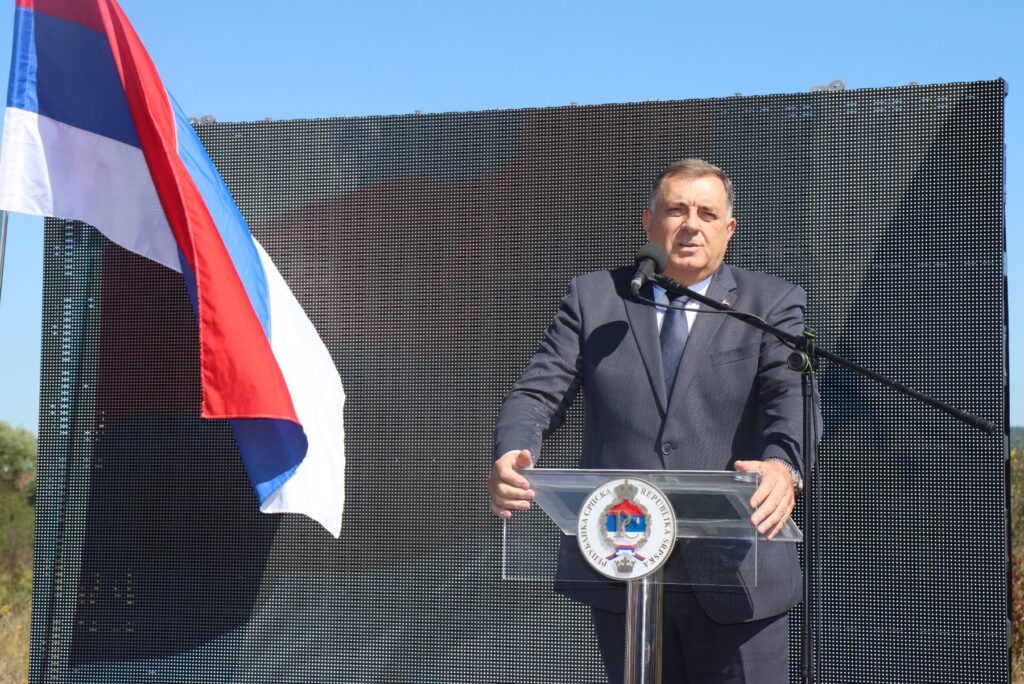
The recent legal troubles of Milorad Dodik, the former President of BiH’s entity Republika Srpska, stemmed primarily from his persistent refusal to comply with the executive decrees issued by the OHR. In 2025, the Central Election Commission of BiH revoked his mandate following a criminal conviction for failing to implement decisions made by the international peace overseer. Dodik often referred to Schmidt as an “illegitimate” or “colonial administrator”.
“The goal of Milorad Dodik’s policy was to lobby for the ‘expulsion of Schmidt’ but also to close the Office of the High Representative. Hidden behind this effort was the intention that the departure of the High Representative and the shutdown of the OHR would bring about the annulment of decisions and amendments to the Criminal Code that Schmidt had made, which effectively removed Dodik from the political scene”, Tanja Topić clarifies for EWB.
Franz-Lothar Altmann underlines that “the Dayton Peace Agreement was set up to end the war and to function as a start-up model out of which in due time the new BiH could be formed”.
“For that transitional period the control function of the International Community with the OHR was necessary, but over the last 30 years only very little progress concerning functionality of the entire state, i.e. Federation plus RS, was achieved, partly because the leading domestic political actors became comfortable with the possibility to blame the International Community and the OHR for not resolving burning issues, but also because the respective HRs did not have the necessary backing for using more robustly their Bonn Powers”, Altmann remarks.
He adds that these conditions were and still are “abused by the RS, i.e. Dodik, to play constantly the own separation-oriented game, supported by Serbia and Russia, thus blocking any strengthening of the political weight of the central authorities in Sarajevo, but also to move towards the necessary membership in the EU”.
“A closure of the OHR would leave BiH again in a limbo”
In November 2025, Wolfgang Petritsch, a former High Representative in BiH, told Federalna TV that it is necessary to close the OHR and transfer oversight to the European Union.
“Schmidt is trying to be an active High Representative. But I do not think the problem is the High Representative. The problem is that the OHR has been there for too long. The problem is that as long as there is a High Representative, politics in Bosnia and Herzegovina will always have addiction syndrome”, Petritsch claimed.
By contrast, Franz-Lothar Altmann notes that “at this point a closure of the OHR and a definite stopping of any supervision from outside will leave BiH again in a limbo as it was just after the end of the war”.
“The responsible Bosnian political actors would be challenged to prove that they are willing and capable to govern the country properly. One can very well understand the opinion that the people of BiH should take their fate into their own hands and responsibility. But what will happen if that dissolution of the OHR and the end of the oversight of the Peace Implementation Council takes place? In many areas there is still the need for reforms, including the set up of a new constitution with clear competencies of the two entities and the center, whereby the center should be definitely strengthened. But again, one does not see the political will among the responsible politicians”, Altmann stresses.
In his opinion, “the probability will increase that the separatist forces in the RS, but also among the Croats, will feel strengthened and, in the end, Bosnia and Herzegovina will fall apart”.
Altmann adds that “if this (scenario) is what the international community and in particular the EU is willing to accept, then the ‘protectorate’ should in fact be terminated quickly, but with these considerations and possibilities in mind, a definite answer concerning the termination of the OHR is extremely difficult to find”.
“An end of the OHR, therefore, must be very well prepared with serious consultations within the international community but also including the political actors in BiH. But as long as on the side of the latter a sincere positive constructive will is not existing we find ourselves in a dead-end alley. And finally, these days the USA and the EU in particular, as the responsible powers, do not seem to be prepared to be confronted with another eventually catastrophic development in the EU´s neighborly back yard”, Altmann concludes.
In a similar manner, Tanja Topić notes that “based on the available information, the OHR remains in Bosnia and Herzegovina, with a new male or a female High Representative”.
“There has already been some speculation in some media in BiH about a possible successor to Schmidt, and it is certain that there will be no relocation of the OHR to Brussels or elsewhere”, Topić remarks.