Oil prices plunge 15% to below $100, stocks surge and dollar slumps after Trump announces US-Iran ceasefire – business live
Investors relieved by news of two-week ceasefire and temporary reopening of strait of HormuzAnd we’re off. The FTSE 100 index has jumped 273 points, or 2.6%, to 10624 in early trading.There are only three fallers: oil companies BP and Shell, down by 8.3% and 7.3% respectively, and British Gas owner
Julia Kollewe
April 8, 2026
0 Comments
And we’re off. The FTSE 100 index has jumped 273 points, or 2.6%, to 10624 in early trading.
There are only three fallers: oil companies BP and Shell, down by 8.3% and 7.3% respectively, and British Gas owner Centrica, down 3.5%.
Interest rate expectations have shifted dramatically, and government bond yields have fallen sharply.
Markets are now pricing in one interest rate hike from the Bank of England this year, probably by September.
Last week, investors were expecting two to three rate increases to rein in rising inflation.
UK government bond yields plummeted on news of the ceasefire as rate hike expectations receded, with the yield, or interest rate on the 10-year gilt down 18 basis points. The five-year yield dropped by 20 basis points.
Sterling has also risen sharply, by 0.9% against the dollar, to $1.3416.
Eurozone government bond yields also plunged as traders scaled back bets on future rate rises from the European Central Bank. Markets are now pricing in a 20% chance of a rate hike in April, compared with 60% on Tuesday, before the dramatic announcement of a US-Iran ceasefire overnight.
The yield, or interest rate, on Germany’s 10-year government bond fell 18 basis points to 2.91%.
Jim Reid, markets analyst at Deutsche Bank, said
Investors will be breathing a big sigh of relief that an offramp out of the war is being taken even as there’ll be various elements to watch to see whether this leads to sustained de-escalation.
Will the ceasefire hold? We saw some strikes by Israel and Iran overnight though these may have been in the works before the conditional ceasefire. We’ve also seen conflicting commentary on whether the ceasefire will extend to Israel’s action in Lebanon. Can talks lead to a permanent cessation of hostilities?
Trump’s comment last night that “Almost all of the various points of past contention have been agreed to” suggests a lower bar for agreement, but Iran’s reported 10-point plan includes elements such as the lifting of all sanctions and Iran controlling the Strait of Hormuz that have previously been unacceptable to the US and allies.
Those points also do not restrict Iran’s enriched uranium, which Trump suggested would be “perfectly taken care of” as he claimed a “total and complete victory” in an interview to AFP late last night. And in his latest post overnight, Trump appeared keen to lean into the prospects for full resolution, claiming “a big day for World Peace” and that the US “will be helping with the traffic buildup in the Strait of Hormuz”.
Good morning, and welcome to our rolling coverage of business, the financial markets and the world economy.
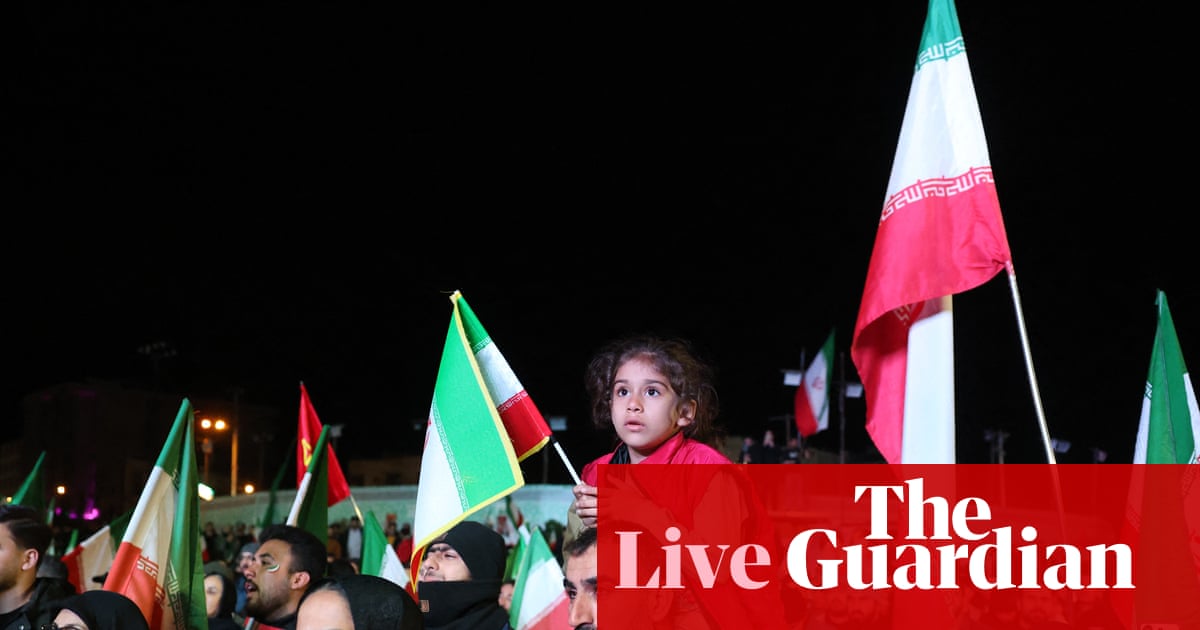
Oil prices plunged more than 15% below $100 a barrel, Asian stocks surged and the dollar slumped after the US and Iran agreed a two-week conditional ceasefire on Tuesday evening, including a temporary reopening of the strait of Hormuz.
Investors breathed a sigh of relief, and Brent crude, the global oil benchmark, fell by more than $15 to $93.82 a barrel in early London trading. It reached a low of $91.7 a barrel in Asian trading – but remains much higher than before the US and Israel launched attacks on Tehran on 28 February, when it traded around $72 a barrel.
Japan’s benchmark Nikkei 225 jumped 5.45%, the Australian market climbed 2.55% and South Korea’s Kospi soared 7.7%. Elsewhere, Hong Kong’s Hang Seng surged 3%, while the Shenzhen Composite in China rose just over 4%.
European stock futures are pointing to a strong rally when markets open soon, with Germany’s Dax seen rising more than 5% and the UK’s FTSE 100 up nearly 3%.
The dollar fell more than 1% against a basket of major currencies. Spot gold rose 2.6% to $4,825 an ounce.
After a last-minute diplomatic intervention led by Pakistan, Donald Trump held off on his threat to bomb Iran “back to the stone ages” and wipe out “a whole civilization”.
With less than two hours to go until his ultimatum of 8pm Eastern time, the US president said a ceasefire agreement had been mediated through Pakistan, whose prime minister, Shehbaz Sharif, had requested the two-week peace in order to “allow diplomacy to run its course”.
Trump wrote in a post that “subject to the Islamic Republic of Iran agreeing to the COMPLETE, IMMEDIATE, and SAFE OPENING of the Strait of Hormuz, I agree to suspend the bombing and attack of Iran for a period of two weeks”.
Soon after, Iran’s national security council confirmed it had accepted a two-week ceasefire under the management of its military if attacks against Iran were halted. Tehran said peace negotiations with the US would begin in Islamabad on Friday.
However, there is still much uncertainty about the outcome of the talks, how the strait of Hormuz will be managed and what will happen to shipping after the two-week period ends.
Charu Chanana, chief investment strategist at Saxo Bank in Singapore, said:
Markets were positioned for a much worse outcome, so the relief rally in equities, FX, and oil makes sense. This is the market unwinding some of its disaster hedges.
The ceasefire does not resolve all the underlying risks. Investors still need clarity on whether hostilities truly stop, whether Hormuz remains reliably open, how quickly disrupted energy supply can recover, and whether the 10 April talks in Islamabad produce real progress.
For macro and rates, the worst immediate inflation shock has eased, so markets can start to put some rate cuts back on the table. But I would not assume they simply return to the exact same pricing as before the war, because shipping, insurance, and supply-chain disruptions may take longer to normalize.
Tactically, the Iran playbook may now be flipping. Relief-sensitive areas such as airlines, consumer discretionary, selected cyclicals, and broader risk assets could benefit if de-escalation holds. Structurally though, I still think investors should balance growth and AI exposure with energy, supply-chain resilience, hard assets, and national-security themes.




 Julia Kollewe