
IMF head warns Middle East war will lead to higher inflation and slower global growthGood morning, and welcome to our rolling coverage of business, the financial markets and the world economy.Oil prices continued to climb on Tuesday above $110 a barrel amid a deadline imposed by Donald Trump for Iran
 Julia Kollewe




Good morning, and welcome to our rolling coverage of business, the financial markets and the world economy.
Oil prices continued to climb on Tuesday above $110 a barrel amid a deadline imposed by Donald Trump for Iran to open the strait of Hormuz or be “taken out,” with the US president threatening to order attacks on Iranian power plants and bridges.
He threatened to rain “hell” on Tehran if it does not meet his deadline of Tuesday 8pm ET (1am BST Wednesday) to reopen the strait, a key shipping route. In response to a US proposal through mediator Pakistan, Tehran rejected a ceasefire and insisted on a permanent end to the war.
Brent crude rose 1.1% to $111.01 a barrel, while New York light crude hit $115.3 a barrrel, up 2.6%.
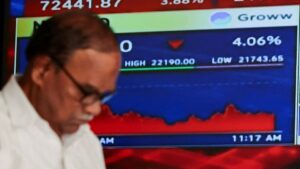
Asian stock markets were mostly higher, with Japan’s Nikkei rising 0.19% and South Korea’s Kospi up 1.2%, while Hong Kong’s Hang Seng fell by 0.7%.
The war in the Middle East will lead to higher inflation and slower global growth, the head of the International Monetary Fund warned, ahead of the lender’s latest forecast next week.
The war has triggered the worst-ever disruption in global energy supply, with millions of barrels of oil production shuttered due to Iran’s effective blockage of the strait of Hormuz, through which a fifth of the world’s oil and gas pass in normal times. Even if the conflict is swiftly resolved, the IMF is set to reduce its forecast for economic growth and lift its outlook for inflation, Kristalina Georgieva, managing director of the IMF, told Reuters.
New car sales in the UK climbed by around 6% in March – usually the biggest month for vehicle registrations, according to preliminary industry data.
Sales of battery electric vehicles reached a record high, the Society of Motor Manufacturers and Traders said. However, their market share of 23% is still below the government-mandated target of 33% for this year.
The industry has called for an urgent review of the UK’s electric vehicle transition, as surging gas prices driven by war in the Middle East have lifted electricity rates.
Kyle Rodda, senior financial market analyst at the trading platform Capital.com, said:
The markets are back on a Trump-imposed countdown clock. To use a sporting analogy, it’s red time, and the result could go either way. Like a fortnight ago when the first threats from the Trump administration to attack Iranian power plants and other infrastructure were made, the markets are plonked at a crossroad, facing a binary outcome, at least in the short term.
Either the attacks happen, marking a possibly catastrophic escalation where regional energy assets and civilian infrastructure across the Gulf is considered fair game. In such an instance, the energy complex jumps, pushing the US Dollar and global yields higher, and equities and non-yielders like gold lower. Or there’s a backdown, even better, a ceasefire, and the markets stage an epic relief rally, where a plunge in oil takes yields and the US Dollar with it, and equities and gold rip.
Despite some hopeful headlines yesterday, most of the news paints a grim picture of how things are unfolding roughly 27 hours after Trump’s deadline. President Trump’s rhetoric is hawkish and increasingly unhinged and the Iranians remain obstinate, with reports suggesting both sides remain worlds apart on the terms of a ceasefire, especially as it pertains to the Strait of Hormuz. Neither would benefit from an escalation.
The Agenda
8.45am-9am BST: Italy, France, Germany, eurozone S&P Global PMIs (final) for March
9am BST: UK new car sales for March
9.30am BST: UK S&P Global PMI for March
1.30pm BST: US durable goods for February