

Russia’s 9 May military parade in Moscow might also be cancelled this year for fear of missile strikes, stopping Slovak leader Robert Fico’s plan to attend.
 Tomáš Vasilko




Every day, the Ukraine Battlefield update newsletter offers a clear look at how the war is unfolding on the ground, highlighting key developments along the frontline and the shifting dynamics of the conflict. This offers readers regular and detailed information to better understand the implications of the war for the country and the whole continent.
A British newspaper described an operation in which Ukrainians destroyed a motorway bridge with drones in March 2025. They used a British drone for this, although in the current situation it has limited use at the front. In Russia there is a debate on whether this year’s military parade in Moscow on 9 May will take place, given fears of Ukrainian missiles. Maps of the day: Russian forces advanced east of Kupiansk and slightly also in the Sloviansk direction. Chart of the day: Last week the Russian army captured only six square km of Ukrainian territory. Videos of the day: What Kostyantynivka looks like now, a successful month for interceptor drones, and burned-out vehicles 57 km from the front line.
For the first time in history, Ukrainians managed to destroy a bridge using unmanned aircraft. The British daily the Daily Telegraph wrote this, bringing testimony from Ukrainian soldiers from the Kherson region. They told the reporter details of an operation that was not new, but could in some respects be historic.
Ukrainian forces managed to destroy the bridge over the Konka river in March 2025, but the details of how this happened had not been reported until now.
The earlier reports had said it was taken out by a bomb from a Ukrainian plane.
It is a motorway bridge near the town of Oleshky, effectively a continuation of the Antonivsky bridge over the Dnipro river, which is located just 3 km further on and which the Ukrainians damaged in 2022.
The multi-lane bridge over the Konka river, which is 150 metres long, was nevertheless used by the Russians even after they were driven from the right bank of the Dnipro, to reach the river islands from where they threatened soldiers and civilians in Kherson.
The location of the bridge:
This bridge over the Konka river was an important target for the Ukrainians. The 436th Regiment of Unmanned Systems of the Ukrainian Naval Infantry was tasked with destroying it.
However, it is not easy to destroy a bridge from above, as the Ukrainians themselves found out when they shelled it, among other things, with HIMARS rocket launchers. This could be seen from the number of holes that were visible on its surface even before it was destroyed.
“Bridges can be destroyed from below relatively easily. But they are constructed so that from above they are extremely resistant,” Ukrainian colonel Olexiy Bulakhov, the regiment’s commander, said to the Daily Telegraph.
But the Ukrainians also had some luck, when the Russians themselves helped them. On social media they published a photograph of a Russian soldier standing under the bridge, thereby revealing to the Ukrainians its structural weaknesses.
And although the Ukrainian army is known for the wide range of drones developed and manufactured in Ukraine, they used a drone supplied by the British to destroy the bridge. More precisely, it was the Malloy T-150, produced by a subsidiary of the British arms company BAE Systems. As the Telegraph wrote, this is a drone that was developed to help Australian ranchers herd cattle from the air. In Ukraine, however, soldiers found a different use for it.
Its advantage is that it can carry a large quantity of explosives. Ukrainians loaded it with 50 kg of material, but according to the manufacturer it can carry a maximum of 68 kg.
According to Ukrainian soldiers, over the course of two months they carried out 30 missions with it, during which the drone, suspended on a cable, delivered a total of 1.5 tonnes of explosives under the bridge. The subsequent detonation significantly weakened its structure.
The bridge – already visibly in poor condition – was finally destroyed for good by a single strike from above.
The destruction of the bridge over the Konka river was first noted in March 2025, when it happened. Footage from a video shows the strike after which the bridge finally collapsed and became impassable. But at the time it was reported that it had been hit by a bomb from a Ukrainian aircraft.
❗️🇺🇦Ukrainian aviation, using a precision-guided bomb, destroyed a bridge across the Konka river in Oleshky, Kherson region. pic.twitter.com/PdptcbFFIO
— 🪖MilitaryNewsUA🇺🇦 (@front_ukrainian) March 15, 2025
Information about the two‑month drone operation that undermined the bridge’s stability has only emerged now.
Although the Russians still control the islands on the Dnipro, without the bridge they have to rotate units and supply positions by boat. “It is a much slower method and the boats are easy to hit,” a soldier with the call sign Journalist, the commander of the unit that came up with using the drone for this operation, said to the British daily.
According to the Daily Telegraph, the Malloy T-150 drone has the advantage of being quiet, relatively resistant to jamming and very hard to see, something it also exploited during the mission at the bridge. On the other hand, it has a range of only 4 km, which is very little given the current “kill zone” at the front, which has expanded significantly.
⚡️ Ukrainians destroy a bridge with drones for the first time — The Telegraph
The Ukrainian Armed Forces carried out a unique operation that lasted about two months. The target was a bridge over the Konka River, which Russian forces used to supply positions on the islands and… pic.twitter.com/fSEGWZLtPQ
— NEXTA (@nexta_tv) April 8, 2026
Will there be a military parade in Moscow? Slovak prime minister Robert Fico announced two days ago that he would again travel to Moscow this year for the 9 May celebrations marking the end of the Second World War. Last year he was the only head of state from an EU country who was in Moscow at that time, even though cameras did not capture him directly at the military parade.
The question is whether this year Fico, or Russian president Vladimir Putin for that matter, will have anything to watch. Russian Telegram channels are seriously debating whether Russia will in a month’s time hold the traditional military parade on Red Square to mark Victory Day. The reason is concern about Ukrainian missile strikes.
On Russian anchorman Vladimir Solovyov’s TV show, this was said by Z‑blogger Ilya Tumanov, the Telegram channel We Can Explain reported. According to him, the authorities in Moscow and St Petersburg have cancelled the air component of the parade, meaning the flypast, and are considering cancelling or postponing the ground parade as well. Recently, Ukrainians have been striking Russian territory far from the front with drones in large numbers. Moscow is 450 km from the border.
Tumanov said that the authorities were more afraid of new Ukrainian missiles that could reach Moscow “in 10 to 30 minutes”. He mentioned Flamingo cruise missiles, and noted that Ukrainians were also developing the FP‑9 ballistic missile.
“Can you imagine it: ‘March, attention, stand at attention’ – and suddenly a missile threat is announced? What would happen on the square and around it? It would be a huge media blow, even if nothing actually hit,” Tumanov reflected on Solovyov’s show over the weekend.
He said that on Sunday there was supposed to be a drill of the marching formations, but it did not take place and the soldiers were told to return to their bases until further orders.
When Kremlin spokesperson Dmitry Peskov was asked about this, he said that Victory Day celebrations were being prepared. But as Tumanov added, while other Russian cities were already getting ready, no similar reports were coming from Moscow or St Petersburg.
Previous military parades in Moscow have taken place since the start of the invasion, although they were not as grand as before. In 2023, only a single tank took part in Moscow – the traditional T‑34 from the Second World War. Last year, during the round 80th anniversary, the parade was bigger, but still not on the scale seen in pre-war years.
The restrictions stem both from fears of attacks and from a shortage of equipment needed at the front. Last year, for example, the July naval parade near St Petersburg was cancelled, and border regions such as Belgorod and Kursk cancelled celebrations.
According to Meduza’s reports, Kaliningrad has cancelled its military parade this year. Ukraine is not attacking this Russian exclave, because it would have to fire across the territory of Nato countries.
The Russian Telegram account Fighterbomber speculated that the parade in Moscow might in the end take place only in a reduced form. The defence ministry replied to him that it was not that ministry which decided whether the parade would be held.
“In short, nobody knows for sure what will happen on 9 May. And those who do know are keeping quiet. This has become standard practice in Laos,” Fighterbomber wrote. Z‑bloggers use the name of the Asian state Laos when they want to criticise the Russian regime directly or indirectly.
If the military parade in Moscow did not take place on 9 May, it would be the first time in 30 years, according to the independent Belarusian website Nasha Niva.
Maps of the day
In recent days, Russian forces have advanced east of Kupiansk near the village of Petropavlivka. The Ukrainian account Petrenko wrote about this, and it was also recorded on the map of the DeepState UA account. According to Petrenko, the Russians have occupied 10 square km of territory, mostly fields.
According to this account, the Russians are preparing a staging area for an attack on the village of Petropavlivka. “Near Kurylivka, the ‘grey zone’ is expanding and enemy manoeuvre groups are very active and trying to penetrate deeper into our positions,” Petrenko wrote.
In Kupiansk itself, the Russians apparently still hold some troops, even though they are completely encircled by Ukrainian forces.
According to Petrenko, the Russians have also made slight advances in the Sloviansk direction, specifically south of the village of Zakitne. “Fighting is taking place towards Kryva Luka and Kalenyky, in the forested areas east of Rai-Oleksandrivka and in the area of Fedorivka Druha,” he wrote.
The Russian channel Rybar wrote that Russian forces had already captured Kalenyky in mid-March.
Overall, however, Petrenko noted that the situation on the front had not changed over the past two months, even though the intensity of attacks had increased in some areas.
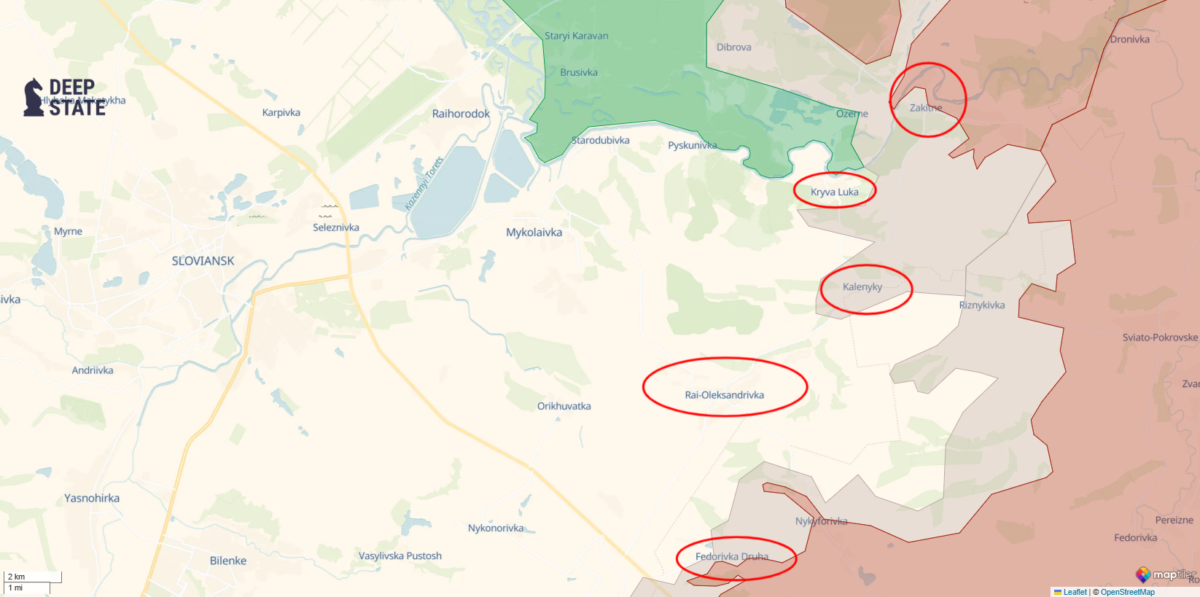
Chart of the day
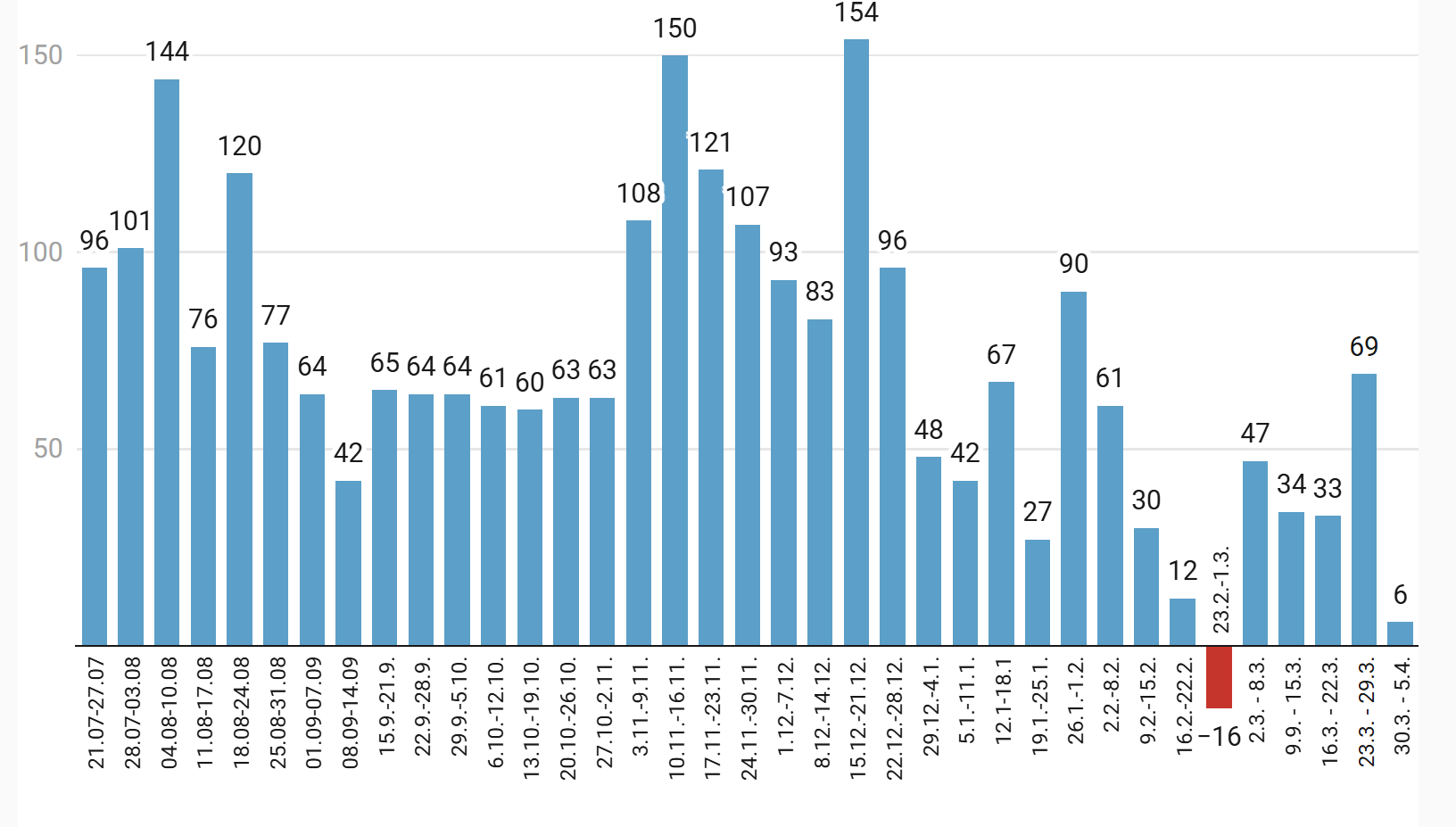
Russian advances last week were the second slowest since at least last summer. This is shown by data from the DeepState UA map, as processed by the Ukrainian account Oko Hora.
According to these data, Russian forces advanced by a net total of only six square km. And even though the DeepState figures may lag slightly, this shows that Russia has so far not launched any broader offensive this year. It is more reminiscent of 2024 than 2025, when in the spring they managed to drive Ukrainians out of Russia’s Kursk region.
Russian advanced per week:
Videos of the day
This is what Kostyantynivka looks like today, another town in Ukraine that Russian forces have almost completely destroyed. And the battle for it is still ongoing. Before the war, 60,000 people lived here.
At first glance, there is nothing particularly unusual in this video, shared by Ukrainian journalist and soldier Yuriy Butusov: we have seen burned-out or burning cars by the roadside many times. It becomes interesting if it is true that it was filmed on Russian‑controlled territory, 57 km from the front line. That is very far, yet even there Ukrainians managed to hit Russian equipment, according to Butusov using drones.
The video shows two burned-out vehicles and one still on fire.
Ukrainians announced that in March they neutralised 33,000 Russian drones, a new record. The number of drones shot down by other drones has increased sharply in recent months. For example, the number of drones downed by the Unmanned Systems Forces, the unit commanded by Robert Brovdi, alias Madyar, increased fivefold between December and March.
This compilation shows footage of several hits.
What the losses are
No update since last Monday.
By Monday morning, Russia had demonstrably lost 24,383 pieces of heavy equipment (on Monday 23 March it was 24,333). Of this total, 19,028 (18,975) pieces were destroyed by Ukrainians, 971 (969) were damaged, 1,204 (1,210) were abandoned by their crews, and 3,180 (3,179) were captured by the Ukrainian army. This includes 4,371 (4,365) tanks, of which 3,276 (3,268) were destroyed in combat. Ukraine has lost 11,697 (11,697) pieces of equipment, of which 9,027 (8,973) were destroyed, 656 (654) damaged, 661 (658) abandoned and 1,405 (1,412) captured. This includes 1,401 (1,401) tanks, of which 1,071 (1,067) were destroyed in combat.
Note: Neither side regularly reports its own dead or destroyed equipment. Ukraine publishes daily figures on Russian casualties and destroyed equipment, but these cannot be independently verified. In this overview we use data from the Oryx project which, since the beginning of the war, has compiled a list of equipment losses documented exclusively by photographic evidence.