
Former President Rumen Radev is on course for a landslide win with his freshly formed Progressive Bulgaria party, vowing to tackle poverty and oligarchic power – but raising questions with his “pragmatic” stance on Russia.
 Svetoslav Todorov



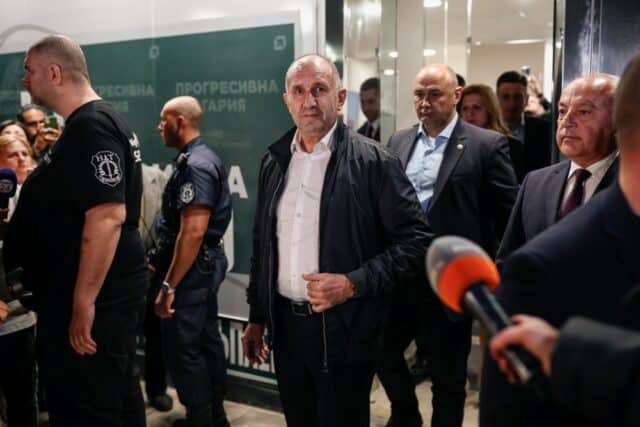
The first official results on Monday morning from Bulgaria’s eighth general election in five years point to an even stronger than expected win for ex-President Rumen Radev’s newly-formed Progressive Bulgaria party.
According to the latest data from the Central Election Committee, with 61 per cent of the ballots counted, Progressive Bulgaria is leading with 44.6 per cent of the vote, well ahead of the pro-EU We Continue the Change/Democratic Bulgaria alliance on 14.3 per cent and Boyko Borissov’s centre-right GERB on 13 per cent.
The figures represent GERB’s worst election performance in its history as Bulgaria’s dominant political force since 2008.
Progressive Bulgaria appears to be on course to secure the majority of seats – around 130, according to various estimates – in Bulgaria’s 240-member parliament.
“This is a victory over apathy, but there’s still a distrust to politics here; this is only the first step towards reinstating the trust of people, the social contract,” Radev told media on Sunday evening.
“It’s a victory of hope over desperation, freedom over fear,” he added. He dodged questions about whether he will become prime minister.
If Radev’s victory is confirmed and he secures a majority, Progressive Bulgaria will have achieved the biggest win for a party in Bulgaria’s democratic history, only comparable to the victory of the United Democratic Forces with 62.4 per cent in 1997, which set the country on course to join the EU and NATO.
Voter turnout was estimated at 48.8 per cent, almost ten per cent higher than in the last elections in October 2024. According to Alpha Research, Progressive Bulgaria topped the vote in every age group, even among younger voters between 18-30 years old – the demographic that became more politically engaged during anti-establishment protests in late 2025. However, although the protests were led by We Continue the Change/Democratic Bulgaria, they did not result in a boost at the polls for the alliance.
Progressive Bulgaria was launched only a month ago by 62-year-old Radev, who resigned from the presidency to contest the parliamentary polls, and built a campaign focusing on preventing poverty, inflation and eradicating oligarchic ties to politics.
But Radev’s populist and pro-Moscow leanings have created worries about whether his party’s victory means a more Eurosceptic future for already divided Bulgaria. In recent statements, he has called for “pragmatism” and “critical thinking” in Europe’s attitude to Russia.
He has spoken out against supplying aid for Ukraine, opposed Western sanctions on Moscow and resisted neighbouring North Macedonia’s accession to the European Union. He was a vocal opponent of Bulgaria adopting the Euro. However, he has also backed Bulgaria’s continued membership of the EU and NATO, and criticised Russia on occasion.
A former air force commander, Radev entered politics in 2016 when he became president, supported by the traditionally Moscow-aligned Bulgarian Socialist Party. He won the presidency again in 2021. He resigned in January and officially launched Progressive Bulgaria in March, one month before the elections.
Bulgaria’s new parliament will also include Movement for Rights and Freedoms – New Beginning, the party led by internationally sanctioned oligarch Delyan Peevski, and pro-Moscow far-right party Revival; however, both parties performed well below expectations at Sunday’s polls.
For the first time in Bulgaria’s recent history, the Socialist Party fell below the threshold to enter parliament.