

“Everything around was covered with a greasy coating and black pellets. At first we thought it was just ordinary dust, but then we realised it looked more like traces of burnt oil,” said one local resident.
 Tomáš Vasilko



Every day, the Ukraine Battlefield update newsletter offers a clear look at how the war is unfolding on the ground, highlighting key developments along the frontline and the shifting dynamics of the conflict. This offers readers regular and detailed information to better understand the implications of the war for the country and the whole continent.
In Tuapse, Russia, oil rain has been falling for several days; people are talking about an environmental disaster. Locals are asking why Ukrainians are doing this to them. Even by Russian standards, Russian general Gerasimov exaggerated how much territory Russia seized in 2026. Map of the day: The situation in Zaporizhzhia region. Chart of the day: Russian advance remains limited. Videos of the day: a Ukrainian soldier attacked Russian motorcyclists; Russian armoured vehicles fitted with hedgehog-style protection.
At the start of the war, some people thought that once the war reached Russian cities and ordinary Russians, pressure on Vladimir Putin would increase to end his “special military operation” against Ukraine. To some extent, the war has already affected Russian cities thanks to Ukrainian drones, especially in border regions such as Belgorod. So far, however, there is no sign that dissatisfaction with the war has increased.
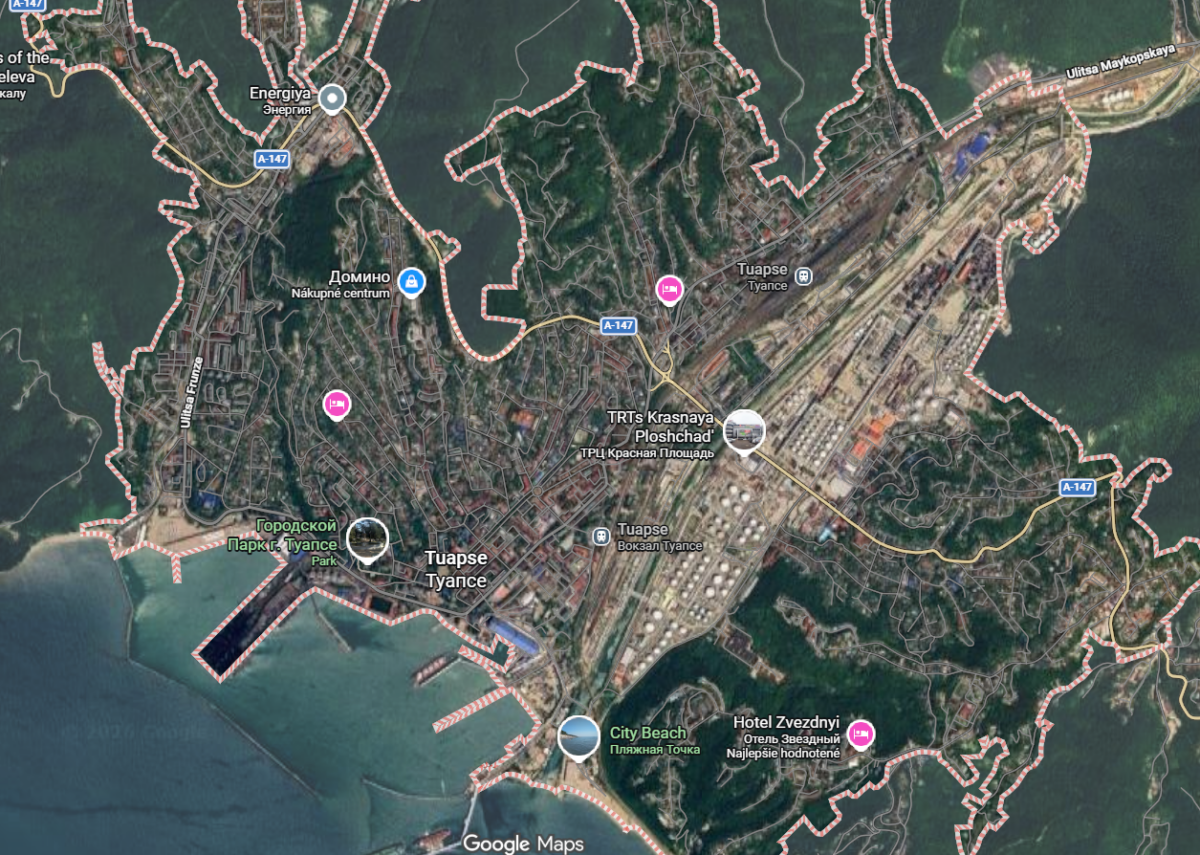
A small experiment regarding this hypothesis – even if that label may sound somewhat insensitive given the circumstances – is currently unfolding in the Russian city of Tuapse. Ukrainian drones have hit the refinery in this town of about 60,000 inhabitants on the Black Sea coast twice over the past week.
The first strike came on 16 April, and the fire in the burning oil was only extinguished on Sunday afternoon. The very next night, the Ukrainians attacked again, this time causing more damage. Videos of burning oil tanks circled the globe. The fire was still not out even on Thursday morning.
This was best illustrated by a satellite image from Tuesday, published by Nasa. A black plume of smoke stretched 300km from the city. “This is absolutely insane, it’s hard to believe,” journalist Mark Krutov wrote. The smoke also reached Sochi, 100 km away, lying to the south-east of Tuapse.
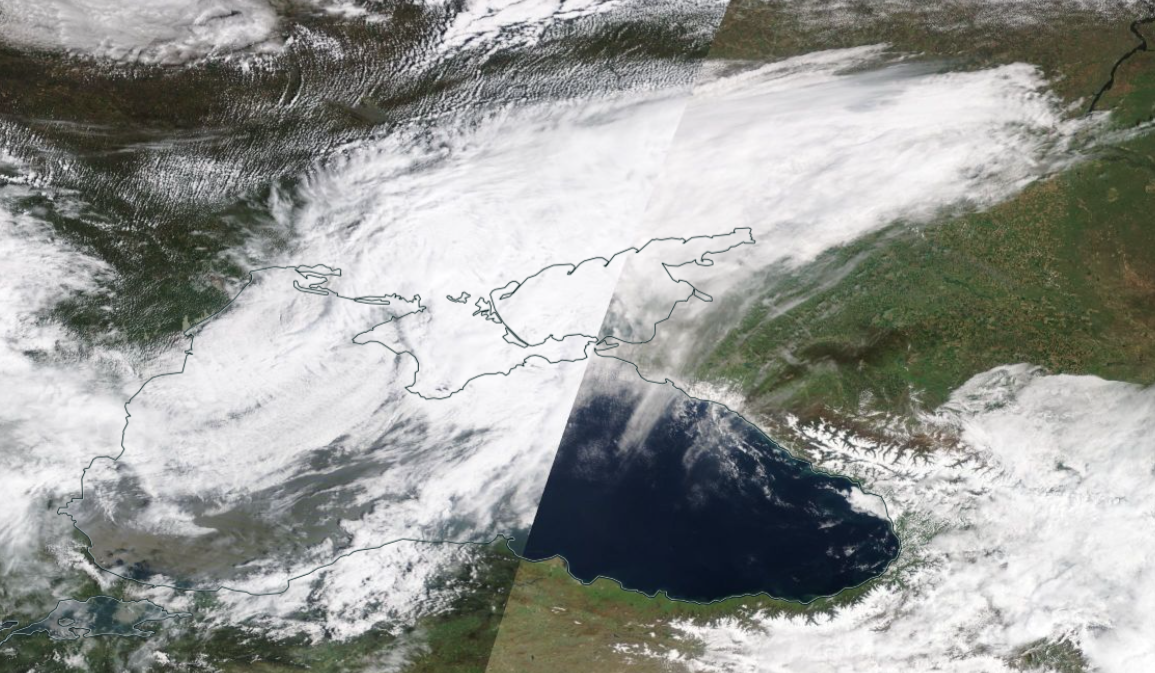 (Source: NASA Worldwiev)
The smoke in the city is causing enormous problems for residents. For several days now, reports have been coming in that oil rain is falling on the city.
“Everything around was covered with a greasy coating and black pellets. At first we thought it was just ordinary dust, but then we realised it looked more like traces of burnt oil,” a local resident told Meduza.
Videos and photographs from the city showed black puddles on pavements, black greasy specks and dust on cars, and animals were affected too: dogs, cats and birds.
В Туапсе прошел «нефтяной» дождь. Местные жители связали это с пожаром на морском терминале
После дождя в Туапсе появились лужи, покрытые масляной пленкой, подобные пятна остались также на автомобилях, животных и даже людях, пожаловались жители города в местных группах.
Помимо… pic.twitter.com/FY8K4AO9rc
— Новая газета Европа (@novayagazeta_eu) April 22, 2026
In addition, an oil slick several kms long has formed on the Black Sea coast, which has also entered the local river.
At first, the authorities provided almost no information about the situation and even claimed that the presence of harmful substances was within normal limits. Local people complained about why children had not switched to online schooling.
The local prosecutor’s office even organised a tree-planting event in the city on Wednesday. Photographs of the planting with a huge black cloud in the background were later removed from the office’s website.
The oil refinery in Tuapse has been burning for days now, and in the meantime, the local prosecutor’s office has decided that the city needs “greening.” Great timing. That will certainly improve the situation. pic.twitter.com/pd8ebBJId4
— WarTranslated (@wartranslated) April 22, 2026
Only on Wednesday did the local authorities announce that the actual measured levels of benzene, xylene and soot had exceeded standards by two to three times. People were urged to avoid being outdoors and to keep their windows closed.
According to the authorities, the situation will return to normal once the fire is extinguished. On Wednesday, more than 276 firefighters and 70 pieces of equipment were battling it. The worst is around the terminal given that the Tuapse refinery is essentially in the city centre, on the other side of the river.
Locals used words such as Chernobyl or Hiroshima to describe the situation. “The consequences of the bombing of Tuapse are simply terrible. Essentially, what is happening there now is a Hiroshima, just without radiation,” Ukrainian journalist Yuriy Butusov quoted a local resident as saying.
Although these comparisons are exaggerated, experts also consider the situation serious.
“Unburned oil products will now spread over part of our district and reach as far as the Greater Caucasus mountain range. The consequences for the town, the Tuapse district and the entire region will last for years,” ecologist Yevgeny Vitishko said, according to Radio Svoboda.
In Ukraine, there is little sympathy for people in the affected city. The Ukrainian Telegram account Exilenova sarcastically wrote that people should put barrels outside. “At last, a country rich in oil and gas is sharing oil with its citizens instead of using it to fund the war,” the account wrote. According to it, what is happening in the city is a “man-made disaster”, yet there is no talk at all of evacuating the city because “the slaves will endure it”.
Local residents do criticise the weak response of the local authorities and lament that it is impossible to live in such a city, but in the published videos, few people see the current situation as a consequence of Russia’s attack on Ukraine.
On the contrary, they are asking Ukrainians why they are attacking them. “Remember that you have children too. Why are you doing this to us?” one woman said, according to Butusov.
“This video is about humanity. When we cannot breathe in Tuapse, citizens of Ukraine write in the comments: ‘Serves you right, it was not enough for you, now enjoy it!’ But we are just ordinary people, mere pawns who suffer. Only one thing sets us apart: your (Ukrainians’) brains have simply been washed, or maybe you never had any,” she said.
Of course, we do not know for sure what Russians think in private and how many of them understand that if Russia had not started the war, there would be no oil rain falling in Tuapse either. In any case, there is so far no indication that their anger is turning towards the Kremlin.
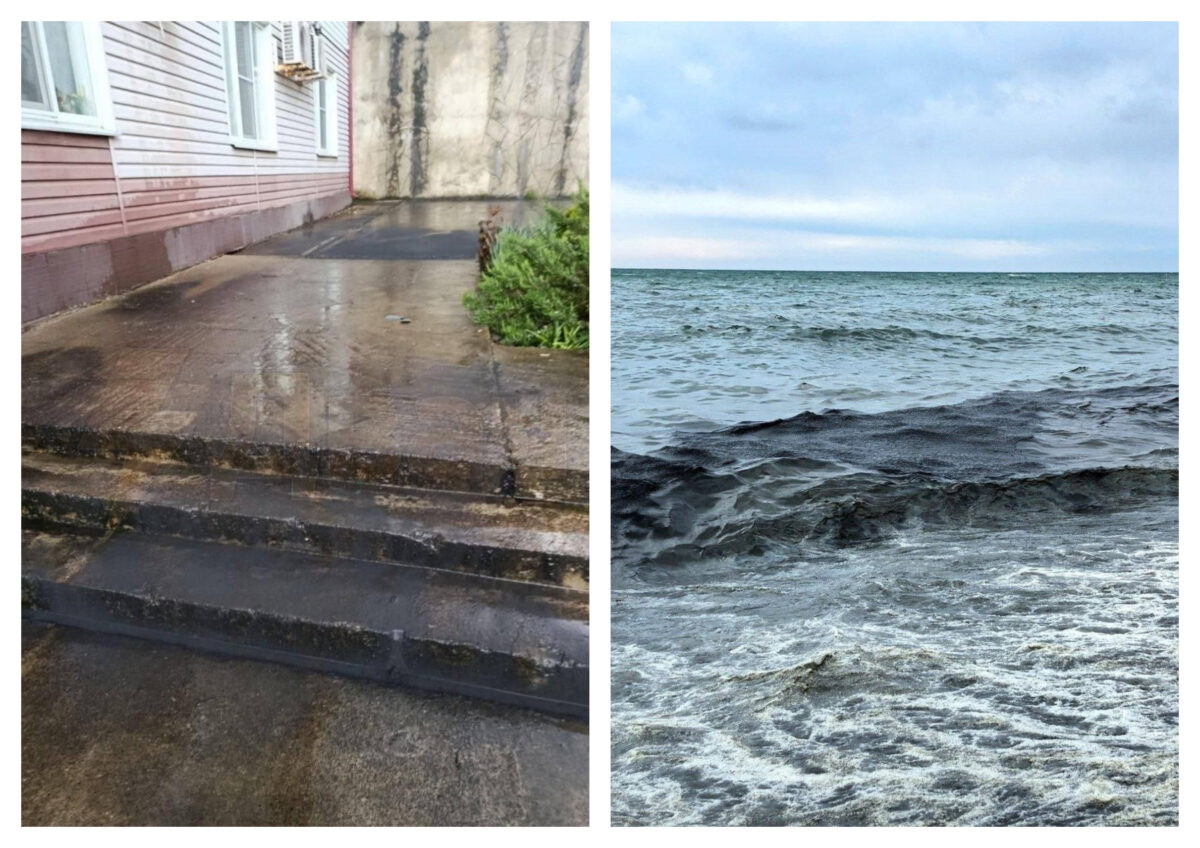 (Source: Telegram/Romanov Lajt)
The Tuapse refinery is owned by the Russian state oil company Rosneft. It is one of the oldest in the country, founded in 1929. It is not among the most important in terms of size – it processes around 240,000 barrels of oil per day into diesel, motor fuel and heating oil, ranking roughly 8th to 10th among Russian refineries.
Its key importance lies in its location on the Black Sea coast. Most of the products processed here are destined for export. Since the beginning of April, the export of oil products from Russia has been banned, because Russia fears there could again be a shortage of diesel and petrol like last autumn. The export ban is supposed to remain in place until the end of July, during the main holiday and agricultural season, when fuel consumption is highest.
Because of its relatively close location, the Ukrainians have already attacked the refinery in this town at least six times. According to Reuters sources, it has been out of operation since the 16 April strike.
Overall damage, however, is unlikely to be so extensive that operations could not be restored. As the Ukraine Control Map account wrote, there are more than 90 oil tanks at the refinery, but only about eight of them have completely burned down. The exact damage will only be assessable once the fire has been extinguished and the smoke has dispersed.
Fire in Tuapse on Wednesday
Russia’s Tuapse oil refinery and Black Sea export facility continued to suffer a catastrophic blaze days after it was hit by a Ukrainian drone attack.
Locals report that crude oil continues to rain on the city for a third day in a row. pic.twitter.com/vNUjd2p8j1
— OSINTtechnical (@Osinttechnical) April 22, 2026
The smoke reached as far as Sochi
It appears that the more slowly Russian forces advance, the more they exaggerate how well they are doing. On Tuesday, Chief of the General Staff Valery Gerasimov visited the command of the Southern Group of Forces. On that occasion, he said that since the start of 2026 Russia had occupied 1,700 square kms of Ukrainian territory.
At the same time, he claimed that Russian forces had seized 80 villages and now controlled the whole of Luhansk region. Incidentally, Russia has announced the capture of all of Luhansk several times already, but according to the DeepState UA map, a number of villages are still missing.
Gerasimov’s claim is completely detached from reality and even goes beyond how Russia has exaggerated its successes in the past.
The Institute for the Study of War (ISW) has measured Russian gains this year at only 381 square kms, that is, one-fifth of the Russian general’s claim. It counts as occupied only those places that Russian forces firmly hold, not areas where their units appeared only briefly.
Even if those positions were also counted as Russian, Moscow would still have captured only 715 square kms, or 42 percent of the area Gerasimov mentioned. It is unclear where he found the remaining 1,000 kms.
George Barros of ISW wrote on X that not even the most optimistic Russian war bloggers draw maps as generously as Gerasimov sees them. For example, the general claims that Russian forces have entered the village of Zaporizhets in Zaporizhzhia region near Stepnohirsk, which according to DeepState UA and also according to Rybar’s map is actually located about ten kms from the nearest grey zone.
“From both a geographical and geometrical standpoint, this is simply impossible. The figure mentioned has absolutely nothing to do with reality,” Barros wrote.
“Gerasimov is probably trying to cover up disappointment with Russia’s insufficient progress in the 2026 spring-summer offensive,” the analyst believed. According to him, Russia launched the spring-summer offensive no later than 17 March, and its advance has slowed further since then.
“Russia’s rate of advance has slowed in north-eastern, eastern and southern Ukraine, including the priority offensive against the defensive belt in Donetsk region, and Russian forces have had to reduce the tempo of operations in several sectors of the front line because of heavy losses,” Barros stated.
Russian nationalist war channels have also long criticised Gerasimov for exaggerating Russian gains, embellishing reality for Putin and “capturing villages on credit”, meaning that later soldiers have to seize them by force because he has already reported them as taken to the Kremlin.
Map of the day
Gerasimov also mentioned that Russian soldiers were fighting in the town of Orikhiv in Zaporizhzhia region. Although capturing this town is apparently one of Russia’s objectives for this year, its forces are still 10–12km away from it. In fact, they have been stuck near the village of Mala Tokmachka for more than a year.
Ukrainians have also categorically rejected the presence of Russian soldiers in Orikhiv as “total nonsense”.
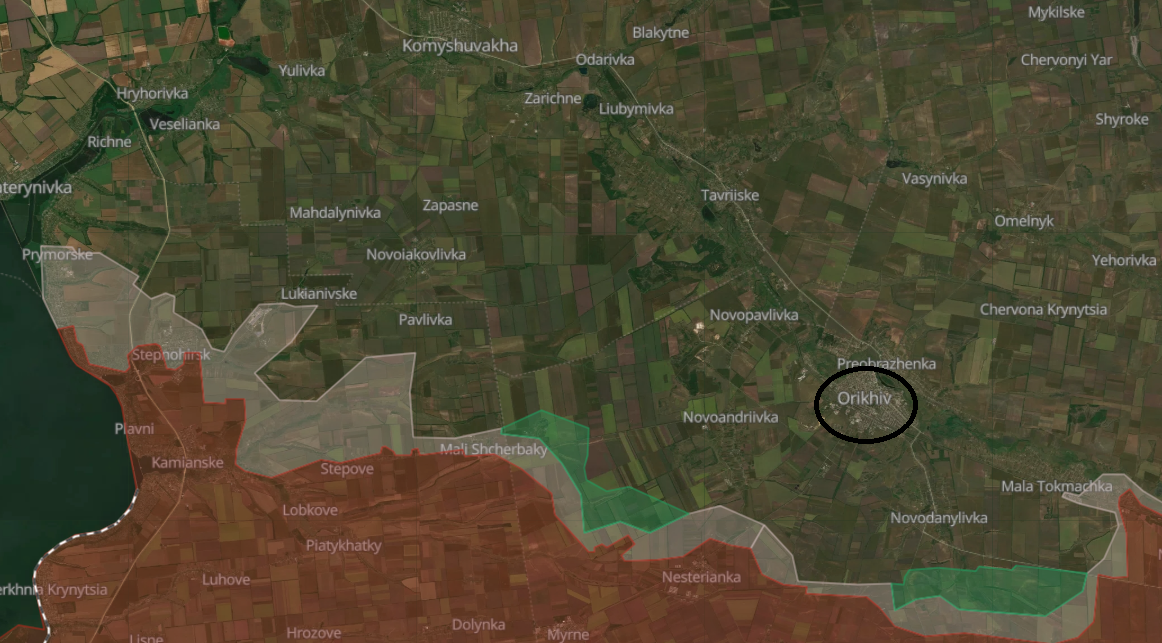
In Zaporizhzhia region near Stepnohirsk and Hulyaipole, Russian forces are not doing particularly well either. As a Ukrainian soldier operating under the call sign Officer wrote, Ukrainian troops are gradually recapturing lost positions there and the situation has stabilised to some extent.
“Ukrainian unmanned systems forces are constantly attacking the enemy’s air-defence systems and troop concentrations every night; the open steppes of Zaporizhzhia region provide ideal terrain for drone operations and in this respect we significantly outmatch the enemy on this axis,” Officer wrote.
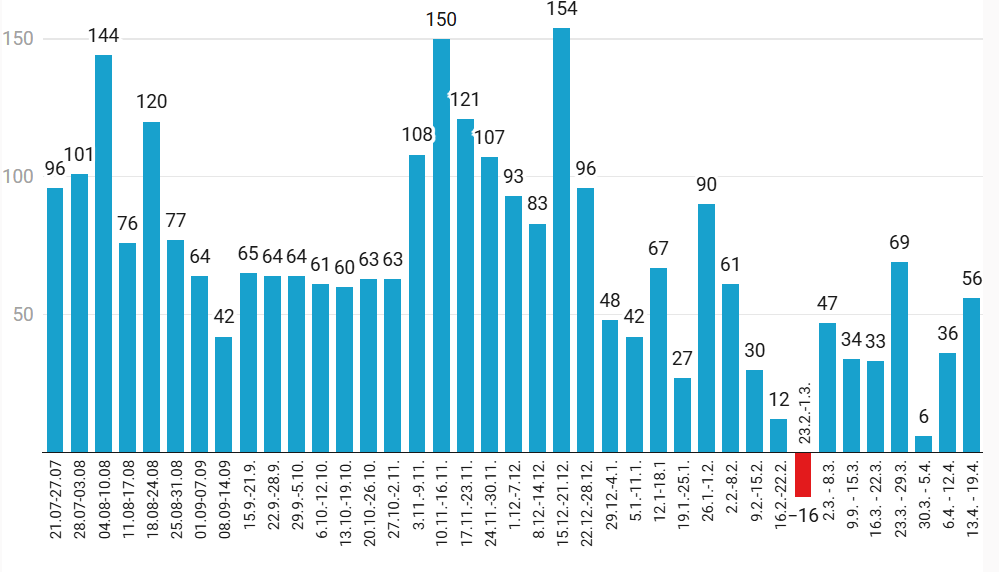
Chart of the day
Russia is still advancing only slowly on the battlefield. Last week, its forces occupied 56 square kms of new Ukrainian territory. This is more than in recent weeks, but still less than the gains in November or December.
This time, moreover, most of the advance was due to activity in the border area of Sumy region. This part of the front is less important than the Donetsk, Zaporizhzhia or Kharkiv regions.
Russian progress by week
Amount of territory occupied by Russians per week. Data are in square kilometers.
 (Source: Dennik N)
Videos of the day
In recent weeks we have mainly been showing Russian drone attacks being stopped. This video offers rather rare footage of a Ukrainian soldier stopping Russian motorcyclists directly on the battlefield. It features a soldier with the call sign Florist in Dnipropetrovsk region. Warning, the footage shows pixelated images of dead soldiers.
Such anti-drone protection is also referred to at the front as “hedgehogs”. In this video, Ukrainian army armoured vehicles are equipped with it, but both sides use it.
This kind of protection for armoured vehicles is considered one of the most effective. As Iryna Rybakova, spokesperson for Ukraine’s 93rd Mechanised Brigade, said to Radio Free Europe back in December, hedgehog-type armour is designed so that drones get tangled up in it but do not explode – or, if they do explode, they do so further away from the vehicle’s hull.
Rybakova also mentioned to the website that “one Russian tank with hedgehog-type armour, which was operating near Toretsk in Donetsk region, absorbed dozens of hits from Ukrainian FPV drones before it was finally destroyed”.
At the same time, she added that it provides only limited protection against larger drones such as the Russian Lancet.
What are the losses
As of Thursday morning, without update.
By Tuesday morning, Russia had verifiably lost 24,471 pieces of heavy equipment (on Monday (13 April) it was 24,440). Of these, 19,108 (19,079) pieces were destroyed by Ukraine, 976 (975) were damaged, 1,206 (1,205) were abandoned by their crews and 3,181 (3,181) were captured by the Ukrainian army. This includes 4,385 (4,381) tanks, of which 3,288 (3,284) were destroyed in combat. Ukraine has lost 11,977 (11,923) pieces of equipment, of which 9,224 (9,175) were destroyed, 669 (668) damaged, 670 (666) abandoned and 1,414 (1,414) captured. This includes 1,416 (1,412) tanks, of which 1,081 (1,078) were destroyed in combat.
Note: Neither side regularly reports on its dead or on destroyed equipment. Ukraine publishes daily figures on Russian casualties and destroyed equipment, which cannot be independently verified. In this overview we use data from the Oryx project, which since the start of the war has compiled a list exclusively of visually documented equipment losses.